

Buddhism's Symbols: Meanings and Secret Depths ☸️
Buddhism took shape as early as the 4th or 6th century BCE, when Siddhartha Gautama began spreading his teachings about suffering, impermanence, nirvana, and rebirth across the Indian subcontinent. Siddhartha himself was reluctant to be represented in human form, and so his followers developed a rich visual language, a set of symbols that pointed toward the teachings without depicting the teacher directly. Those symbols have traveled across two and a half millennia, crossing the boundaries of Theravada, Mahayana, and Vajrayana traditions, and they still carry their full philosophical weight today.
What follows is a careful walk through the most significant of Buddhism's symbols: where they come from, what they encode, and why they continue to matter in living practice.
⭐ Key points to hold in mind
- Early Buddhism was largely aniconic, symbols stood in for the Buddha before human images were used.
- The eight auspicious symbols (Ashtamangala) originated in pre-Buddhist Indian ceremony and were adopted by Buddhist tradition after Shakyamuni's enlightenment.
- Many symbols carry different layers of meaning across Theravada, Mahayana, and Vajrayana contexts.
- Symbols in Buddhism are not decorative: they function as teaching tools and focal points for meditation.
- The Dharma wheel's eight spokes map directly onto the Noble Eightfold Path, the Buddha's practical guide to ending suffering.
Why Symbols Came Before Images in Buddhism
The role of images in early Buddhism is not fully settled by textual evidence, but surviving art from the Maurya period onward tells a consistent story. Before human representation became common, Buddhist artists communicated through symbols alone: a wheel, a throne, a pair of footprints, a tree. This approach was not arbitrary. It reflected a principle embedded in the Dharma itself, that the teachings point beyond any single person, even the teacher who articulated them.
The first hint of human representation in Buddhist symbolism is the footprint of the Buddha. Long before sculptors carved seated figures, craftsmen carved feet, sole-down in stone, adorned with the Dharma wheel and the 108 auspicious signs. The footprint was a way of saying: he passed through here, and the path remains.

Among the oldest and most common symbols in Buddhism are the stupa, the Dharma wheel, and the lotus flower. The Dharma wheel, traditionally depicted with eight spokes, has a layered history. Initially it conveyed royalty, the concept of the chakravartin, or "wheel-turning monarch", but it entered Buddhist visual culture definitively on Ashoka's pillars in the 3rd century BCE, where it became the emblem of the Dharma and the Noble Eightfold Path.
Other ancient symbols include the Trisula, used since the 2nd century BCE, which combines the lotus, the diamond vajra staff, and a representation of the Three Jewels, the Buddha, the Dharma, and the Sangha. The swastika was also used across India by Buddhists and Hindus as a sign of auspiciousness. In East Asia it became a general marker of Buddhism; it can be oriented to the left or right, and its meanings in that context are entirely distinct from its 20th-century Western associations.
💡 Did you know?
The word Ashtamangala comes from Sanskrit: ashta means eight, and mangala means auspicious or fortunate. The eight-symbol set predates Buddhism, it was used in ancient Indian royal coronation ceremonies before being adapted into the Buddhist tradition, where it came to represent the offerings made by the gods to Shakyamuni at the moment of his enlightenment.
The Eight Auspicious Symbols, The Ashtamangala
In the Tibetan Buddhist tradition, the eight auspicious symbols are understood to map onto the body of the Buddha himself. Each symbol corresponds to a part of his being, creating a complete and unified image of enlightened presence.

- The parasol represents the head of Buddha
- The two fish represent the eyes of Buddha
- The vase represents the neck of Buddha
- The lotus represents his tongue
- The golden Dharma wheel represents his feet
- The victory banner represents the body of Buddha
- The conch represents the speech of Buddha
- The endless knot represents the mind of Buddha
This sacred sequence of eight auspicious symbols appears in various Dharmic traditions, Hinduism, Jainism, Buddhism, and Sikhism each have their own enumerations. Within Buddhism, these symbols serve as both focal points for meditation and instructional tools: they point toward the qualities of an enlightened mind and serve as adornments that embody those qualities.
In India, early sets of eight auspicious symbols were used during royal inaugurations and coronations. The original pre-Buddhist set included: a throne, a swastika, a handprint, a hooked knot, a vase of jewels, a water libation flask, a pair of fish, and a covered bowl. The Buddhist tradition adapted this set and gave each element a specific doctrinal resonance.
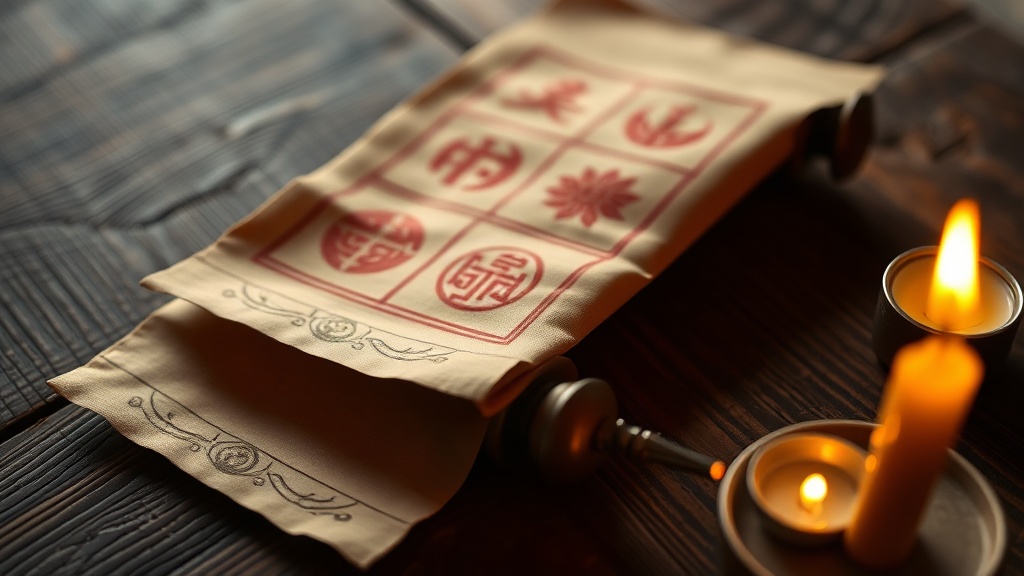
1. The Buddhist Parasol (The Chatra)

A parasol shelters those beneath it from sun, rain, and the elements. In the Buddhist context, the Chatra signifies protection from suffering and harmful forces. It also carries the secondary meaning of dignity and cool shade, the relief that comes from taking refuge in the Dharma. In Tibetan iconography, multi-tiered parasols indicate the degree of a teacher's spiritual authority.
Learn more about the Buddhist parasol
2. The Two Golden Fish

The two golden fish were originally drawn to symbolize the sacred rivers Ganges and Yamuna in ancient India. Within Buddhist symbolism, they represent courage and the fearlessness to move through the ocean of suffering, swimming freely, without the weight of clinging or aversion. The fish do not sink; they navigate.
Learn more about the two golden fish
3. The Conch

The large white conch shell that spirals to the right is one of the most acoustically significant symbols in the tradition. In ancient warfare across many cultures, the conch was blown to signal battle. Buddhism inverted this use: here, the deep resonant sound of the conch signals the Dharma teachings. According to Buddhist belief, hearing that sound awakens disciples from the sleep of ignorance. A conch spiraling to the right is considered especially auspicious in Tibetan tradition.
Learn more about the Symbol of the Buddhist Conch
4. The Lotus Flower

The lotus root sits deep in mud at the bottom of a pond. The stem pushes through dark water. The flower opens above the surface, clean and fragrant. This movement, from murk to bloom, is one of the most enduring metaphors in Buddhist teaching for the journey from suffering and confusion toward clarity and awakening.
Different colors of lotus carry distinct meanings in Buddhist iconography:
- White, mental and spiritual purity
- Red, the heart, love, and compassion
- Pink, the historical Buddha, Shakyamuni
- Violet, mysticism and the esoteric path
- Blue, wisdom and mastery of the senses
Learn more about the Lotus Flower and its Meaning
5. The Victory Banner

According to Buddhist tradition, the Victory Banner commemorates the moment when the Buddha overcame the demon Mara, a figure who embodies passion, lust, and pride. The banner is placed atop monasteries and carried in processions not as a symbol of military triumph, but as a reminder that the real battle is interior. Practitioners are called to conquer the same forces within themselves before the path to liberation becomes clear.
Learn more about The Victory Banner
6. The Treasure Vase (Wisdom Urn)

The treasure vase is a broad-shouldered vessel with a narrow neck and a jewel at its peak. In Buddhist symbolism, it holds the inexhaustible wealth of the Dharma, health, longevity, prosperity, wisdom, and what the tradition calls the phenomenon of space itself. No matter how much is drawn from it, the vase remains full. This is understood as pointing toward the nature of the teachings: they do not diminish through being shared.
Learn more about the Wisdom Urn
7. The Dharma Wheel (Dharmachakra)

The Dharma Wheel, or Dharmachakra, is arguably the most widely recognized symbol in Buddhism and is often used to represent the Buddha himself in aniconic art. The eight spokes map onto the Noble Eightfold Path: right view, right intention, right speech, right action, right livelihood, right effort, right mindfulness, and right concentration. The hub represents moral discipline; the rim represents meditative concentration that holds everything together. When the Buddha delivered his first sermon at Deer Park in Sarnath, Buddhist texts describe this as "turning the wheel of the Dharma" for the first time.
8. The Eternal Knot

The endless knot, a continuous, closed line that weaves back through itself without beginning or end, encodes one of the central insights of Buddhist philosophy: the interdependence of all phenomena. Nothing exists in isolation. According to Buddhist teaching, the knot also represents the union of wisdom and compassion, and the mutual dependence of religious doctrine and life in the world. The intertwining lines are not chaos; they are a pattern that has no loose ends.
Learn more about the Symbolic Meaning of the Endless Knot in Buddhism
| Symbol | Part of Buddha's Body | Core Meaning |
|---|---|---|
| Parasol (Chatra) | Head | Protection from suffering |
| Two Golden Fish | Eyes | Courage, freedom from fear |
| Treasure Vase | Neck | Inexhaustible wisdom and abundance |
| Lotus | Tongue | Purity, awakening from suffering |
| Dharma Wheel | Feet | The Noble Eightfold Path |
| Victory Banner | Body | Overcoming inner obstacles |
| Conch Shell | Speech | Awakening through Dharma teachings |
| Endless Knot | Mind | Interdependence, wisdom and compassion |
Other Buddhist Symbols with Significant Depth
The Bodhi Leaf and the Bodhi Tree

The Bodhi tree, known in Sinhalese as "Bo", is a sacred fig tree (Ficus religiosa) of considerable age and girth. It was at Bodh Gaya, approximately 100 km from Patna in the Indian state of Bihar, that Siddhartha Gautama sat beneath such a tree and attained enlightenment, or Bodhi. In Buddhist iconography, the Bodhi tree is recognized by its distinctively heart-shaped leaves, which are featured prominently in artistic representations. A Bodhi tree may take between 100 and 3,000 years to reach full maturity.
The tree standing today at the Mahabodhi Temple in Bodh Gaya is a direct descendant of the original specimen and remains the most important of the four main Buddhist pilgrimage sites. Other significant Bodhi trees include the Anandabodhi tree in Sravasti and the Bodhi tree in Anuradhapura, Sri Lanka, both believed to have been propagated from the original tree.
Learn more about the Meaning of the Bodhi Tree
The Footprint of the Buddha

The Buddha's footprint, known in Pali as Buddhapada, is an impression of one or both feet of Siddhartha Gautama. Two forms exist: those found naturally in stone or rock, and crafted representations. Many of the so-called "natural" ones are understood to be replicas or symbolic representations rather than literal impressions. They function as Cetiya (Buddhist relics) and as anionic representations of the Buddha in the earliest phase of the tradition.
Buddha footprints are found throughout Asia, across many centuries. They typically bear distinctive marks: a Dharma wheel at the center of the sole, and sets of 32, 108, or 132 auspicious signs engraved or painted on the surface.
Learn more about the Meaning of the Buddha's Footprint
The Empty Throne

The empty throne sits at the intersection of two key Buddhist concepts: royal lineage and philosophical emptiness. Before human images of the Buddha appeared in art, the throne indicated his royal origin, Siddhartha Gautama was born a prince of the Shakya clan. At the same time, the empty seat points toward sunyata, the concept of emptiness that runs through Mahayana philosophy. Nothing is permanently, inherently occupied. The absence itself becomes the teaching.
Learn more about The Empty Throne in Buddhism
The Buddhist Lion

The lion carries a dual significance in Buddhist symbolism. It represents the royal lineage from which Siddhartha Gautama descended, his clan, the Shakyas, traced their origins to a lion lineage according to tradition. But the more philosophically resonant use is the metaphor of the "lion's roar" (Pali: sīhanāda), a term used in the Sutta Pitaka to describe the fearless proclamation of the Dharma. When the Buddha taught, the texts say, it was like a lion's roar: clear, unambiguous, and capable of silencing lesser noise.
Learn more about The Lion in Buddhist Religion
The Swastika

In the Buddhist tradition, the swastika symbolizes the feet or footprints of the Buddha and is frequently used to mark the beginning of sacred texts. Modern Tibetan Buddhism uses it as a decorative element on clothing and textiles. As Buddhism spread east through China and into Japan, the swastika came to denote plurality, abundance, prosperity, and longevity. Its two orientations, left-facing and right-facing, are both used in Buddhist contexts, with meanings that vary by school and region. The symbol's pre-Buddhist origins are widespread across South and East Asian traditions, where it has carried auspicious associations for millennia.
Learn more about Swastika, the Buddhist Swastika Cross
The Four Celestial Kings

In the Buddhist cosmology preserved in the Pali Canon and expanded in later Mahayana texts, the Four Celestial Kings, known in Sanskrit as the Lokapala, are guardian deities assigned to protect each of the four cardinal directions of the world. They appear at the entrance to many Buddhist temples and monasteries, positioned as threshold guardians. Each king rules over a class of supernatural beings: Dhrtarastra guards the East over the Gandharvas; Virudhaka the South over the Kumbhanda; Virupaksha the West over the Nagas; and Vaisravana the North over the Yakshas.
Learn more about The Four Celestial Kings in Buddhist Religion
The Eyes of Buddha (Wisdom Eyes)

Also known as Wisdom Eyes, this symbol is most visible on Nepalese stupas, where a pair of large painted eyes gaze outward from all four faces of the tower. According to Buddhist belief, these eyes represent the all-seeing awareness of the awakened mind, present in every direction simultaneously. The curved line between and below the eyes (where a nose would be on a face) corresponds to the Sanskrit numeral one, indicating the unity of all phenomena and pointing to the Dharma as the sole path to liberation. Between and above the eyes sits the urna, or third eye, representing spiritual awakening and insight beyond ordinary perception.
Learn more about The Eye of Buddha | Meaning & History
The Vajra

The Vajra is one of the most philosophically dense objects in the entire Buddhist symbolic vocabulary. It names a whole branch of the tradition, Vajrayana, and refers simultaneously to a ritual implement, a state of mind, and a set of metaphysical qualities. The word vajra in Sanskrit carries two meanings at once: diamond (indestructible, perfectly clear) and thunderbolt (irresistible force, instantaneous). Shaped like a short club with ribbed, spherical heads at each end, the Vajra embodies the steadfast quality of an awakened mind: nothing can dent or distort it, and it cuts through illusion without effort.
In Tibetan Buddhism, the Vajra is known as Dorje and is used in paired ritual practice alongside the bell (Drilbu). Lamas and sadhana practitioners hold the Vajra in the right hand (representing method and compassion) and the bell in the left (representing wisdom). The pairing is essential, neither functions completely alone.
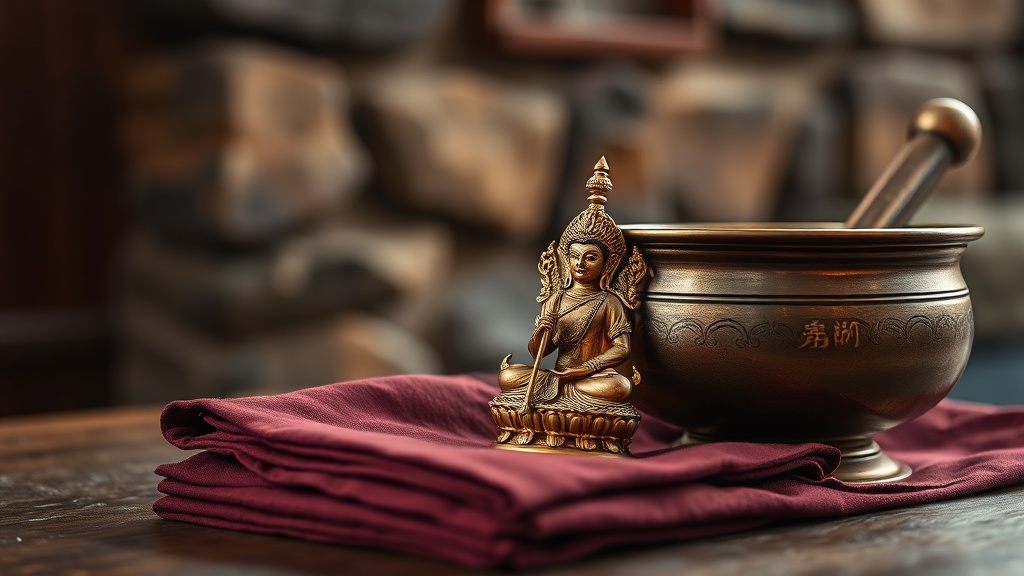
Learn more about Vajra, a widely used ritual object in Tibetan Buddhist ceremonies
Ensō, The Circle of Enlightenment
In Zen Buddhism, the ensō is a sacred symbol drawn in one or two brushstrokes, a circle that captures a single moment when the mind is sufficiently quiet to let the hand move without interference. Some practitioners draw an open circle; others close it. Both are considered correct, and the difference is read as meaningful.

What looks at first glance like a rough circle encodes a great deal: strength, elegance, the universe, the innermost self, the beauty that exists in imperfection, and the irreducible uniqueness of every thing and every moment. The ensō is also understood as a visual expression of the Heart Sutra's central formulation, form is emptiness, emptiness is form. The circle contains everything within it, and equally excludes everything beyond its boundary. The two readings are both present simultaneously.
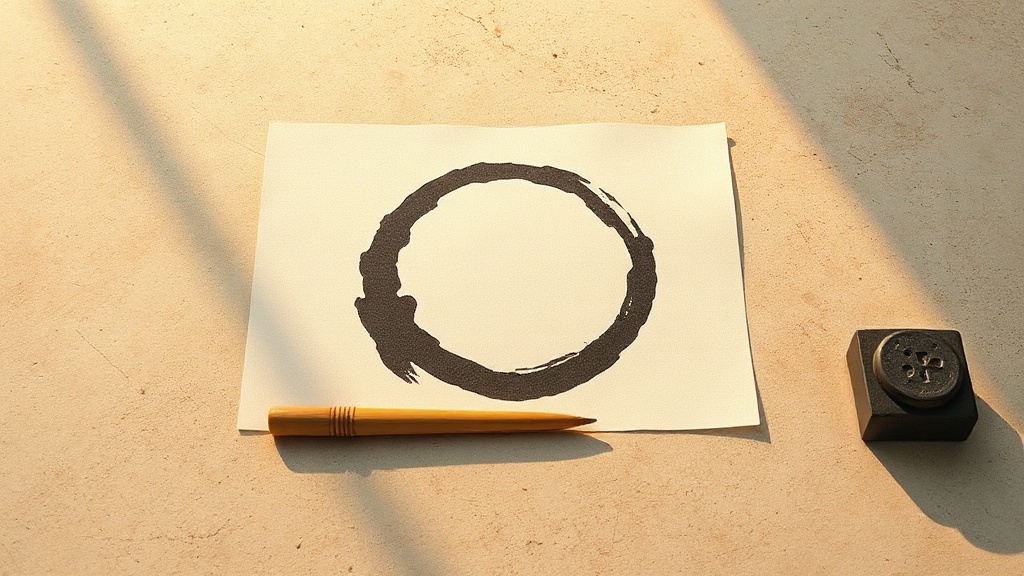
Learn more about Ensō | The Circle of Enlightenment in Buddhism
Aum (Om)

Om, also written as Aum, is a syllable that originated in the Vedic tradition of India and was subsequently integrated into both Hinduism and Buddhism, where it carries distinct but related meanings. In its Hindu context, Om represents the first sound of creation, encompassing birth, life, and death. In Buddhist practice, the most well-known use is as the opening syllable of the mantra Om Mani Padme Hum, associated with Avalokiteshvara (Chenrezig), the bodhisattva of compassion.
In the mantra, the three letters A-U-M symbolize the body, speech, and mind of the Buddha. "Mani" refers to the jewel of the method teachings; "Padme" to the wisdom of the path; and "Hum" to the indivisible unity of method and wisdom. Reciting or contemplating the syllables is understood, according to Tibetan tradition, as a way of invoking the compassion of the bodhisattva and gradually assimilating those qualities.
The Three Jewels (Triratna)

The Three Jewels, the Buddha, the Dharma, and the Sangha, form the foundation of Buddhist practice and identity. Taking refuge in the Three Jewels is the formal act that marks entry into the Buddhist path, across all schools and traditions. The Buddha represents the awakened being as both historical teacher and as the potential for awakening present in every mind. The Dharma is the body of teachings, the path itself. The Sangha is the community of practitioners, those who walk the path together and support one another.
As a visual symbol, the Triratna takes the form of three shapes arranged in a triangular cluster, often depicted rising from a lotus. In the Theravada tradition, the Three Jewels are recited in Pali: Buddham saranam gacchami, Dhammam saranam gacchami, Sangham saranam gacchami, "I take refuge in the Buddha, the Dharma, the Sangha."
The Alms Bowl

The alms bowl (patta in Pali) is one of the most immediate, material symbols in Buddhist life. In Theravada monasticism, monks and nuns carry the bowl during early morning alms rounds, receiving food from laypeople as an act of mutual exchange, the monastics offer teachings and the opportunity for generosity; the laypeople offer sustenance. The bowl itself signifies simplicity, non-attachment, and the interdependence of the monastic and lay communities. According to canonical accounts, the Buddha received his bowl as one of the few possessions a monk is permitted to keep.
The Buddhist Bell

The bell in Buddhist ritual use signals transitions: the beginning of meditation, the end of a period of practice, the invocation of deities in Vajrayana ceremony. Its sound is understood to represent the Dharma, clear, carrying far, fading naturally without effort or clinging. In Tibetan practice, the bell always appears paired with the Vajra. The handle of the Tibetan ritual bell is often shaped as a half-Vajra, reinforcing the inseparability of the two objects and the qualities they represent.
The Buddhist Flag

The modern Buddhist flag was designed in 1885 in Sri Lanka and adopted internationally in 1952 by the World Fellowship of Buddhists. It consists of five vertical stripes, blue, yellow, red, white, and orange, followed by a sixth panel that combines all five colors in horizontal bands. Each color represents a quality: blue for loving-kindness and peace; yellow for the Middle Way and freedom from extremes; red for the blessings of practice; white for purity of the Dharma; and orange for the wisdom of the teachings. The flag is now used in temples and Buddhist communities across the world.
🗂️ Voir la collection
Buddhism Books
Go deeper into the meaning of every symbol with texts that trace their roots in canonical Buddhist teaching.
3 références
Discover the collection →Living With These Symbols: What Practice Actually Looks Like
Buddhist symbols are not meant to be catalogued and set aside. Each one functions as a reference point, something to return to during meditation, something that quietly reorients attention when it appears in daily life. The Dharma wheel spotted on a temple gate reminds the practitioner of the Eightfold Path. The lotus on an altar recalls the possibility of clarity emerging from difficulty. The ensō painted on a scroll asks: when did you last act without second-guessing?
In Tibetan Buddhist practice, the visualization of symbols is a formal meditative technique. A practitioner might hold the image of the Vajra in the mind's eye, contemplating its qualities, indestructibility, clarity, irresistible precision, not as abstract concepts but as capacities to be cultivated. In Zen, the ensō might be used as an object of contemplation in the same spirit that a koan is used: not to reach an intellectual conclusion, but to exhaust the habit of purely conceptual thinking.
The symbols of Buddhism carry their full meaning only when they are met with genuine attention. They have survived two and a half millennia not because they are decorative, but because each one is a compressed form of the Dharma itself, and the Dharma does not require translation to do its work.
Questions about Buddhist symbols
What is the most important symbol in Buddhism?+
There is no single "most important" symbol, it depends on the tradition and the context. The Dharma wheel (Dharmachakra) is the most universally recognized, appearing as a formal emblem of Buddhism and representing the Noble Eightfold Path. In Vajrayana contexts, the Vajra holds central importance. In Zen, the ensō carries particular weight. Each symbol maps onto a specific dimension of the teaching.
What are the eight auspicious symbols of Buddhism (Ashtamangala)?+
The eight auspicious symbols are: the parasol (Chatra), the two golden fish, the treasure vase, the lotus flower, the victory banner, the Dharma wheel, the conch shell, and the endless knot. In the Tibetan Buddhist tradition, they correspond respectively to the head, eyes, neck, tongue, feet, body, speech, and mind of the Buddha.
Why did early Buddhism avoid depicting the Buddha in human form?+
The earliest Buddhist art was largely aniconic, it avoided direct human representation of the Buddha. Scholars suggest this reflected the principle that the teachings point beyond any single personality, including the teacher who articulated them. Symbols such as the footprint, the empty throne, and the Bodhi tree stood in for the Buddha while keeping the focus on the Dharma itself rather than on veneration of a figure.
What does the swastika mean in Buddhism, and how is it different from its 20th-century use?+
In the Buddhist tradition, the swastika is an ancient Indic symbol predating Buddhism by millennia. It represents the footprints of the Buddha, marks the beginning of sacred texts, and in East Asian Buddhism signifies abundance, prosperity, and long life. Its orientation (left-facing or right-facing) varies by region and carries its own local meanings. Its Western 20th-century associations are entirely unrelated to its long history in Asian religious cultures.
What is the difference between Theravada, Mahayana, and Vajrayana uses of Buddhist symbols?+
Theravada practice tends to focus on symbols tied closely to the historical Buddha, the Bodhi tree, footprints, the alms bowl, the Dharma wheel. Mahayana traditions add bodhisattva iconography and symbols like the lotus in its many colors. Vajrayana, practiced primarily in Tibet and Mongolia, incorporates an additional layer of ritual symbolism including the Vajra, bell, mandalas, and an extensive range of tantric deity representations. The Ashtamangala are common across all three.
What do the colors on the Buddhist flag represent?+
The Buddhist flag, designed in 1885 in Sri Lanka and internationally adopted in 1952, features five colors: blue (loving-kindness and peace), yellow (the Middle Way), red (the blessings of practice), white (purity of the Dharma), and orange (wisdom). A sixth panel combines all five colors in horizontal bands to represent the unity of all Buddhist traditions worldwide.


