

The Bagua Mirror: Meaning, Placement, and How to Use It Wisely
Few objects in the Taoist and feng shui tradition carry as much symbolic weight as the bagua mirror. Small enough to hang above a doorway, yet rooted in one of the oldest cosmological frameworks in Chinese thought, it has been used for centuries to define the boundary between a protected home and the forces, architectural, energetic, or symbolic, that threaten its balance. Whether you are approaching it as a practitioner of feng shui, as someone with an interest in Taoist cosmology, or simply as a curious observer of a deeply layered tradition, the bagua mirror rewards close attention.
Its eight-sided frame is not decorative. Each side corresponds to one of the eight trigrams of the I Ching (Yi Jing), the ancient Chinese classic of divination and philosophy. Those trigrams map relationships between natural forces, Heaven, Earth, Water, Fire, Thunder, Wind, Mountain, and Lake, and together they form the bagua, the "eight diagrams" that have structured Taoist cosmology for over two millennia. The mirror at the center is not incidental either. Understanding how these elements work together is the first step toward using the object responsibly.
⭐ À retenir
- The bagua mirror draws on the eight trigrams of the I Ching, one of the foundational texts of Chinese philosophy.
- Three distinct mirror types exist, flat, concave, and convex, each with a specific traditional use case.
- Placement follows strict conventions: exterior use only is the standard in classical feng shui.
- The object belongs to a living symbolic tradition, not a generic decorative category.
- Misplacement, particularly indoors, is considered counterproductive in the tradition itself.
The Eight Trigrams: What the Octagon Actually Means
The bagua (八卦, bā guà) is a set of eight three-line symbols, each composed of broken or unbroken lines representing yin and yang in combination. These trigrams originate in the I Ching, which dates in its earliest oral forms to the Western Zhou period (circa 1050, 771 BCE), though the cosmological system surrounding it developed over subsequent centuries. The philosopher Confucius is traditionally credited with commentaries that deepened the text's interpretive layers, and Taoist thinkers later wove the trigrams into their own frameworks of natural philosophy.
In feng shui practice, the bagua is arranged in one of two configurations. The Earlier Heaven arrangement (先天八卦, Xian Tian Bagua) places the trigrams according to a more abstract cosmological order attributed to the mythical emperor Fu Xi. The Later Heaven arrangement (後天八卦, Hou Tian Bagua) follows the order attributed to King Wen of Zhou and is more commonly used in the feng shui of living spaces. Bagua mirrors most commonly display the Earlier Heaven arrangement, particularly when used for protective purposes on an exterior wall.
Each trigram governs a direction, a family member, a natural element, and a life area. Qian (Heaven) sits at the top in the Earlier Heaven arrangement and represents the creative, masculine principle. Kun (Earth) sits opposite, representing receptivity and the feminine principle. The other six, Zhen (Thunder), Xun (Wind), Kan (Water), Li (Fire), Gen (Mountain), and Dui (Lake), fill the remaining positions, creating a complete map of natural and human forces in dynamic relationship.
💡 Did you know?
The word "bagua" literally means "eight diagrams" in Mandarin Chinese (八 = eight, 卦 = diagram/trigram). The same eight trigrams, doubled to create 64 hexagrams, form the complete structural framework of the I Ching, a text that influenced not only Taoist and Confucian thought, but also later Western philosophers including Leibniz, who studied the binary logic of its line structure.
Flat, Concave, Convex: Choosing the Right Mirror
Not all bagua mirrors are interchangeable. Classical feng shui distinguishes three types based on the curvature of the mirror at the center, and each is assigned a different function within the tradition.
| Type | Mirror Shape | Traditional Use |
|---|---|---|
| Flat Bagua Mirror | Flat, standard reflection | General protective use; reflects external influences back outward without distortion |
| Concave Bagua Mirror | Curved inward; inverts and absorbs | Used to draw in and neutralize negative sha qi (cutting energy); more absorptive than reflective |
| Convex Bagua Mirror | Curved outward; wide-angle reflection | Reflects a wide field back outward; traditionally used when the source of sha qi is large or diffuse |
Among feng shui practitioners, the convex mirror is by far the most commonly recommended for standard residential use. Its outward curve sends reflections back in a broad arc, which in traditional understanding redirects unfavorable energy, generated by sharp architectural angles, T-junctions where roads point directly at a building, or neighboring structures, away from the home's entrance.
The concave mirror is used more selectively. Because it inverts its reflection, it is considered more aggressive in its action in some schools of feng shui, and is generally reserved for experienced practitioners working on specific configurations rather than a general first choice.
Where the Bagua Mirror Belongs, and Where It Doesn't
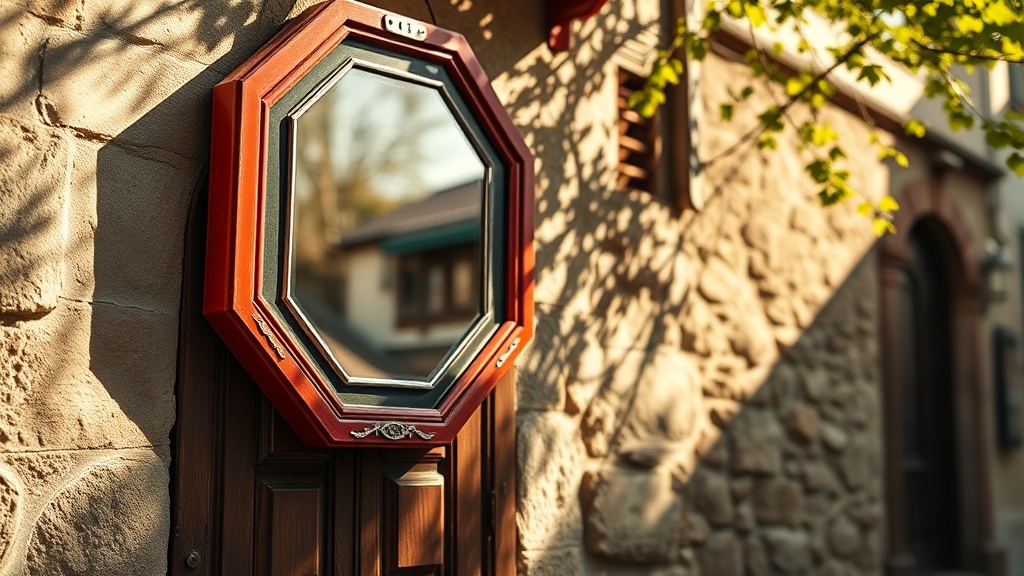
Placement conventions for the bagua mirror are among the most consistent elements across different feng shui lineages, and they are worth taking seriously if you are working within the tradition rather than treating the object as décor.
The mirror is placed on the exterior of the building, above or beside the main entrance door, facing outward. This is its intended location. It is not a room decoration. It is not an indoor object. Classical feng shui holds that a bagua mirror pointed inward, at the people who live in the home, reverses its function entirely. This is not superstition for its own sake; it reflects the underlying logic of the tradition, which holds that the mirror's protective role is directional. It faces what is outside, not what is inside.
The second key placement consideration is what the mirror is facing. Traditionally, a bagua mirror is hung to address a specific sha qi, a term in classical feng shui that refers to energy configurations considered disruptive or destabilizing. Common sources cited in the tradition include a road that runs straight toward the front of the house (a "poison arrow"), a large dead tree directly opposite the entrance, the sharp corner of a neighboring building pointing at the door, or a utility pole directly in the sightline of the entrance.
If none of these configurations exist, many feng shui teachers suggest there is no particular need for a bagua mirror. It is a tool for specific situations, not a universal cure applied to every doorway.
The Role of the Mirror Itself: Reflection as Symbol
The mirror at the center of the bagua frame carries its own symbolic weight, independent of the trigrams around it. Mirrors in Chinese tradition have been understood as protective objects for a very long time, bronze mirrors from the Han dynasty (206 BCE, 220 CE) were buried with the dead as protective talismans, and literary and historical records describe mirrors hung at entrances to deflect malevolent forces. The mirror reflects and reveals; it shows what is approaching.
"The mirror reflects without judgment. It neither adds nor subtracts. It shows only what is."
A recurring idea in Taoist and Chan Buddhist contemplative writing on the nature of mind and perception
In Taoist cosmology, the combination of the mirror with the bagua creates an object that both maps the forces at play (through the trigrams) and actively engages with them (through the mirror's reflective surface). The octagonal frame is not arbitrary; the eight sides echo the eight directions, the eight trigrams, and the cyclical completeness of the cosmological system they represent.
In Chinese Buddhist practice, particularly in Chan (Zen's Chinese antecedent) and in folk religious traditions that blend Buddhist, Taoist, and Confucian elements, the mirror also appears as a contemplative symbol. The "mirror mind," clear and undistorted, is a recurring image in Chan literature. The bagua mirror as a household object sits at the intersection of these overlapping traditions.
Bagua Mirrors and Feng Shui Schools: A Brief Map
Feng shui is not a single unified system. It encompasses multiple lineages with different methodologies, and attitudes toward the bagua mirror vary across them. Understanding this helps avoid treating any one prescription as universal.
The Form School (巒頭派, Luán Tóu Pài), one of the oldest lineages, focuses on the physical landscape, the shapes of mountains, the flow of water, the orientation of structures. In this school, the bagua mirror is a practical tool for managing sha qi produced by problematic landforms or architectural configurations.
The Compass School (理氣派, Lǐ Qì Pài) incorporates the luopan (feng shui compass) and calculates directional influences with considerable specificity. Practitioners in this lineage may be more precise about the exact orientation and timing of mirror placement.
Contemporary Western feng shui, sometimes called "Black Hat" or BTB (Black Tantric Buddhist) feng shui, developed in the late 20th century and takes a more intuitive approach. While it uses the bagua as a room-mapping tool overlaid on floor plans, its relationship to the bagua mirror specifically varies considerably by teacher.
Whichever approach you follow, the consistent advice across lineages is to consult a practitioner if you are making significant placement decisions, and to approach the object as part of a living tradition with its own internal logic rather than as a standalone charm.

🗂️ Voir la collection
Zen Wall Art
Symbolic wall pieces that bring the same grounded, contemplative energy as the bagua tradition into your interior space.
20 références
Découvrir la catégorie →What the Bagua Mirror Is Not
Part of approaching the bagua mirror with respect means understanding what it does not do, and where the tradition itself draws lines that popular usage sometimes blurs.
It is not a universal good-luck symbol. Pointing a bagua mirror without a specific reason, simply because it seems protective, is regarded in classical feng shui as unnecessary at best and disruptive at worst, particularly if it is aimed in ways that direct reflective energy toward neighboring homes or public spaces. Several classical texts explicitly caution against using the mirror as a weapon in disputes with neighbors.
It is not an indoor decoration. The frequency with which bagua mirrors are sold as interior ornaments reflects a drift from their functional tradition. Hung inside a room, facing the people who inhabit it, the object is simply a mirror in an octagonal frame, the trigrams do not confer additional meaning to an indoor placement that contradicts the tradition's own logic.
It is not a substitute for other feng shui assessments. If a home has structural or orientational challenges, the bagua mirror addresses one specific dimension, the management of sha qi at the entrance, and nothing more. It does not balance the five elements, correct compass orientations, or substitute for a proper feng shui analysis of the space as a whole.

🗂️ Voir la collection
Wall Hangings
Handcrafted symbolic pieces, including Yin Yang and Tree of Life designs, that bring Taoist and Eastern cosmological motifs to your walls with authenticity.
40 références
Découvrir la catégorie →Caring for and Activating a Bagua Mirror
Traditional guidance on the installation and maintenance of a bagua mirror is fairly consistent across feng shui lineages, even if the specific rituals vary by school and region.
The mirror should be clean and unobstructed. A dusty or cracked mirror is considered ineffective in the tradition, the reflective surface needs to be clear to function as intended. Regular wiping with a soft cloth is sufficient. If the mirror cracks, most practitioners recommend replacing it rather than continuing to use a damaged piece.
The frame should be intact. The trigrams are part of the object's function; a frame where markings are worn away or damaged is no longer a complete bagua mirror in the traditional sense.
Some feng shui practitioners recommend a brief activation ritual when first hanging the mirror, a moment of clear intention about what the mirror is meant to address, sometimes accompanied by incense or a spoken intention. This varies considerably by lineage and is not considered strictly obligatory in all schools. What is consistent is the idea that the object is placed with awareness and purpose, not casually or decoratively.

🗂️ Voir la collection
Buddhist Incense
Traditional incense blends rooted in over two thousand years of altar and contemplative practice, a fitting companion to any intentional placement ritual.
2 références
Découvrir la catégorie →The Bagua Mirror in the Broader Context of Taoist and Buddhist Home Practice
The bagua mirror sits at the intersection of Taoism, Chinese folk religion, and the practical philosophy of feng shui, a tradition that is often misunderstood in Western contexts as either pure superstition or a decorating system. Neither characterization does it justice. Feng shui, in its classical form, is a discipline rooted in careful observation of landscape, orientation, and the movement of air and water. The I Ching, which gives the bagua mirror its cosmological framework, is one of the most seriously studied philosophical texts in East Asian intellectual history.
For practitioners who bring both Buddhist and Taoist elements into their home practice, which is extremely common across Chinese, Vietnamese, Korean, and Japanese cultural contexts, the bagua mirror occupies a natural place alongside other symbolic objects: statues, thangkas, prayer flags, incense, and altar pieces. It is protective in intention, cosmological in framework, and deeply practical in application.
What distinguishes thoughtful engagement with a bagua mirror from casual use is the same thing that distinguishes any serious practice from its surface-level imitation: knowing what you are working with, why the tradition makes the choices it does, and what the object is genuinely meant to do. The bagua mirror is not a shortcut. It is a considered tool within a considered tradition, and treating it as such is both more respectful and, within its own terms, more effective.
Questions fréquentes
What is a bagua mirror used for?+
In classical feng shui, the bagua mirror is placed on the exterior of a home, typically above the main entrance, to address sha qi, which refers to energy configurations considered disruptive in the tradition. Common triggers include a road pointing directly at the house, a sharp architectural corner from a neighboring building aimed at the entrance, or a large dead tree directly in front of the door. It is a tool for specific situations, not a generic protective charm.
Can I hang a bagua mirror inside my home?+
Classical feng shui consistently advises against indoor placement. The bagua mirror is designed to face outward, addressing forces that approach the home from outside. Hung indoors and facing the inhabitants, it reverses its intended direction. Most practitioners recommend exterior-only placement above or beside the main entrance door.
What is the difference between a flat, convex, and concave bagua mirror?+
A flat bagua mirror reflects energy directly back outward and is considered general-purpose. A convex mirror curves outward and reflects a wide field, making it suited for diffuse or large sources of sha qi, it is the most commonly recommended type for residential use. A concave mirror curves inward and is considered more absorptive; it is used more selectively and typically by experienced practitioners addressing specific configurations.
Which way should the bagua mirror face?+
The mirror should face outward, toward the source of the sha qi you are addressing, or outward from the front entrance in a general protective placement. In the Earlier Heaven arrangement used on most protective bagua mirrors, the Qian trigram (three unbroken lines, ☰) should appear at the top of the frame when correctly oriented.
Is the bagua mirror a Buddhist object?+
The bagua mirror originates in Taoist cosmology and feng shui practice rather than Buddhism proper. However, in Chinese, Vietnamese, and broader East Asian cultural contexts, Taoist, Buddhist, and folk religious practices have been deeply intertwined for centuries. Many households that follow Buddhist practice also work with feng shui principles and objects like the bagua mirror without contradiction. The I Ching framework at its core predates both Buddhism's arrival in China and the formal systematization of Taoism.


