

Feng Shui Bedroom: A Practical Guide to Balanced Sleep and Rest
Sleep is not passive. Every night, you return to the same room, the same arrangement of furniture, the same quality of air and light. Feng shui, the classical Chinese system for aligning spaces with the flow of qi (vital energy), has applied this insight for over two thousand years. The bedroom, in this tradition, is not just a place to sleep. It is where the body and mind regenerate, where defenses come down, and where the quality of surrounding space has its deepest effect on a person's wellbeing.
What follows is a grounded, practical look at what feng shui bedroom principles actually mean, their origins in Chinese cosmological thought, how they translate into concrete room arrangements, and where the tradition draws a clear line between symbolic intention and interior decoration common sense.
⭐ À retenir
- The commanding position of the bed is the single most important feng shui bedroom principle.
- Clutter, heavy electronics, and mirrors facing the bed are consistently discouraged across feng shui schools.
- Color choices follow the five-element system: earth tones and soft neutrals support rest; fiery reds and bright whites are used sparingly.
- Feng shui symbols, turtles, water features, certain wall art, each carry specific cosmological meanings tied to the bagua map.
- The system is a framework for intention, not a guarantee of outcomes.
The Roots of Feng Shui: More Than Interior Design
Feng shui (pronounced "fung shway") is a discipline rooted in Taoist cosmology, first systematized during the Han Dynasty (206 BCE, 220 CE) and refined across centuries of practice in China, Vietnam, Korea, and the wider East Asian world. The name itself translates literally as "wind-water," two forces considered in classical Chinese thought to carry and disperse qi, the vital energy that flows through landscapes, buildings, and human bodies alike.
Two main schools dominate contemporary practice. The Form School focuses on physical shapes: how mountains, rivers, and the silhouettes of surrounding structures direct energy flow. The Compass School uses the bagua, an eight-sided map of eight life areas (wealth, fame, relationships, family, health, creativity, knowledge, career), oriented by cardinal directions to diagnose and adjust a space. Most modern feng shui practitioners draw on both.
💡 Did you know?
The earliest known feng shui texts, including the Zang Shu (Book of Burial) attributed to Guo Pu (276, 324 CE), were originally concerned with the placement of tombs, not living rooms. The principles migrated over centuries into the arrangement of homes, palaces, and cities, with Beijing's Forbidden City representing one of the most ambitious feng shui-informed architectural projects in history.

The Commanding Position: Where You Place the Bed Matters
If there is one principle that cuts across all feng shui schools, it is the commanding position. In a bedroom, this means placing the bed so that the person lying in it has a clear sightline to the door without being directly in line with it. The back of the bed, and ideally the headboard, rests against a solid wall.
The reasoning is pragmatic as much as symbolic. A person asleep with their back to the door cannot see who enters; in classical thought, this creates a position of vulnerability that disrupts rest and keeps the nervous system alert. A bed placed directly in line with the door ("coffin position," as it is sometimes called in Chinese tradition, because the feet point toward the exit) is considered particularly unfavorable and is avoided even by those who take a casual interest in feng shui.
- Ideal placement: diagonal from the door, headboard against a solid wall, with a view of the entrance.
- Avoid: bed directly opposite the door, bed under a window (no support behind), bed tucked into a corner with access on only one side (restricts partner energy in the relationship area).
- If room layout forces an in-line position: a low bench or screen placed between the bed and door can interrupt the direct flow.
Five Elements, Colors, and the Bedroom Palette
The five-element system, Wood, Fire, Earth, Metal, Water, is one of feng shui's core analytical tools. Each element carries qualities, a color range, a season, and a direction. In the bedroom, the goal is to support rest and intimacy, which in this system falls primarily under the Earth and Water elements.
| Element | Associated Colors | Effect in Bedroom |
|---|---|---|
| Earth | Sandy beige, terracotta, warm brown | Grounds, stabilizes, well-suited to rest |
| Water | Deep navy, charcoal, soft grey-blue | Quiets mental activity, use in moderation |
| Wood | Sage green, olive, muted teal | Growth energy, lighter shades are calming |
| Metal | White, light grey, pale silver | Crisp and clarifying, can feel too cool as a dominant tone |
| Fire | Red, bright orange, strong purple | Activating, generally avoided as dominant bedroom color |
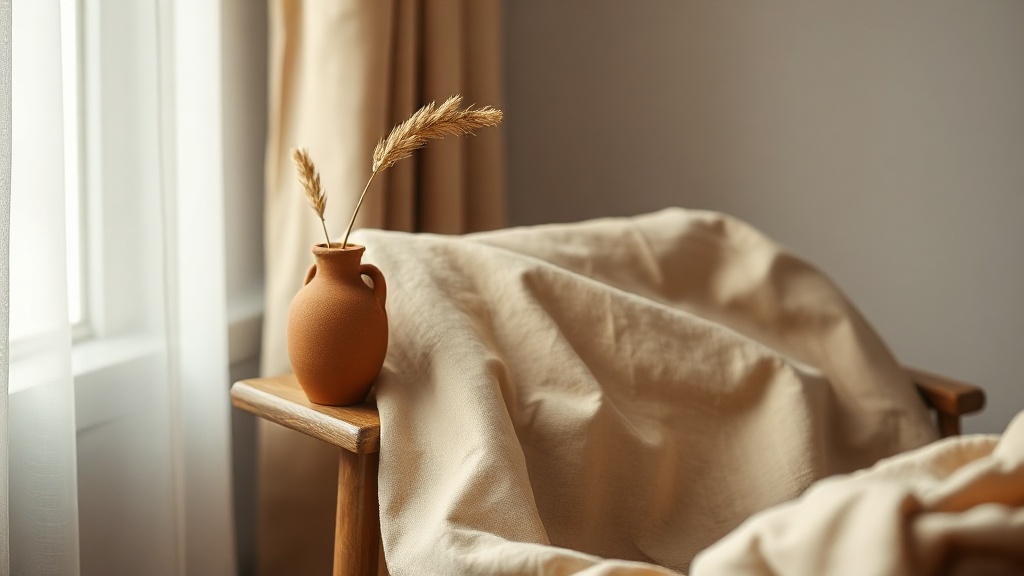
A feng shui bedroom palette typically layers earth tones as a base (walls, bedding, rugs) with restrained water or wood accents. Pure white walls, common in minimalist Western design, sit in the Metal element and are considered acceptable but are often warmed with terracotta or wooden textures to avoid a clinical feel. Strong reds and oranges, tied to Fire, are considered overstimulating for a space meant for sleep, though a small amount as an accent (a cushion, a small art piece) is not forbidden.
Mirrors, Electronics, and What Feng Shui Asks You to Remove
Two objects draw consistent caution in feng shui bedroom guidance: mirrors and screens.
Mirrors facing the bed are discouraged across virtually all feng shui schools. Classical texts describe a mirror as a reflective, activating surface that "doubles" the energy in a space, useful in a hallway or living area, but disruptive during sleep. Some practitioners frame this practically: waking in the night and seeing movement (your own reflection) is startling, and sustained over time, this low-level disruption undermines rest quality. If a built-in wardrobe mirror faces the bed, covering it at night with a lightweight curtain or cloth is the standard adjustment.
Electronics, televisions, laptops, phones, are the contemporary extension of the same concern. In feng shui terms, screens are Fire-element objects that carry active, stimulating energy. Kept in the bedroom, they blur the room's function. Most practitioners recommend keeping them out of the bedroom entirely, or at minimum ensuring they are off and ideally covered or in a closed cabinet when not in use.
Clutter under the bed is perhaps the most universally cited feng shui bedroom issue. Stored boxes, luggage, clothing piled beneath the mattress are said to create stagnant energy directly beneath the sleeping body. The practical read is simple: obstructed airflow and accumulated objects beneath the bed are not conducive to clean rest. The traditional recommendation is either a completely clear space under the bed or, if storage is unavoidable, only soft items (spare linens, seasonal clothing), nothing sharp, broken, or emotionally charged.
Symbols in the Feng Shui Bedroom: What Belongs and Why
Feng shui bedroom decor is not arbitrary. Each symbol or object type carries a specific cosmological rationale tied to the bagua map and the five-element system.
The relationship corner (Southwest) is where paired objects belong, two nightstands of equal height, artwork depicting two figures or paired motifs, twin candles. Single, solitary objects in this corner are considered to reinforce isolation in the relationship area of life.
Water features, fountains, aquariums, are generally kept out of the bedroom despite their popularity in feng shui living-room applications. The Water element in excess is considered too "yin" (cool, fluid, yielding) for a space that needs grounded, stable energy for rest. A small, still water element on a nightstand is occasionally used, but flowing water is recommended for other rooms.
Plants sit in the Wood element and bring growth energy. In a bedroom, most practitioners suggest limiting them and ensuring they are healthy, a wilting plant in a corner carries very different symbolic weight than a thriving one. Dried flowers, in classical feng shui, are consistently avoided as they are associated with stagnant, spent energy.

🗂️ Voir la collection
Feng Shui Decor
Thoughtfully chosen feng shui objects, figurines, statues, and symbolic pieces, to anchor intention in every corner of your bedroom.
81 références
Découvrir la catégorie →Feng Shui Wall Art in the Bedroom
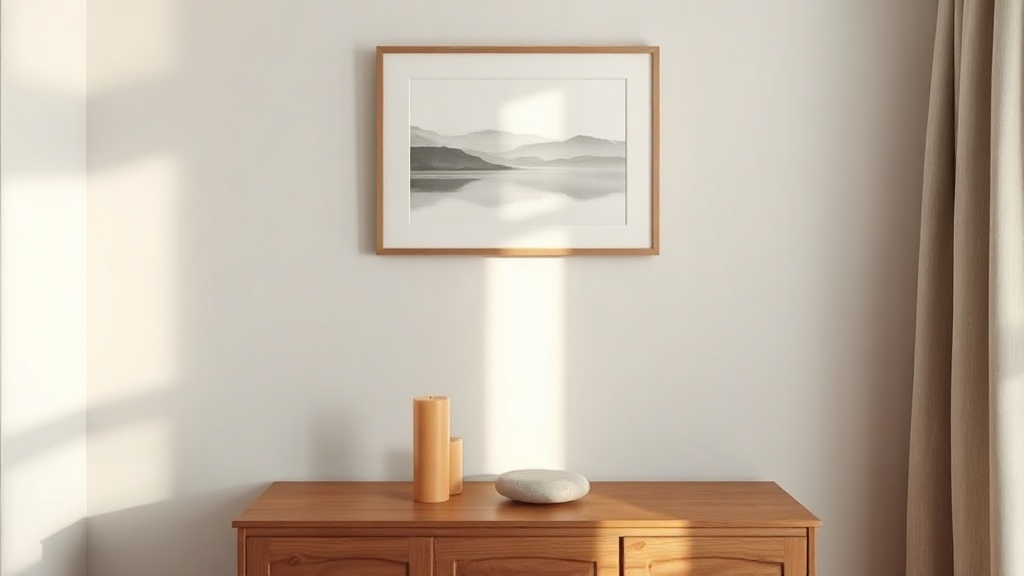
Imagery in the bedroom is taken seriously in feng shui practice. The logic is straightforward: what you see last before sleeping and first upon waking shapes the mind's tone. Classical guidance recommends imagery that is calm, paired (for the relationship area), and free of violent, solitary, or melancholic associations.
Landscapes, particularly those with a clear horizon and soft, balanced composition, are considered well-suited. Water scenes work if the water depicted is calm, rivers, still lakes, gentle ocean views. Abstract mandalas, which carry their own visual centering properties rooted in Buddhist and Hindu cosmological traditions, are commonly placed in meditation or rest spaces.
What is consistently avoided: images of lone figures in postures of sadness or isolation, battle or hunting scenes (Fire/Metal energy), and portrait photography with direct eye contact (creates a sense of being watched during sleep).

🗂️ Voir la collection
Feng Shui Wall Art
Symbolic wall pieces drawn from Chinese cosmological tradition, chosen to set a calm, intentional visual tone in your bedroom.
Voir la collection
Découvrir la catégorie →Applying the Bagua Map to Your Bedroom
The bagua is an octagonal grid that maps eight life areas onto the floor plan of a space. There are two main methods for orienting it in a bedroom: aligning the map so that the career/path area (North) corresponds to the room's entrance wall (Black Hat Tantric Buddhist feng shui, widely used in Western practice), or orienting it by compass direction (traditional Compass School). Results differ depending on which system you follow, and both are internally consistent.
The practical application: once you know which corner of your bedroom corresponds to which life area, you place objects, colors, and symbols accordingly. The relationship corner (Southwest in Compass School) gets paired objects and earth tones. The knowledge corner (Northeast) might hold books, a small meditation cushion, or a symbolic figure associated with wisdom. The wealth corner (Southeast) traditionally welcomes Wood-element objects, a healthy plant, wooden figures.
The bedroom bagua is not a rigid prescription but a framework for noticing what a space already communicates. A relationship corner stacked with work files and a broken lamp communicates something, feng shui simply asks you to notice it.
Scent, Sound, and the Invisible Dimensions of the Feng Shui Bedroom
Feng shui addresses qi in all its forms, not only the visible. Air quality and airflow are fundamental: a bedroom that is regularly ventilated, free of damp, and not overcrowded with heavy synthetic materials is considered better qi-wise than any symbolic arrangement placed in a stagnant, poorly aired room. Morning airing, opening windows for at least ten minutes, is a baseline practice across virtually all feng shui traditions.
Scent enters through incense, essential oils, or natural materials. Sandalwood, cedarwood, and vetiver are traditionally associated with grounding and calm in East Asian ritual contexts; they appear in Buddhist temple practice as well as Taoist ceremony. The key distinction: these materials are used for their sensory and ceremonial properties, not as therapeutic agents. Their role in a feng shui bedroom is atmospheric and intentional.
Sound, specifically the deliberate absence of disruptive noise and the optional presence of considered sound, also features. Wind chimes placed at a window or doorway are among the oldest feng shui tools for redirecting fast-moving qi and marking transitions between spaces. In a bedroom context, a small set of metal or bamboo chimes near an entrance can function both symbolically and practically, as a quiet acoustic marker of the room's threshold.
"The wise arrange their dwelling as they arrange their mind, nothing excessive, nothing absent, each thing in its proper place."
Paraphrase attributed to classical Chinese architectural philosophy, origin disputed
Starting the Feng Shui Bedroom Shift: A Practical Sequence
Comprehensive feng shui renovations are not necessary to begin working with the system. Most practitioners recommend a layered approach that addresses the most impactful changes first and builds from there.
- Clear the clutter. Under the bed, on nightstands, inside closets visible from the sleeping area. This single step has more impact than any symbolic addition.
- Fix the bed position. If it's currently in line with the door or pushed against a wall on both sides, move it if possible. The commanding position shift is the most structurally significant change in a feng shui bedroom.
- Address mirrors and screens. Cover or relocate mirrors that face the bed. Remove or cover screens.
- Review color and materials. Is the room dominated by Fire or Metal tones? Consider introducing Earth-element textiles, linen, cotton in warm neutral tones, through bedding, rugs, or curtains.
- Add intentional objects thoughtfully. Once the basics are stable, you can introduce symbolic pieces: a piece of wall art with calm, paired imagery; a small figurine in the relationship or knowledge corner; wind chimes near the entrance.
💡 Did you know?
The commanding position principle appears not only in feng shui but also in traditional Tibetan Buddhist monastery design, where senior monks' quarters are arranged so the occupant faces the room's entrance. This cross-cultural convergence suggests the underlying logic, awareness of space, orientation toward the threshold, resonates beyond a single tradition.
Questions fréquentes
What is the most important feng shui bedroom rule?+
The commanding position of the bed is consistently cited as the foundational principle across all feng shui schools: the sleeper should have a clear sightline to the door without being directly in line with it, with the headboard resting against a solid wall. Everything else is secondary to this placement.
Are mirrors bad feng shui in the bedroom?+
Mirrors facing the bed are discouraged in virtually all feng shui traditions. They are considered activating and reflective surfaces that disturb the calm, restorative quality needed during sleep. The practical adjustment for a fixed wardrobe mirror is to cover it at night with a curtain or cloth panel.
What colors are best for a feng shui bedroom?+
Earth-element tones, warm beiges, sandy neutrals, terracotta, are the most widely recommended base palette for a feng shui bedroom, as they support stability and rest. Soft blue-greens (Water and Wood elements) work as accents. Strong reds, bright oranges, and stark white as a dominant tone are generally avoided for sleeping spaces.
Can I use a feng shui bedroom if I rent and can't move the bed?+
Yes. If structural constraints prevent moving the bed, feng shui offers adjustments: place a mirror angled so you can see the door's reflection from bed; use a screen or curtain to break a direct line between bed and door; focus instead on color, cleared clutter, and intentional objects in the relevant bagua corners. The system is adaptive, not absolute.
Is feng shui scientifically proven?+
Feng shui is a traditional system rooted in Taoist cosmology and classical Chinese thought, not a scientific discipline. Its principles have not been validated by controlled scientific research. Many of its recommendations overlap with common-sense environmental psychology, good lighting, clear sightlines, reduced clutter, but its cosmological framework (qi, bagua, five elements) belongs to the domain of cultural and spiritual tradition.


