

Feng Shui Crystals: Which Stones to Use, Where to Place Them, and What the Tradition Actually Says
If you are new to feng shui, start simple: pick one room, identify its dominant bagua zone using the table below, and place a single stone that matches its element. That single intentional act is already feng shui practice. Everything else in this guide builds on that foundation.
Feng shui crystals sit at a curious crossroads: a classical Chinese system for arranging space meets the more recent Western fascination with natural stones. The two traditions don't always overlap as neatly as lifestyle blogs suggest. Before placing an amethyst cluster on your nightstand and calling it feng shui, it helps to understand what the practice actually involves, where stones fit within it, and which placements carry real symbolic weight.
This guide covers the foundational logic of feng shui, the specific role feng shui crystals play within it, the most commonly used stones and their associated symbolism, and practical placement advice drawn from classical theory. No therapeutic promises. No mystical shortcuts. Just a clear map of a rich tradition.
⭐ Key takeaways
- Feng shui is a classical Chinese spatial system rooted in Taoist cosmology, not a decorating style.
- Crystals enter feng shui primarily as earth-element objects, not as standalone healing tools.
- Placement logic follows the bagua map: each area of a space corresponds to a life domain and an element.
- The most relevant stones in feng shui are clear quartz, black tourmaline, citrine, amethyst, rose quartz, and pyrite.
- The qualities attributed to stones belong to spiritual traditions and beliefs. No therapeutic effect is scientifically recognized. These objects are not substitutes for medical advice or treatment.
What Feng Shui Actually Is (and Isn't)
**Feng shui** (pronounced "fung shway") is a system developed over roughly 3,000 years in China, rooted in Taoist cosmology. Its core premise is straightforward: the arrangement of a space affects the flow of qi (vital energy), and a well-ordered environment supports the people living within it. The name itself translates literally as "wind-water," two natural forces the tradition treats as carriers of qi.
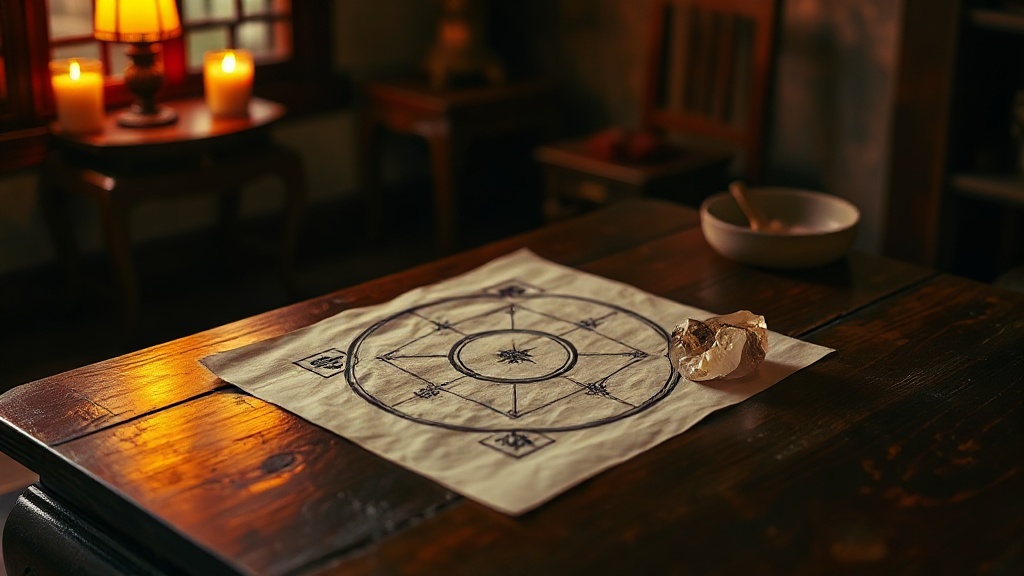
Classical feng shui draws on several interlocking frameworks. The five elements, wood, fire, earth, metal, and water, describe cycles of generation and control that govern how objects, colors, and materials interact in a room. The bagua, an eight-sided map derived from the I Ching, divides any space into zones corresponding to domains of life: wealth, relationships, career, health, and so on. A trained practitioner reads a floor plan against compass directions, birth charts, and these elemental cycles to give specific recommendations.
What it is not: a vague aesthetic of zen minimalism, a guarantee of prosperity if you place a crystal in the right corner, or a system interchangeable with New Age crystal healing. Conflating the two does a disservice to both traditions.
Where Feng Shui Crystals Fit Within the Five Elements
Within the five-element framework, natural stones and feng shui crystals belong primarily to the earth element. Earth governs stability, nourishment, and grounded support. Its associated spaces in the bagua include the center (health and wellbeing), the southwest (relationships and partnership), and the northeast (knowledge and self-cultivation).
This placement logic is why feng shui practitioners recommend earth-element objects, including stones, ceramics, and low heavy furniture, in these zones specifically, not scattered everywhere at random. A crystal placed in the center of a room addresses a different intention than one placed in the far left corner.
Some stones also interact with other elements through color. A black tourmaline, for instance, carries the visual weight of the water element alongside its earth-element material nature. A piece of citrine's yellow resonates with earth. A red jasper activates fire associations. Color matters as much as mineral composition in this framework.
💡 Did you know?
The bagua map predates modern feng shui by centuries. Its eight trigrams appear in the I Ching (Book of Changes), a text compiled during the Western Zhou dynasty (circa 1000 BCE). Each trigram describes a natural force: heaven, earth, thunder, wind, water, fire, mountain, and lake. Feng shui adapted these trigrams into a spatial grid only later, during the Tang dynasty (618, 907 CE).
The Six Feng Shui Crystals Most Used in Practice
The following stones appear consistently across both classical Chinese feng shui texts and contemporary practice. Each has a specific symbolic logic within the tradition. None of them work as mechanical shortcuts: placement matters, intention matters, and the overall arrangement of a space matters far more than any single object.
If you are just starting out, read this section as a reference guide rather than a shopping list. Choose one stone that matches the bagua zone you most want to work with, and begin there.
1. Clear Quartz: The All-Purpose Clarifier
Clear quartz is the closest thing feng shui has to a neutral amplifier. Practitioners place it to clarify the energy of a space rather than to push a specific elemental quality. It catches and scatters light, which in feng shui terms activates stagnant areas. A cluster near a window in the northwest (travel and helpful people zone) or the center of a room is a common recommendation.
In the Chinese tradition, rock crystal has been carved into ritual objects since the Han dynasty (206 BCE - 220 CE): bowls, seals, and ornaments valued for their clarity and perceived permanence. Its feng shui use extends this older symbolic weight.
🪨 Best placement
Center of the room, northwest zone, or near any window where natural light enters. Use a cluster for broad activation; use a point when you want to direct focus toward a specific area.
2. Black Tourmaline: Boundary-Setting Stone
Black tourmaline is placed near entrances in feng shui practice. The north-facing front door, the main entry corridor, or a window facing a busy street: these are the spots where practitioners recommend it. The logic is elemental: dark, dense, opaque stones are associated with the water element and with protective boundary-setting in Chinese cosmological thought.
According to Taoist spatial theory, sha qi (disruptive or sharp energy) can enter a home through direct lines of sight from the street. A heavy, dark stone near the threshold is one way to interrupt that flow, alongside mirrors, screens, and plants.
🪨 Best placement
Low on the floor beside the front door, or on a low console in the entry hallway. One piece on each side of the entrance is a common pairing in classical practice.
3. Citrine: Earth Energy and Abundance Symbolism
Citrine's yellow-gold color connects it directly to the earth element and, through that, to the wealth and abundance associations of the southeast bagua zone. Practitioners often place a citrine point or cluster in the far left corner of a room (measured from the main entrance), which corresponds to the wealth area in the BTB (Black Tantric Buddhist) school of feng shui.
It's worth noting: the "wealth corner" concept belongs more to popularized Western feng shui than to classical compass-based practice, where wealth associations follow specific compass directions adjusted for each property. Both approaches use citrine for its color symbolism, though they place it differently.
🪨 Best placement
Southeast zone (compass method) or far-left corner from the front door (BTB method). A raw cluster or a natural point works better than a heavily tumbled piece; the mineral structure should be visible.
4. Amethyst: Stillness and the Northeast Zone
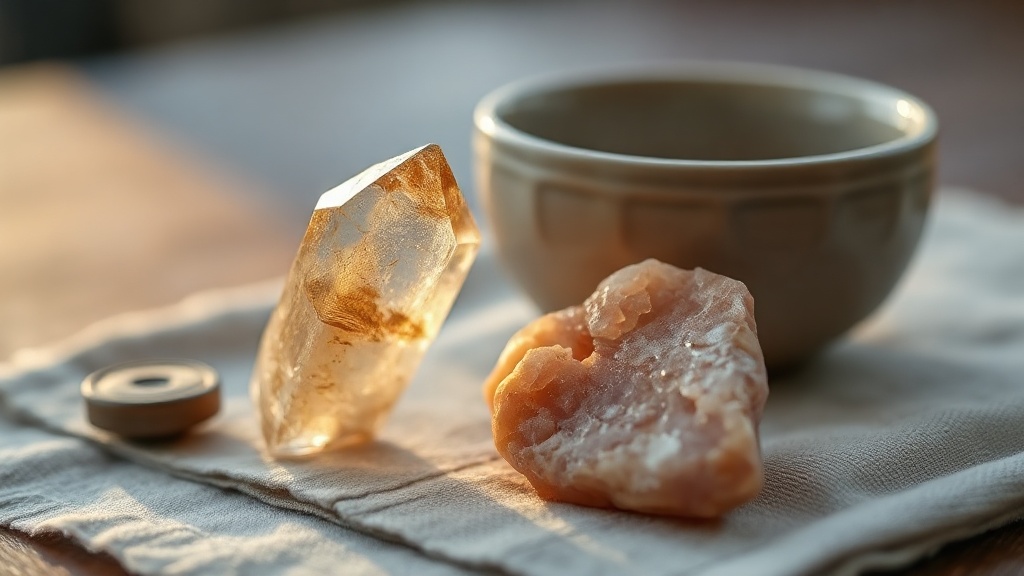
Amethyst carries a purple-violet color associated in Chinese tradition with spiritual authority and refinement. Within the bagua, the northeast zone governs knowledge, wisdom, and self-cultivation: a natural fit for a stone used in meditation practice across multiple traditions, including Tibetan Buddhism where purple stones appear in some ritual contexts.
Placing an amethyst cluster in a study, meditation corner, or the northeast area of a bedroom aligns with this symbolic reading. The stone's visual weight also grounds a space, which is consistent with its earth-element classification.
🪨 Best placement
Northeast zone of a study or meditation space. In the bedroom, place it on a low shelf rather than directly beside the pillow; its visual density suits the periphery of a sleeping area more than the immediate bedside.
5. Rose Quartz: The Southwest and Relationship Symbolism
The southwest bagua zone governs relationships, partnerships, and marriage. Pink and red are the colors associated with this area. Rose quartz, with its pale-to-medium pink tone, fits cleanly within this elemental color system. Feng shui practitioners commonly recommend it for bedrooms and the southwest corner of living spaces.
The stone has been carved into decorative objects throughout Chinese history: small animals, pendants, and ornamental pieces. Its presence in feng shui is as much about color symbolism and aesthetic harmony as any mineral-specific property.
🪨 Best placement
Southwest corner of the bedroom or living room. A smooth sphere or carved piece suits the relationship zone well; the rounded form carries no directional emphasis, which aligns with the southwest's associations of receptive, mutual energy.
6. Pyrite: Metal Meets Earth at the Wealth Zones
Pyrite's gold metallic luster makes it unusual: it straddles earth element (mineral origin) and metal element (visual appearance and reflective surface). This dual quality makes it useful in zones where both elements are relevant, including the west (creativity, children) and northwest (travel, mentors), both governed by the metal element.
Its popular association with wealth is partly folk symbolism (it resembles gold) and partly aligned with the metal element's link to precision, clarity, and financial structures in Chinese cosmological thought. A raw pyrite cluster on a work desk or in the northwest corner of a home office is a placement practitioners endorse for this reason.
🪨 Best placement
Northwest corner of a home office, or on a work desk facing north or northwest. Keep it away from the bedroom: its reflective surface and visual energy are better suited to active, daytime spaces.
Reading the Bagua: How to Map Your Space
The bagua map is the practical tool that turns abstract feng shui theory into specific placement decisions. There are two main methods for applying it to a floor plan.
The compass method (used in classical and Form School feng shui) overlays the bagua according to true compass directions. North always aligns with the career zone, south with fame and reputation, east with family and health, west with creativity. This approach requires a compass reading at the front door and applies different recommendations based on the year the property was built.
The BTB (Black Tantric Buddhist) method, popularized in the West by Master Lin Yun in the 1970s, always aligns the bagua relative to the front door, regardless of compass direction. The bottom edge of the map (career, knowledge, helpful people) runs along the wall containing the main entrance. This method is simpler and more widely used outside China.
For crystal placement, the practical difference matters. In the BTB system, the wealth corner is always the far-left corner from your front door. In the compass system, it's the southeast regardless of door orientation. Choose one method and apply it consistently across your space.
| Bagua Zone | Life Domain | Element | Recommended Crystal |
|---|---|---|---|
| North | Career and life path | Water | Black tourmaline, aquamarine |
| Northeast | Knowledge and self-cultivation | Earth | Amethyst, clear quartz |
| East | Family and health | Wood | Green aventurine, jade |
| Southeast | Wealth and abundance | Wood | Citrine, pyrite, green jade |
| South | Fame and reputation | Fire | Carnelian, red jasper |
| Southwest | Relationships and partnership | Earth | Rose quartz, rhodonite |
| West | Creativity and children | Metal | Clear quartz, white selenite |
| Northwest | Helpful people and travel | Metal | Pyrite, hematite |
| Center | Health and overall balance | Earth | Yellow calcite, clear quartz |
Room-by-Room Placement: Practical Starting Points for Feng Shui Crystals
Crystal placement in feng shui isn't about filling every surface. The principle of sha qi includes clutter: too many objects in a space creates visual noise that interrupts qi flow. One or two well-chosen pieces in the right zone carry more weight than a collection scattered everywhere.
Living Room
The living room benefits from stones that anchor earth energy: a citrine cluster on a side table in the southeast corner, or a clear quartz point catching light near a window. If the room faces a busy street or has a direct line from the front door through to a window (a configuration classical feng shui calls "rushing qi"), a black tourmaline near the entry interrupts that flow.
Bedroom
The bedroom is the most debated space in feng shui crystal practice. Classical texts rarely mention stones in sleeping areas; this is largely a Western addition. If you do place stones in a bedroom, the preference is for calming, low-reflectivity pieces: rose quartz in the southwest corner for relationship energy, or an amethyst on a low shelf rather than directly next to the head of the bed. Highly reflective stones like pyrite or large clear quartz clusters are generally kept out of sleeping spaces.
Home Office or Study
The northeast (knowledge zone) is the natural home for amethyst or clear quartz in a study. A pyrite cluster on the desk connects to the northwest (helpful people) if your desk faces that direction. Keep the surface clear: a single intentional piece does more than five randomly arranged stones.
Entrance and Hallway
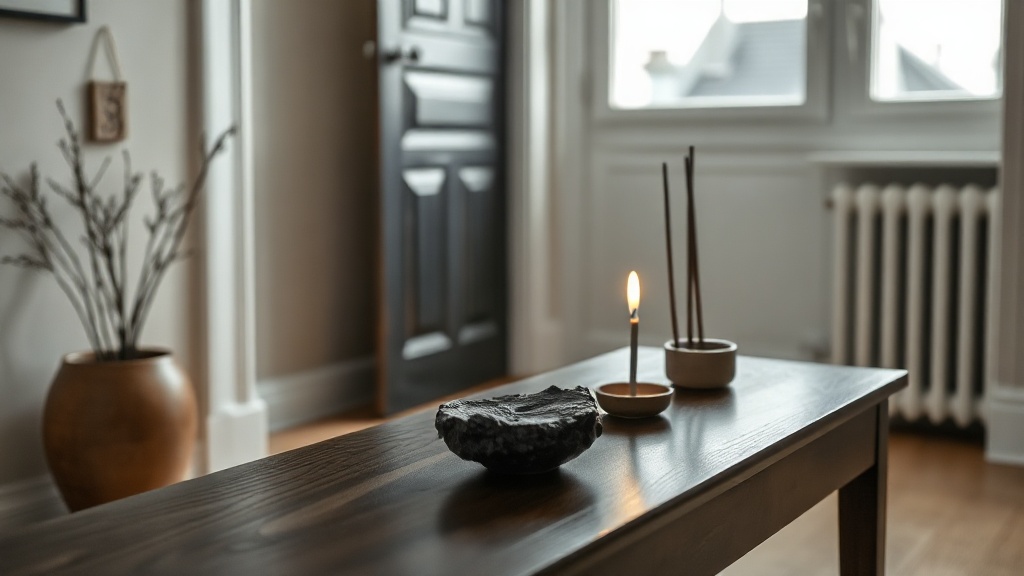
Entrances are the most active feng shui zone: this is where qi first enters. Black tourmaline is the most commonly recommended stone here, placed low (on the floor beside the door, or on a low console) to anchor the threshold. A small quartz point pointing inward, positioned on either side of the entrance, is a secondary option.

🗂️ See the collection
Feng Shui Decor
Natural stones, carved objects, and placement tools selected for symbolic accuracy and craft quality. Each piece is chosen to ground a specific bagua zone with genuine elemental weight.
81 références
Discover the collection →Choosing Stones With Intention: What to Look for When Buying Feng Shui Crystals
Quality matters more than quantity. A well-formed piece of natural stone with visible mineral structure carries more visual presence in a space than a bag of tumbled chips that all look identical.
When selecting feng shui crystals, pay attention to these practical criteria:
- Form: Points and clusters direct and scatter energy in different ways according to feng shui theory. A point placed with the tip facing a zone "activates" it; a cluster radiates in all directions and is better suited to open areas.
- Size and weight: Larger, heavier stones carry more earth-element energy. A palm-sized citrine has more visual and symbolic presence than a small tumbled piece.
- Color integrity: Avoid dyed stones (common in agate and some quartz). Color symbolism in feng shui depends on the natural color of the mineral, not an artificial coating.
- Origin and craft: Natural, unpolished or minimally polished stones stay truer to their elemental character. Heavily processed stones (bleached, irradiated, dyed) have less connection to the earth-element quality the tradition values.
- Combining multiple stones: You can place more than one stone in a room, but keep elemental logic consistent. Avoid placing stones with opposing elemental colors in the same small zone (for example, a fire-associated red jasper next to a water-associated black stone in the same corner). Across different rooms or different bagua zones, combinations work well.
"Wind and water shape stone over millennia. The arrangement of stones shapes the space we inhabit. Both move slowly, and that is the point."
Classical feng shui principle, Form School tradition
A Note on the Western Crystal Healing Overlap
Much of what circulates online under the label "feng shui crystals" is actually a blend of feng shui and Western crystal healing, two distinct traditions that share some objects but not the same framework.
Western crystal healing, popularized in the 1980s through New Age movements, assigns specific properties to individual stones based on a mix of folk tradition, theosophy, and contemporary wellness culture. It is not rooted in Chinese cosmological theory. When a source tells you that amethyst "raises your vibration" or that black tourmaline "absorbs negative energy," that language comes from the Western tradition, not from classical feng shui.
This distinction matters for two reasons. First, the placement logic differs: feng shui places stones according to bagua zones and elemental balance, not individual crystal "properties." Second, the cultural attribution matters. Misattributing Western wellness practices to ancient Chinese tradition can obscure both.
The qualities attributed to stones belong to spiritual traditions and beliefs. No therapeutic effect is scientifically recognized. These objects are not substitutes for medical advice or treatment.

🗂️ See the collection
Feng Shui Bracelet
Natural gemstone bracelets rooted in Chinese and Tibetan symbolic tradition, for those who prefer to carry their stones with them. Each stone is selected for its elemental color and traditional symbolism within the bagua system.
16 références
Discover the collection →Integrating Feng Shui Crystals Into a Broader Practice
Crystals work best as one layer of a larger spatial arrangement, not as a substitute for it. Classical feng shui pays attention to furniture placement, light sources, airflow, the orientation of doors and windows, and the relationship between the building and its surrounding environment. Stones fit within this system as earth-element accents that reinforce or correct elemental imbalances.
A room with blocked natural light, furniture pushed against every wall, and cluttered surfaces won't be transformed by a crystal in the corner. But a room where the basic principles of qi circulation are already respected, clear pathways, balanced lighting, minimal clutter, responds visibly to the addition of well-placed earth-element objects, including stones.
The most grounded approach: start by learning the bagua map and identifying the dominant element of each zone in your space. Then select feng shui crystals that reinforce or balance those elemental associations. Place one or two at first. Live with them for a few weeks before adding more. Attention and deliberateness are themselves part of the practice.
Frequently asked questions about feng shui crystals
Do crystals actually do anything in feng shui, or are they purely decorative?+
Within feng shui theory, crystals function as earth-element objects that carry specific color and weight properties relevant to elemental balance. Their role is real within the system's own logic. Whether that logic produces measurable environmental effects is a different question. No scientific evidence supports the idea that crystal placement changes physical or psychological outcomes. Their value, as with most ritual objects, lies in the attention and intentionality the practice cultivates.
Which crystal is considered the most versatile for feng shui use?+
Clear quartz is the most adaptable choice. Its neutral color means it doesn't push elemental energy in any specific direction, and its light-scattering properties make it useful in any zone where the goal is to activate or clarify stagnant energy. It works particularly well in the center of a space, near windows, and in the northeast knowledge zone.
Can I put feng shui crystals in the bedroom?+
Classical feng shui doesn't specifically recommend stones in sleeping areas, but contemporary practice often includes them. The general guidance is to avoid highly reflective or visually active stones (large clear quartz clusters, pyrite) near the bed, as they can make a space feel restless. Rose quartz in the southwest corner and a small amethyst on a low shelf are the most common bedroom recommendations.
How do I clean or reset a crystal before placing it?+
Common ritual methods include rinsing the stone in cool running water (avoid this with water-soluble stones like selenite or halite), leaving it in indirect sunlight for a few hours, passing it through incense smoke, or leaving it in moonlight overnight. These are symbolic cleansing gestures found across several traditions, including Tibetan practice. They don't alter the mineral structure of the stone but mark a deliberate new beginning for its use.
Is there a difference between using a crystal point vs. a tumbled stone in feng shui?+
Yes, according to feng shui theory. A crystal point is directional: it focuses energy along its axis, which makes it suitable for activating a specific zone when the tip faces inward. A tumbled stone is non-directional and radiates evenly, making it better suited for general placement on a surface or in a bowl. A cluster radiates in all directions and is best in open areas where the goal is broad activation rather than focused direction.
Can I combine multiple feng shui crystals in the same room?+
Yes, with one important guideline: keep the elemental logic consistent within each zone. Place stones whose colors and elemental associations match the zone they occupy. You can use different stones in different bagua zones within the same room without conflict. Where practitioners advise caution is placing two stones with opposing elemental colors (fire red and water black, for instance) directly beside each other in the same small area. Spread them across the room according to the bagua grid instead.
What size stone works best for feng shui placement?+
Size should be proportional to the space. In a large living room, a palm-sized or larger piece carries enough visual and symbolic weight to register. In a small study or bedroom corner, a stone that fits comfortably in your hand is sufficient. The key principle is that the stone should be visible and intentionally placed, not hidden under clutter or lost on a crowded shelf. A single well-sized piece in the right zone is always preferable to several small pieces scattered randomly.


