

Feng Shui Front Door: How to Welcome Energy Into Your Home
In feng shui, the front door is not simply an architectural feature. It is referred to as the "mouth of qi", the primary point through which vital energy enters a home and, by extension, the lives of those who inhabit it. The Chinese concept of qi (sometimes romanized as chi) describes the animating force that flows through environments, landscapes, and living spaces. How that energy arrives, collects, or disperses at your threshold has been a central concern of feng shui practice for well over two thousand years.
This is not superstition dressed in interior design language. Classical feng shui is a geomantic discipline rooted in Taoist cosmology, refined through centuries of observation of how built environments interact with natural forces, sunlight, wind, water, topography. The front door sits at the intersection of all these considerations. Getting it right, or at least getting it more intentional, can shift the entire quality of a space before you step inside.
⭐ À retenir
- The front door is the primary entry point for qi, its orientation, condition, and surroundings all matter.
- Color choices are guided by the five-element system and the compass direction your door faces.
- Clutter, obstruction, and disrepair directly block the flow of energy into a space.
- Symbolic objects, statues, water features, plants, can support a welcoming entrance when placed with awareness.
- Small, concrete adjustments carry more weight than major renovations.
The Mouth of Qi: Why the Front Door Holds Such Weight
Classical feng shui texts, including the foundational Zangshujing (Book of Burial) attributed to Guo Pu in the fourth century, describe qi as something that rides the wind and scatters, but is retained when it meets water. Before it reaches water, it must first find its way in, and that way in is the front door.
The logic is straightforward: a door that faces a long, straight road allows qi to rush in and out too quickly, carrying energy away before it can settle. A door that faces a solid wall opposite has its path immediately blocked. The ideal is a gradual, meandering approach, the same principle that governs the design of monastery courtyards in both the Chinese and Tibetan traditions, where a visitor passes through several thresholds before reaching the central hall.
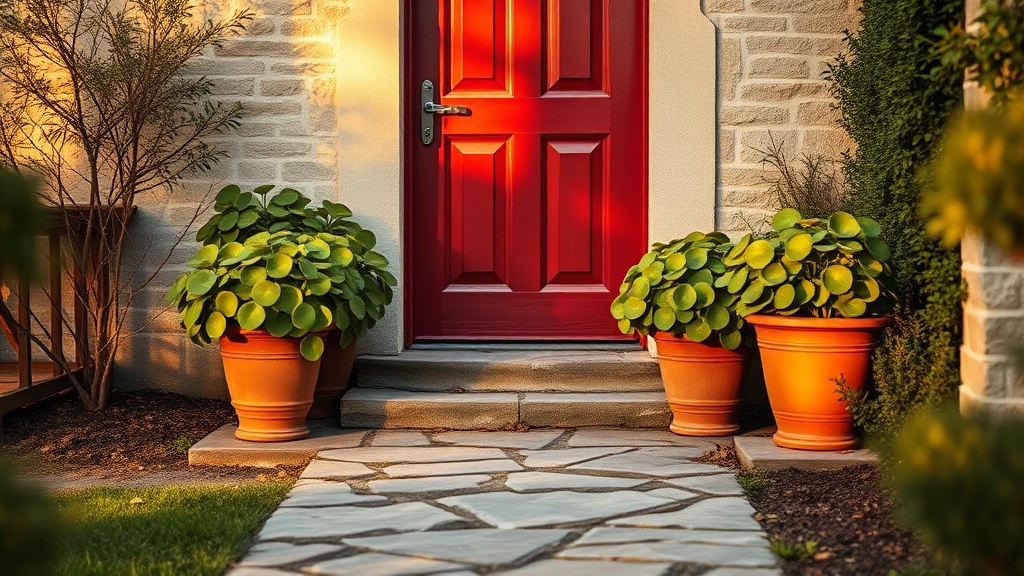
Your own entrance works on a smaller but analogous scale. The space directly in front of your door, whether it is a porch, a step, a path, or a landing, functions as a gathering zone for qi before it crosses the threshold. Keeping this area clean, proportionate, and welcoming is the first practical step.
Facing Direction and the Five Elements
One of the most practical tools in feng shui is the relationship between compass direction and the five-element system: Wood, Fire, Earth, Metal, and Water. Each direction is associated with one or two elements, and these associations inform color recommendations, material choices, and even the types of plants or objects that harmonize with a given door orientation.
| Facing Direction | Associated Element | Supportive Colors |
|---|---|---|
| South | Fire | Red, orange, strong yellow |
| North | Water | Black, dark blue, charcoal |
| East / Southeast | Wood | Green, teal, brown |
| West / Northwest | Metal | White, grey, silver, light gold |
| Northeast / Southwest | Earth | Terracotta, sandy beige, yellow-ochre |
The rationale behind color choices is not aesthetic preference alone. In the five-element cycle, each element either nourishes or diminishes the next. Choosing a color aligned with your door's direction is understood in feng shui tradition as reinforcing the native elemental energy of that sector. A south-facing door painted red, for instance, amplifies Fire energy, which is associated with visibility, warmth, and active engagement, qualities many practitioners find appropriate for an entrance that faces the midday sun.
If you are unsure of your door's facing direction, a simple compass reading from the exterior of your home (standing in the doorway, facing outward) will give you the orientation you need. Most smartphones include a reliable compass application.
💡 Did you know?
The Chinese character for "qi" (氣) is also used in Japanese as ki and in Korean as gi. The same character originally depicted rising steam above cooked rice, a vivid image of invisible vital force becoming perceptible. It appears in classical medical texts, martial arts manuals, and cosmological writings alike, pointing to a shared conceptual root across East Asian traditions.
The Condition of the Door Itself
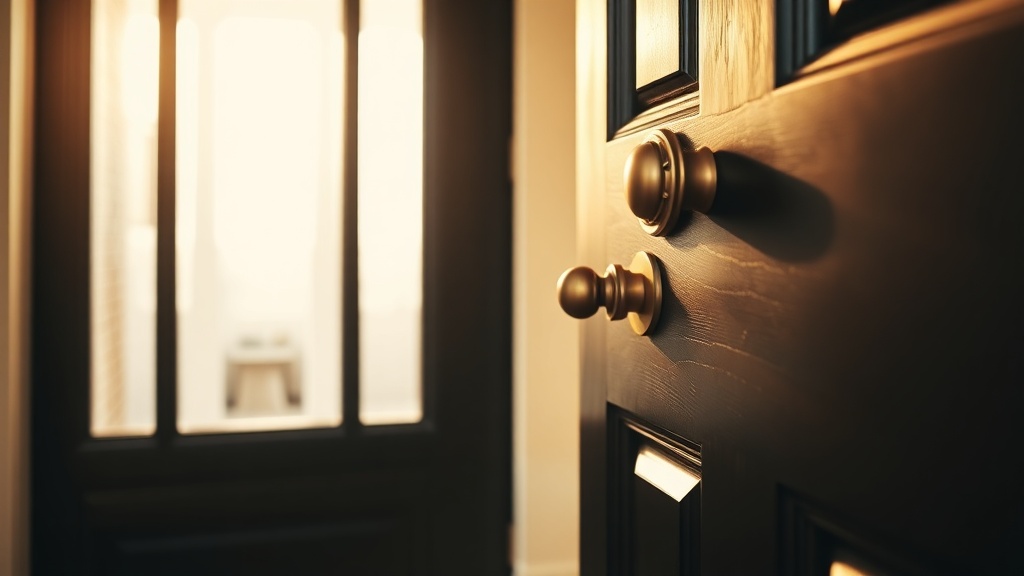
Before any symbolic adjustment, the physical state of the door carries the most immediate weight in feng shui practice. A door that sticks, creaks loudly, has peeling paint, or opens to a wall of accumulated shoes and coats is working against you regardless of its color or orientation.
The recommendations here are concrete:
- Hinges and hardware: A door should swing open fully and silently. Squeaking hinges are considered in feng shui to signal stagnation. Oil them.
- Paint and finish: Chipped or faded paint weakens the energetic presence of the door. A fresh coat, even in a neutral tone, restores its visual weight.
- Proportionality: Classical feng shui recommends that the front door be clearly the largest door on the façade, making it unmistakably the primary entrance. If a side door or garage door is more prominently used, practitioners suggest making a habit of using the front door regularly to reestablish its role.
- Lighting: The entrance should be well lit, both for practical safety and because light is considered an activator of yang energy, active, outward-moving, welcoming.
What to Place Near the Front Door, and What to Remove
Feng shui gives clear guidance on what kinds of objects support a healthy entrance and what creates interference. The underlying logic is consistent: anything that blocks, deflects, confuses, or overwhelms the entry of qi is problematic; anything that guides, slows, or gently accumulates it is beneficial.
Objects that support the entrance
- Plants with rounded leaves: In feng shui tradition, soft, rounded leaf shapes are considered more conducive to flowing qi than sharp, pointed ones. A jade plant, a lemon tree in a pot, or a simple round-leafed shrub flanking the door is a well-established recommendation.
- Water features: A small fountain placed to the left of the front door (as you stand facing out) is a classic feng shui adjustment. The left side corresponds to the Azure Dragon in classical geomancy, associated with incoming energy and opportunities. Moving water activates qi. It should flow toward the door, not away from it.
- Statues with protective or auspicious symbolism: Stone or resin guardian figures, lions, elephants, or tortoise forms, have been placed at entrances in Chinese, Tibetan, and Southeast Asian traditions for centuries. According to Buddhist and Taoist belief, these figures mark the threshold as a protected and considered space.
- A clean, clearly visible house number: Practical and symbolic, the address marks the identity of the dwelling and allows qi (and people) to find it.
What to remove or manage
- Shoes, bags, or clutter immediately inside the door, these obstruct the first interior space qi encounters.
- Dead or dying plants, in feng shui, decaying organic matter is considered a yin imbalance, pulling vitality downward.
- A mirror directly facing the front door, in traditional practice, this is thought to reflect qi back out before it can settle inside.
- A staircase that faces the front door directly and steeply, qi is thought to rush upward and dissipate. A landing, a plant, or a piece of art at the foot of the stairs can slow this movement.

🗂️ See the collection
Zen Fountains
A well-placed water feature near the entrance is one of the most grounded feng shui adjustments you can make.
30 références
Discover the collection →Elephant Statues and Guardian Figures at the Threshold
Among the most widely recognized feng shui objects for the front entrance is the elephant, a figure that carries deep significance across Buddhist, Hindu, and Taoist traditions. In Buddhist iconography, the elephant is connected to strength, stability, and the quality of upekkha (equanimity). White elephants in particular appear in the birth narratives of the historical Buddha, Siddhattha Gotama, making them a figure of both regal dignity and spiritual significance.
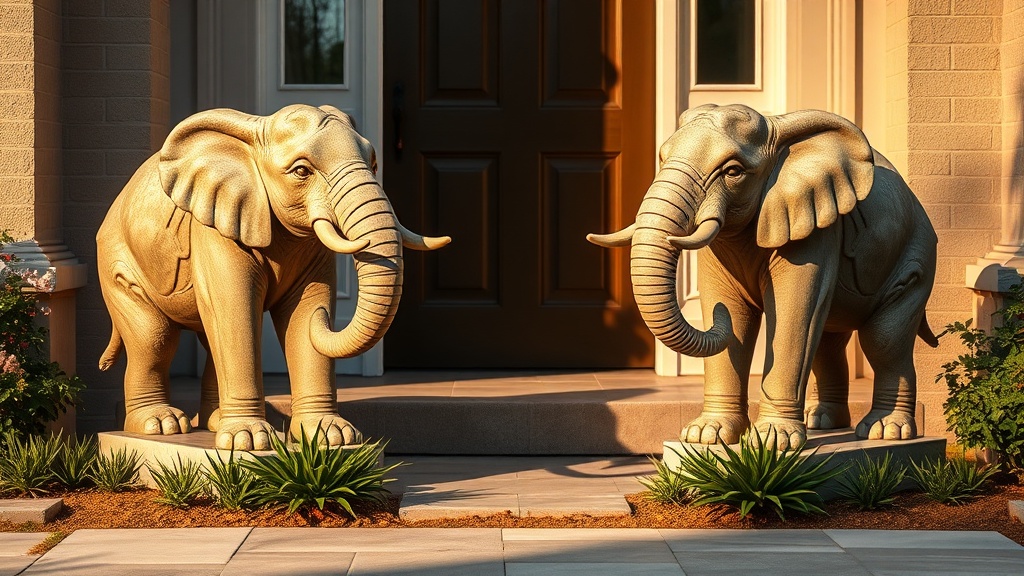
In feng shui practice, a pair of elephant figures placed at either side of the front door, with trunks raised, is a traditional symbol of protection and auspicious welcome. According to this tradition, the raised trunk is understood to represent an upward flow of positive energy. The material matters: stone-finish resin or terracotta forms harmonize with Earth element placements (northeast and southwest doors), while bronze-finish figures suit Metal-element directions (west and northwest).

🗂️ See the collection
Elephant Statues
From Ganesh figurines to classic feng shui elephant pairs, these pieces carry centuries of symbolic tradition to your entrance or garden.
22 références
Discover the collection →The Interior Entryway: What the Door Opens Onto
Feng shui does not stop at the threshold. The space immediately inside the front door, the foyer, hallway, or landing, is considered just as important as the exterior approach. This interior space functions as a transitional zone, a buffer between the outside world and the living environment.
Several principles apply consistently across classical and contemporary feng shui schools:
- The entryway should be visible and unobstructed. If the first thing a visitor encounters is a wall two feet in front of them, or a cluttered coat rack, the energy arriving through the door has nowhere to settle.
- Light and height matter. Low ceilings and dark foyers contract the energy of an entrance. A well-placed light source, whether natural or artificial, counteracts this. A mirror on a side wall (not directly facing the door) can open the perceived space.
- Scent is a recognized tool. In Buddhist temple practice, incense marks sacred thresholds. Bringing a considered scent, through a diffuser, fresh flowers, or natural incense, into the entryway is both a practical and traditional way to set the quality of a space as you cross into it.
"The gate of the temple is not the beginning of the temple. It is the beginning of the transition."
Traditional principle of sacred architecture, cited in studies of East Asian temple design
Making Adjustments That Actually Hold
One of the most common mistakes in applying feng shui principles to a front door is treating it as a one-time decoration project. Classical feng shui is a living practice, not a renovation checklist. The condition of your entrance changes with the seasons, with occupancy, with the wear that daily life brings to a threshold.
A practical approach involves a few recurring habits:
- Seasonal clearing: At each change of season, clear the exterior path to the door, refresh plants, and check the condition of hardware and paint. This is both practical maintenance and a way of renewing intention in a space.
- Regular cleaning of the threshold itself: In Taoist and Buddhist household traditions, the threshold, the strip of wood or metal at the base of the door, is considered a symbolic boundary. Keeping it clean and intact is a simple but consistent practice.
- Noticing what accumulates: Clutter at an entrance tends to reflect patterns in the rest of the home. If objects pile up at the door, it is worth asking whether the same tendency appears elsewhere, in unread mail, in deferred decisions, in the quality of the first room visitors step into.
The feng shui front door, considered carefully, is less about acquiring the right objects and more about maintaining a living relationship with the primary threshold of your home. The specific adjustments, color, orientation, guardian figures, water, are tools within a larger practice of spatial awareness that has its roots in Chinese cosmology and Buddhist-influenced design thinking across Asia.
Frequently Asked Questions
What is the best color for a feng shui front door?+
There is no single "best" color. According to feng shui tradition, the most supportive color depends on the compass direction your door faces and the five-element associations of that direction. South-facing doors are traditionally suited to red and orange (Fire element); north-facing doors to black or dark blue (Water element); east and southeast to green and brown (Wood); west and northwest to white, grey, or gold (Metal); northeast and southwest to earthy terracotta and ochre (Earth).
Should a feng shui front door always face south?+
South-facing doors are considered auspicious in many classical feng shui texts because they receive ample sunlight and face the warming yang direction in the Northern Hemisphere. However, feng shui does not hold that only south-facing doors are favorable. Each orientation carries its own elemental character and appropriate adjustments. The goal is alignment with the existing direction, not a renovation to change it.
Is it bad feng shui if my front door faces a staircase?+
A staircase that descends directly toward the front door is considered a challenging configuration in feng shui, because qi arriving through the door is thought to rush back up and disperse before settling in the home. Traditional remedies include placing a plant, a piece of artwork, or a decorative screen at the base of the stairs to slow and redirect the flow. A landing area, if space allows, also helps.
Can I place a mirror near the front door?+
A mirror placed directly opposite the front door is generally advised against in feng shui practice, as it is believed to reflect incoming qi back out through the entrance. A mirror on a side wall, where it opens the perceived space without facing the door, is considered neutral to beneficial, particularly in a narrow foyer where it adds a sense of depth and light.
Do elephant statues belong at the front door in feng shui?+
Elephant figures have been used as protective and auspicious entrance guardians in Chinese, Indian, and Southeast Asian traditions for centuries. In feng shui practice, a pair of elephants flanking the front door, with trunks raised, is a recognized symbol of steady, welcoming energy at the threshold. The raised trunk is associated in this tradition with an upward and outward gesture of abundance. The placement and material should be matched to the elemental direction of the door for best harmony.


