

Feng Shui Plants: Which Species to Choose and Where to Place Them
Plants have held a place in Chinese interior tradition for over two thousand years. Not as decoration, exactly, but as living participants in the flow of feng shui plants practice: a way of using natural growth, leaf shape, and color to influence how qi (vital energy) moves through a home. The classical texts don't rank species by popularity or aesthetics. They pay attention to direction, season, the five elements, and the specific quality of life force a plant brings into a space.
This guide cuts through the noise. You'll find which plants matter in the feng shui tradition, where they belong according to the bagua, and what to avoid placing in rooms where it can create stagnation rather than movement.
⭐ Key takeaways
- Feng shui plant selection is guided by the five elements (Wood, Fire, Earth, Metal, Water) and the bagua map.
- Rounded, upward-growing leaves generally support qi flow; sharp, downward-pointing leaves may interrupt it in sensitive areas.
- Placement matters more than species: even a "lucky" plant in the wrong sector can be counterproductive.
- Living, healthy plants strengthen a space; neglected, dying plants do the opposite.
- No plant species has scientifically verified feng shui effects. These placements reflect Chinese cosmological tradition and belief.
What Classical Feng Shui Actually Says About Plants
Feng shui (風水, literally "wind-water") is a system rooted in Taoist cosmology, developed and codified across several dynasties, most formally during the Tang and Song periods. Its core premise is that qi flows through built and natural environments in patterns that can be observed, adjusted, and harmonized with human activity.
Plants belong to the Wood element. In the five-element framework (*Wu Xing*), Wood is associated with growth, upward movement, spring, the east and southeast compass directions, and the color green. When you introduce a healthy plant into a space, you are, according to this tradition, actively feeding the Wood element and stimulating upward, outward momentum.
That's the principle. From it follow the practical choices: the type of growth the plant exhibits, the shape of its leaves, and whether it is thriving or struggling all affect the quality of qi it contributes. A robust, upward-reaching jade plant in the wealth corner reads differently from a drooping, yellowing pothos. One is considered an active presence; the other, stagnant wood energy.
💡 Did you know?
The earliest references to plants as energetic actors in domestic spaces appear in texts from the Han dynasty (206 BCE - 220 CE), where specific trees planted near the entrance of a house were described as indicators of family fortune. Peach and willow both appear repeatedly in these records, long before the formalized bagua system took its current shape.
The Bagua Map: Where Each Plant Belongs
The *bagua* (八卦, "eight trigrams") divides your home into nine sectors, each linked to a life area, a compass direction, an element, and a color palette. Plants fit into this grid not arbitrarily but according to elemental logic: they support sectors governed by Wood, activate sectors that benefit from Wood energy, and can overwhelm sectors where the dominant element needs restraint.
Here is how the nine sectors relate to feng shui plants placement:
| Bagua Sector | Life Area | Element | Plants: Support or Caution? |
|---|---|---|---|
| East | Family, health | Wood | Strong support. Lush green plants thrive here. |
| Southeast | Abundance, wealth | Wood | Strong support. Jade plant and money tree are traditional choices. |
| South | Reputation, clarity | Fire | Moderate support. Wood feeds Fire; good placement with restraint. |
| North | Career, path in life | Water | Use sparingly. Water feeds Wood, but too much Wood can drain Water here. |
| West | Creativity, children | Metal | Caution. Wood challenges Metal; avoid heavy plantings here. |
| Northwest | Helpful people, travel | Metal | Caution. Same logic as West; Metal and Wood conflict. |
| Northeast | Knowledge, wisdom | Earth | Mixed. Wood challenges Earth; keep plants small and grounded here. |
| Southwest | Relationships, love | Earth | Mixed. Same as Northeast; flowering plants may soften the conflict. |
| Center | Overall balance | Earth | Avoid large plants. Keep the center open and uncluttered. |
The Best Feng Shui Plants by Element and Purpose
Most feng shui plant guides focus on species names without explaining why those species appear. The reasoning behind each recommendation matters more than the list itself. Below, each plant is explained in terms of what it contributes to the five-element system, not just which room it supposedly improves.
Jade Plant (Crassula ovata)
The jade plant is the most widely cited feng shui plant in Chinese domestic tradition, particularly in Cantonese and Shanghainese households. Its leaves are round, thick, and a deep, saturated green, which in five-element terms represents stable, mature Wood energy rather than the fast, spindly growth of a vine. It belongs in the southeast sector (abundance area) or near the entrance to a home, where it is understood to invite incoming energy rather than exhaust the household's existing reserves.
Practically: jade plants thrive on neglect. They need little water, tolerate indirect light, and live for decades. In feng shui terms, a long-lived plant in a space is preferable to a fast-growing one that demands constant intervention. Brother Tenzin keeps a jade plant that is over twelve years old on a southeast-facing shelf. The plant has outlasted three apartments. That kind of continuity is, in itself, the point.
Lucky Bamboo (Dracaena sanderiana)
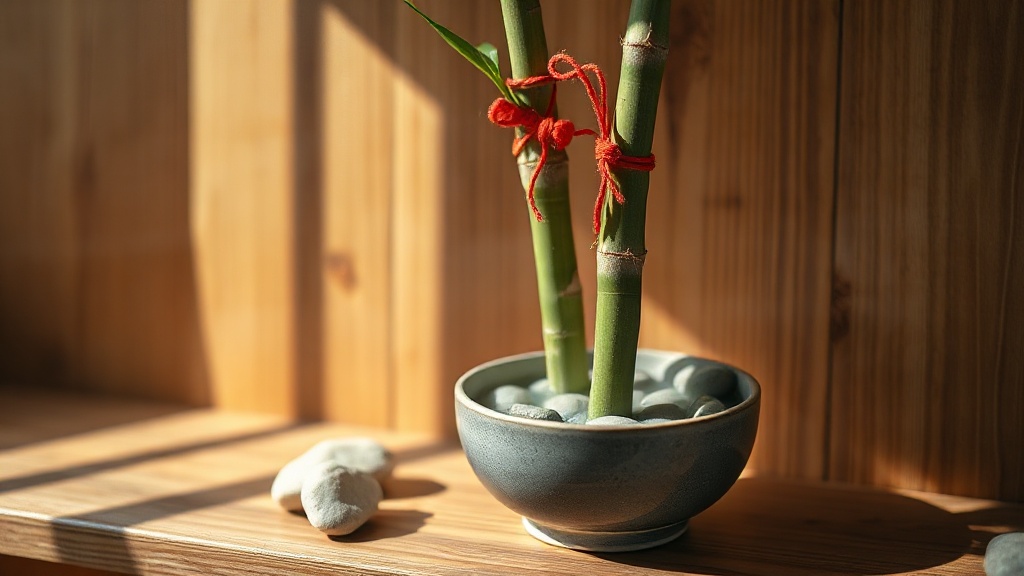
Strictly speaking, lucky bamboo is not bamboo at all. It belongs to the *Dracaena* genus and was popularized in East Asian feng shui markets in the late 20th century, though its symbolism draws on genuine associations between bamboo and resilience in classical Chinese culture. The plant's stalks grow upward without branching, which is read as an uninterrupted channel for qi movement.
The number of stalks carries meaning in this tradition: three stalks are associated with happiness, health, and longevity; five with the five elements themselves; eight with abundance (the word for eight, 八, sounds like the Cantonese word for prosperity). Avoid four stalks; four (四) shares its sound with death (死) in both Mandarin and Cantonese.
Money Tree (Pachira aquatica)
The money tree's braided trunk and palmate leaves make it one of the more distinctive houseplants in feng shui use. The braided form is a 20th-century horticultural invention, not a classical symbol, but its five-leaf clusters are interpreted through the lens of the *Wu Xing*: five leaves, five elements, balance. The plant belongs in the southeast sector and does best in indirect light with moderate watering.
Peace Lily (Spathiphyllum)
The peace lily is one of the few flowering indoor plants that thrives in low-light conditions, which makes it useful for north-facing rooms and interior hallways where other plants would struggle. In feng shui applications, its white blooms are associated with the Metal element: clarity, precision, cutting away the unnecessary. Some practitioners place it in the northwest or west sectors for precisely this reason, using the plant to introduce a light Metal quality rather than heavy structural objects.
One practical note: peace lilies are toxic to cats and dogs. If you share your home with animals, position this one carefully or substitute with a non-toxic alternative.
Snake Plant (Dracaena trifasciata, formerly Sansevieria)
The snake plant is a polarizing choice in feng shui discussions. Its upright, sword-like leaves are considered protective in some schools of thought: the sharp form is said to cut through stagnant or hostile energy near doorways. Other practitioners advise against it in bedrooms or relationship corners because the aggressive leaf shape is too activating for spaces meant to support rest or intimacy.
The practical resolution: snake plants work well near an entrance or in a home office, where stimulating energy is appropriate. Keep them out of the bedroom and away from the southwest sector (relationships).
Pothos (Epipremnum aureum)
Pothos is fast-growing, trailing, and nearly impossible to kill. Those qualities make it both appealing and worth examining carefully before placing it. Fast, downward-trailing growth can, in feng shui interpretation, pull energy toward the floor rather than lifting it. Hanging pothos in a stagnant corner (a dark hallway, a bathroom with poor ventilation) can help move sluggish qi. Placing it in the wealth or family sector, where you want stable upward growth, is a less considered choice.
If you love pothos, train it upward on a trellis or moss pole. Upward growth reads differently than trailing growth in this framework.
Orchids (Orchidaceae)
Orchids belong to the Wood element but carry a secondary association with the Fire element through their blooms. In traditional Chinese households, orchids are placed in living rooms and reception areas where guests are welcomed: the southwest sector of relationships or the south sector of reputation. They signal refinement and the care of living things. The challenge of keeping an orchid in continuous bloom is part of its message: attention, patience, and sustained effort.

🗂️ See the collection
Feng Shui Decor
Brother Tenzin recommends pairing every living plant with an elemental anchor. This collection brings together figurines, sculptures, and symbolic objects chosen for cultural grounding and craft quality, one for each sector of the bagua.
81 references
Browse the collection →Room-by-Room Feng Shui Plant Placement
The bagua gives you directional guidance. But most people orient their thinking by room first, then by direction. Here is a practical breakdown of both approaches together.
Entrance and Hallway
The entrance is where qi enters a home. Classical feng shui treats it as the mouth of the building: what it receives shapes what flows through the rest of the space. A healthy plant near the entrance is strongly supported in this tradition. Choose something robust and upright: a jade plant on a small table, a rubber tree (*Ficus elastica*) in a corner, or a potted bamboo palm if the space has height.
Avoid dead or dried plants anywhere near the entrance. A struggling plant at the threshold is considered a particularly unfavorable sign in Chinese domestic tradition.
Living Room
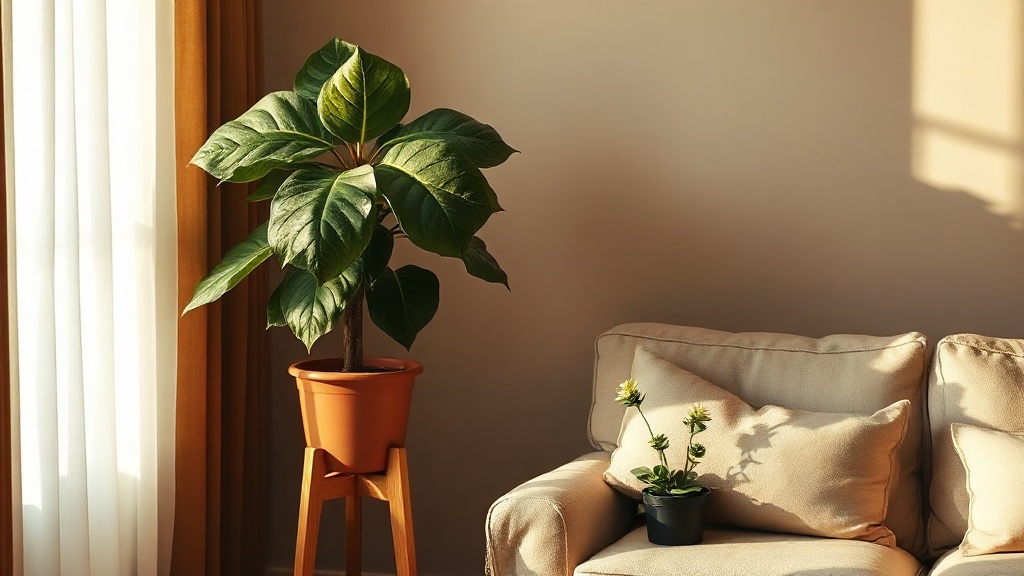
The living room is the most flexible space for indoor feng shui plant placement. It is generally a communal area where Wood energy supports gathering, conversation, and warmth. Large floor plants work well here: fiddle-leaf figs (*Ficus lyrata*), bird of paradise (*Strelitzia*), or a substantial peace lily. Place plants in corners to address stagnant areas where qi tends to pool and slow.
The southeast corner of the living room is the traditional location for plants associated with abundance. A healthy jade plant or money tree positioned there reflects the most direct application of bagua logic.
Kitchen
Kitchens in feng shui are already rich in Fire and Metal (from appliances, knives, and heat sources). Adding strong Wood energy through large plants can create an elemental imbalance. Small herb gardens on a windowsill are the most balanced approach: practical, living, and modest in scale. Avoid placing plants directly above the stove or too close to the sink, where the competing Water-Fire dynamic is already at play.
Bedroom
Feng shui guidance on bedroom plants is more cautious than popular wellness culture suggests. The bedroom is meant to support *yin* energy: rest, restoration, and stillness. Large, fast-growing plants introduce too much Wood activation. If you want greenery in a bedroom, keep it small. A single, compact plant (a small pothos in a pot, a succulent on a nightstand) is enough. Flowering plants in the southwest corner of a bedroom are considered supportive of the relationship sector, but only if the flowers are healthy and changed before they wilt.
Avoid placing any plant directly at the foot of the bed or above the headboard. Both positions are considered energetically disruptive to sleep quality in this tradition.
Bathroom
Bathrooms present a specific challenge: they are spaces of drainage, both literally and symbolically. Qi is considered to flow out through drains and open windows. Plants that thrive in high humidity (ferns, pothos, ZZ plant) work well here on a practical level and can help counteract the sense of energy loss. Keep the toilet lid closed, a recommendation that appears in both classical feng shui texts and in common-sense reasoning about hygiene and water conservation.
Home Office
A home office benefits from Wood energy, which in five-element theory supports focused upward growth, planning, and execution. Snake plants near the entrance to an office, or a robust money tree behind and to the left of the desk (from the seated position, this is the wealth position), are common feng shui arrangements. Keep the desk surface itself clear: plants on the immediate work surface can crowd the Metal and Earth qualities that support precision and follow-through.

🌱 Tenzin's pick
Ganesh Statue on Lotus - Golden 4-Arm Hindu Deity Figurine
Brother Tenzin recommends placing this golden Ganesh (the elephant-headed deity revered in Hindu tradition as the remover of obstacles) in the east or southeast sector alongside living plants. The resin casting has substantial weight and a warm gold finish that grounds the corner without overwhelming the green of the plants beside it.
À partir de 32.90 USD
View product →Plants to Avoid in Feng Shui Practice
The conversation about which plants to include tends to overshadow the equally practical question of which to avoid, or at least to place carefully. Feng shui is not prescriptive in the same way across all schools, but several categories of plants appear consistently as problematic.
Cacti and Spiny Succulents
Sharp points and spines are read as *sha qi* (cutting or attacking energy) in classical feng shui. This doesn't mean cacti are forbidden: they have a place near windows where external negative energy might enter, as protective plants. But placing a large cactus in a living area, relationship corner, or bedroom is generally discouraged. The energy is too pointed and inward-cutting for spaces meant to support connection or rest.
Dried or Artificial Plants
Dried plants are dead plants. In a system that values living qi, dried arrangements (no matter how aesthetically refined) represent stagnation. Artificial plants are also broadly discouraged: they carry no Wood energy because they are not living. Silk flowers in a vase are a compromise some practitioners accept, but the consensus in classical feng shui is that no plant is preferable to a fake one.
Large Trees in Small Rooms
Scale matters. A large fiddle-leaf fig in a small bedroom dominates the room's energy budget. Feng shui values proportionality: the plant should fit the space without overwhelming it. In a generously sized living room or studio, a large tree creates presence and upward movement. In a compact room, it crowds both the physical and energetic space.
⚠️ Worth noting
Several popular feng shui plants are toxic to pets or children: peace lily, pothos, snake plant, and many Dracaena varieties. Always verify the toxicity profile of any new plant before placing it in a home with animals or young children. This is a practical concern quite separate from any cosmological consideration.
Combining Plants with Feng Shui Objects
Plants rarely work in isolation in a well-considered feng shui arrangement. The tradition pairs living Wood energy with elemental objects: ceramic pots (Earth), copper or brass plant stands (Metal), or small water features nearby (Water feeding Wood). The goal is a coherent elemental conversation, not a single element dominating a sector.
In the southeast wealth corner, a common arrangement combines a feng shui decorative object with a healthy jade plant. The object anchors symbolic intention; the plant provides living Wood energy. Together they create a layered presence rather than a single-note visual statement.
The feng shui water fountain is another pairing that appears frequently in classical sources. Water feeds Wood in the five-element cycle, which means a small tabletop fountain placed near a healthy plant (particularly in the east or southeast) creates a natural elemental cycle. The sound of moving water also masks background noise, which has practical benefits for focus and rest regardless of one's relationship to feng shui as a system.

🌱 Tenzin's pick
Ganesh Statue Resin Bronze Finish - Handcrafted Hindu Elephant God Figurine
Brother Tenzin favors this bronze-finish Ganesh as an Earth-element anchor beside Wood-element plants, particularly at the entrance or in the northeast knowledge sector. Its warm, earthy tone complements terracotta pots and natural stone without competing with the greenery around it.
À partir de 28.90 USD
View product →Caring for Your Plants: The Most Overlooked Feng Shui Rule
Every school of feng shui agrees on one point: a dead or dying plant is worse than no plant at all. Withered leaves, dry soil, and drooping stems represent exhausted or stagnant Wood energy. They signal neglect, and in the logic of qi flow, what you model in your environment tends to reflect and reinforce what you carry internally.
This is not a spiritual claim. It is a perceptual one. Spaces with thriving plants feel different from spaces with struggling ones. The quality of attention you bring to living things in your environment generally says something about the quality of attention you bring elsewhere.
Practical rules for keeping feng shui plants genuinely alive:
- Remove dead or yellowing leaves immediately. Don't leave them on the plant or soil surface.
- Repot when rootbound. A plant that can't grow becomes visually and energetically static.
- Match the plant to its actual light conditions, not the light conditions you wish the space had.
- If a plant keeps dying in a particular spot, stop trying to force it. Choose a species suited to that environment, or accept that the spot doesn't support plant life and use an object instead.
- Dust large leaves regularly. A dusty fiddle-leaf fig is less able to process light, and less visually alive.
"He who tends his plants well, tends himself well."
Traditional Chinese proverb on domestic cultivation
A Note on How to Read Feng Shui Plant Guidance
Feng shui is a cosmological and philosophical system with a long, internally consistent history. It is not a branch of botany, and its claims about how plants affect human experience are rooted in tradition and belief rather than scientific study. The bagua is a symbolic map, not a floor plan. The five-element cycle is a philosophical framework, not a chemistry textbook.
That said, many of its practical recommendations align with what makes spaces feel ordered, alive, and well-maintained: healthy plants at the entrance, proportionate greenery in living areas, no clutter of dead or artificial matter, attention to scale and light. Whether or not you accept the metaphysical premises, the design sensibility behind feng shui plant placement principles tends toward livable, considered spaces.
If you are building a broader arrangement that includes symbolic objects alongside your plants, the feng shui collection brings together figurines, decorative pieces, and elemental objects chosen for craft quality and cultural grounding. And for those whose interest extends into Buddhist contemplative traditions that overlap with feng shui's East Asian roots, the Zen decor collection offers a complementary range of pieces for meditation rooms and home altars.
Frequently asked questions about feng shui plants
Which plant is best for the southeast wealth corner?+
The jade plant (Crassula ovata) is the most consistently recommended species for this sector across multiple schools of feng shui. Its rounded leaves, deep green color, and slow, stable growth are interpreted as mature Wood energy that aligns with the abundance-building character of the southeast sector. The money tree (Pachira aquatica) is a close second. Both require indirect light and minimal watering, which makes them practical choices regardless of your relationship to feng shui principles.
How many lucky bamboo stalks should I use?+
The number of stalks in a lucky bamboo arrangement carries specific symbolic meaning in Chinese tradition. Three stalks are associated with happiness, health, and longevity. Five stalks represent the five elements and overall balance. Eight stalks are associated with abundance (the Cantonese word for eight sounds like the word for prosperity). Avoid four stalks entirely: the word for four in both Mandarin and Cantonese sounds like the word for death, making it an inauspicious choice. Two stalks are sometimes given as a symbol of partnership, though they appear less often in classical sources than the groupings above.
Are artificial plants acceptable in feng shui?+
Most classical feng shui guidance discourages artificial plants because they carry no living Wood energy. A high-quality silk plant may be visually similar to a living one, but within the five-element framework it contributes nothing to qi flow. If maintaining a living plant in a particular space isn't practical (low light, high traffic, irregular watering habits), choose a genuinely low-maintenance species like a ZZ plant or snake plant rather than substituting with an artificial one.
Can I put plants in the bedroom according to feng shui?+
Yes, but with restraint. The bedroom is a yin space in feng shui terms, meant to support rest and restoration. Large, fast-growing plants introduce too much active Wood energy for this environment. Small, compact plants (a single succulent, a small pothos in a modest pot) are generally considered appropriate. Avoid plants at the foot of the bed or directly above the headboard. If you want to support the relationship sector (southwest corner of the bedroom), small flowering plants are a traditional choice, provided the blooms are fresh and changed before they wilt.
Why are cacti sometimes discouraged in feng shui?+
The spines and sharp points of cacti are associated with sha qi in classical feng shui: a form of cutting or attacking energy that disrupts smooth qi flow. This doesn't make cacti universally forbidden. Near windows or exterior walls, they are sometimes placed as protective barriers against external sha qi. The concern is with placing them in areas meant to support connection, rest, or steady growth, where the pointed energy is considered counterproductive.
How does lucky bamboo differ from real bamboo in feng shui use?+
Lucky bamboo (Dracaena sanderiana) is botanically unrelated to true bamboo. It was marketed under that name in East Asian export markets beginning in the mid-20th century, borrowing the cultural symbolism associated with bamboo's resilience and upright growth. In feng shui practice, the number of stalks carries the primary symbolic meaning: three for happiness, health, longevity; five for the five elements; eight for abundance. Real bamboo (*Bambusoideae*), where climate allows, carries similar associations and is used in garden feng shui to mark boundaries and direct wind.


