

Laughing Buddha Placement: Where to Put Him and Why It Matters
Walk into almost any Chinese restaurant, a Chinatown gift shop, or a feng shui practitioner's home, and you will almost certainly find him: a round, laughing figure with a bare belly and a sack slung over one shoulder. In the West, he is almost universally called the Laughing Buddha. The question most people ask next is a practical one, where does he go?
The answer involves a little history, a fair amount of feng shui logic, and a handful of firmly held traditions that vary by region and household. None of it is arbitrary. Every placement recommendation for the Laughing Buddha traces back to a specific symbolic reading of the figure and the space around him. Understanding the reasoning makes the difference between placing him thoughtfully and simply finding a spot on the shelf.
⭐ À retenir
- The Laughing Buddha is not the historical Buddha, he is Budai, a 10th-century Chinese monk celebrated for his generosity and contentment.
- In feng shui, placement direction and room function both matter: the entrance and the southeast are the most recommended positions.
- He should be placed at eye level or above, never on the floor or in bathrooms.
- Different postures carry different symbolic meanings, seated, standing, with children, or holding a bowl each represent a distinct quality.
- The same figure can serve as a Buddhist folk icon, a feng shui symbol, or simply a meaningful piece of decor, depending on the household's intent.
Budai, Not the Buddha: A Clarification Worth Making
The Laughing Buddha is almost always identified with Budai (also spelled Pu-Tai), a wandering Chinese monk said to have lived during the Later Liang dynasty around the 10th century CE. Historical records describe him as an eccentric figure who traveled from village to village carrying a cloth sack filled with candy and small gifts for children. He was known for his patience, his generosity, and his seemingly inexhaustible good humor.
Over centuries, Budai became associated in Chan (Zen) Buddhism with the ideal of the bodhisattva Maitreya, the future Buddha. His rotund belly is not gluttony but a classical symbol of contentment and abundance in Chinese folk iconography. His sack represents the capacity to hold the world's suffering and transform it.
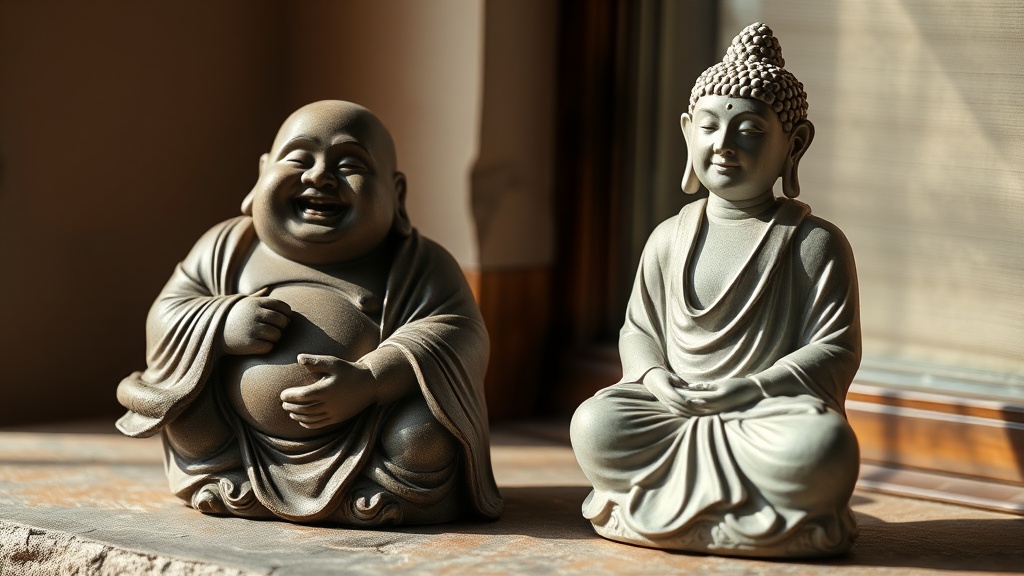
He is emphatically not Siddhartha Gautama, the historical Buddha who lived in northern India around the 5th century BCE and whose representations show an altogether different figure, serene, often thin from ascetic practice, with elongated earlobes and a ushnisha (the raised crown of the head). Confusing the two is extremely common in the West, but worth correcting before placing either figure in your home.
💡 Did you know?
In some Chan Buddhist monasteries in China, a statue of Budai is traditionally placed at the entrance of the main hall, facing the gate. This positions him as the first figure a visitor encounters, welcoming arrivals before they proceed deeper into the sacred space. The practice has a direct parallel in the feng shui household tradition of placing him near the front door.
The Entrance: The Most Recommended Placement
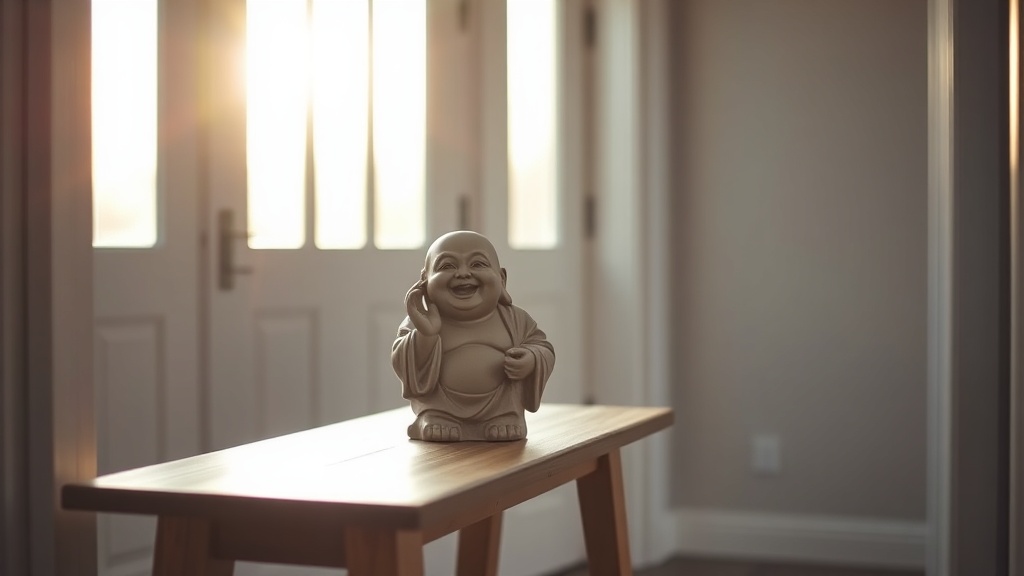
In feng shui tradition, the main entrance of a home is where qi (vital energy) enters the building. The entrance hall sets the tone for the entire dwelling. Placing a Laughing Buddha figure near the front door, positioned so that he faces the door, welcoming what comes in, is the single most consistently recommended placement across Chinese and Southeast Asian household traditions.
The specific guidance is usually to place him roughly 30 inches (about 76 cm) above the floor, on a console table, shelf, or dedicated altar stand. He should face the entrance directly, not a wall. The reasoning is symbolic: Budai greets whatever enters the home, visitors, energy, the day itself, with openness and good humor.
A common variation in Chinese-American homes is to place him slightly to the right or left of the door rather than directly opposite it, particularly in smaller entryways where a figure directly facing the door might feel confrontational rather than welcoming. The key principle is sightline: from the doorway, you should see him.
Room by Room: A Practical Guide to Each Space
The Living Room
The living room is the most flexible space for Laughing Buddha placement. A figure placed on the main shelf, sideboard, or mantelpiece of a living room is considered appropriate in most traditions. The preference is for the diagonal corner from the main entrance, this is typically the "wealth corner" in feng shui's bagua map, associated with abundance and stability.
In the living room, a larger, more prominent figure is entirely appropriate. This is the room where guests gather, where daily family life unfolds, and where a figure of Budai functions as both decor and a kind of ambient statement about the household's values.
The Home Office or Study
A Laughing Buddha placed in a home office or study is associated in Chinese folk tradition with professional contentment and the patience required for sustained work. The recommended position here is on the desk itself, or on a shelf behind and slightly to the right of the primary working seat, placed so that he is visible during the workday but does not obstruct the workspace.
The Dining Room
Some Chinese household traditions place Budai in the dining room, particularly on a sideboard or buffet table. The dining table is, in many East Asian household traditions, the symbolic center of family life and material provision. A figure of Budai here is read as an expression of gratitude for shared meals and household warmth.
The Bedroom
This is where traditions diverge. Many feng shui practitioners advise against placing a Laughing Buddha in the bedroom, particularly facing the bed. The reasoning is that the bedroom is a private, restorative space, and decorative or symbolic figures that carry "active energy" are better suited to shared, public rooms. Others consider a small seated Budai on a bedside table entirely appropriate, especially if the figure is in a calm, meditative pose. If you do place him in the bedroom, avoid positioning him so that he is directly facing your sleeping position.
Spaces to Avoid
There is broad consensus across Chinese, Southeast Asian, and feng shui traditions on spaces where a Laughing Buddha figure should not be placed. These include bathrooms and toilets, the kitchen floor or near cooking surfaces, and any location on the floor where he might be stepped over or stepped on. The consistent underlying principle is one of basic respect for a figure that, whatever its decorative or ornamental use, carries substantial cultural and spiritual weight in its traditions of origin.
| Room / Space | Recommended? | Best Position |
|---|---|---|
| Entrance / Hallway | ✅ Highly recommended | Facing the front door, ~30 in. above floor |
| Living Room | ✅ Recommended | Diagonal corner from door, on a shelf or sideboard |
| Home Office | ✅ Appropriate | On desk or shelf, visible during work |
| Dining Room | ✅ Appropriate | On sideboard or buffet table |
| Bedroom | ⚠️ Mixed opinions | Bedside shelf, not facing bed directly |
| Bathroom / Kitchen floor | ❌ Not recommended | , |
Directions and the Feng Shui Bagua
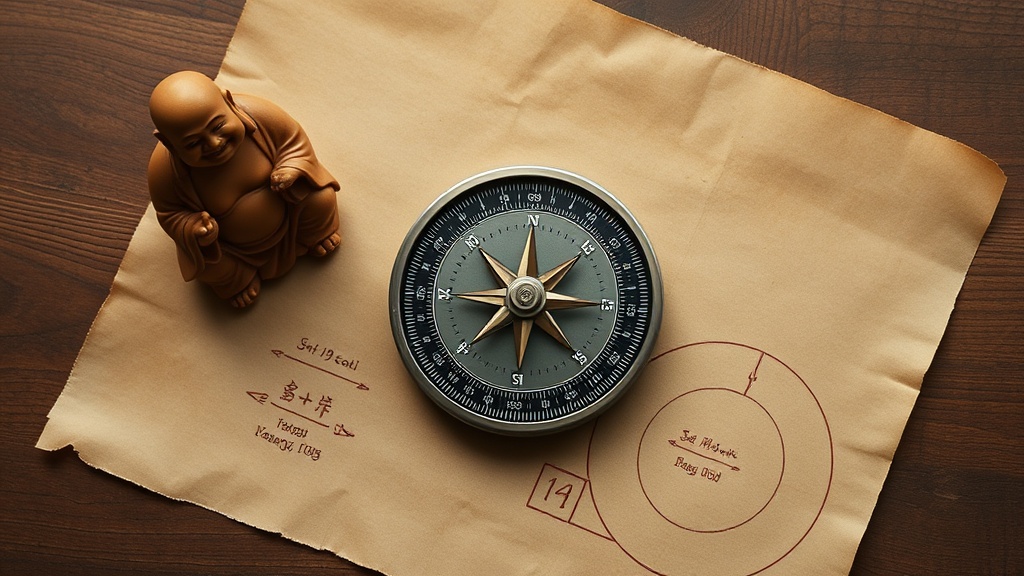
Beyond which room, feng shui practitioners often speak about compass directions when advising on Laughing Buddha placement. The southeast sector of a home or room is associated in the bagua system with material wealth and abundance, making it a commonly cited position for Budai. The east sector is associated with family and health. The north is associated with career and life path.
The directional guidance assumes you have taken a proper compass reading from the center of your home, which is the standard method in Classical feng shui. Using a smartphone compass app can give you a reasonable approximation, though traditional practitioners use a Chinese luo pan (a multi-ring feng shui compass) for greater precision.
It is worth noting that directional feng shui advice can vary considerably between the Black Hat Sect school (which orients the bagua from the front door rather than compass north) and Classical or Flying Stars schools. If you are working with a practitioner from a specific school, follow their directional guidance rather than mixing systems.
Reading the Posture: What Each Form Represents
Not all Laughing Buddha figures are the same. The posture and attributes of the figure carry distinct symbolic meanings that can inform which placement makes most sense for your intentions.
- Seated Budai with hands raised: The most common form. Associated in Chinese folk tradition with contentment and receiving. Well suited to the entrance or living room.
- Standing Budai with sack over shoulder: The traveling monk, generosity in motion. A good choice for home offices or entryways, where the sense of active movement suits the symbolic function.
- Budai with children around him: A figure closely associated with family life and the joy of the household. Traditionally placed in the living room or dining area.
- Budai holding a bowl: This posture carries a closer association with Buddhist mendicant practice, the bowl is the monk's begging bowl, a symbol of simplicity and acceptance. Often placed on home altars or meditation spaces.
- Budai with a gold ingot or coins: A version more explicitly tied to Chinese folk beliefs about material abundance. Common in businesses and commercial spaces.
"Budai carries his sack wherever he goes. The sack is never full, and it is never empty."
Traditional Chan Buddhist saying, origin uncertain

🗂️ Explore the collection
Buddhist Decor
Laughing Buddha figurines, statues, and altar pieces chosen for craft quality and cultural grounding, ready to place with intention.
57 références
Discover the category →Business Spaces and the Commercial Tradition
The Laughing Buddha is perhaps even more common in commercial spaces than in homes. In Chinese business culture, a figure of Budai near the cash register, at the reception of an office, or in a restaurant's main dining area is a longstanding tradition. The placement logic mirrors the residential one: he faces the entrance, welcoming customers and the day's business.
In some Southeast Asian countries, particularly Thailand and Vietnam, it is customary to place a small Budai figure on a dedicated shelf with offerings, incense, fresh fruit, a small cup of water, as part of daily practice. This moves the figure from pure decor into something closer to a household shrine. Whether you maintain that level of engagement is a personal decision, but it is worth knowing that the tradition exists and that many practitioners consider it the most respectful way to keep such a figure in a home or business.

🗂️ Explore the collection
Feng Shui Decor
From Laughing Buddha figurines to golden elephant statues, pieces selected for craft quality and grounded in Chinese cosmological tradition.
81 références
Discover the category →Rubbing the Belly: Ritual Gesture or Tourist Habit?
The gesture of rubbing Budai's belly is widely cited as a tradition that brings contentment or good fortune. Its origins are murky, it does not appear in canonical Buddhist texts, and scholars of Chinese folk religion are divided on how old the practice actually is. What is clear is that it is deeply embedded in popular Chinese folk culture and in the overseas Chinese communities that have carried these traditions to Southeast Asia, the Americas, and beyond.
Whether you engage with this practice or not, it is worth treating it with the same matter-of-fact respect you would extend to any folk religious gesture: it means something specific within its tradition of origin, and that meaning deserves more acknowledgment than a casual tourist interaction. If you keep a Laughing Buddha in your home, treating the figure with basic physical respect, keeping it clean, keeping it placed at an appropriate height, not storing it behind clutter, reflects a reasonable baseline of care regardless of your personal beliefs.
Questions fréquentes
Is it disrespectful to keep a Laughing Buddha as home decor if I'm not Buddhist?+
The Laughing Buddha (Budai) is primarily a figure of Chinese folk religion and feng shui tradition, not strictly a Buddhist devotional object. Keeping him as home decor is a common and widely accepted practice across many cultures. Basic respect, placing him at an appropriate height, keeping him clean, and understanding who he represents, is all that is reasonably expected.
Which direction should the Laughing Buddha face?+
The most consistent recommendation is that he faces the main entrance of whatever room or building he is placed in, usually the front door of the home. In a living room without a direct sightline to the entrance, facing inward toward the center of the room is generally considered appropriate.
Can I place a Laughing Buddha in the bedroom?+
Opinions vary. Many feng shui practitioners prefer to keep Budai in shared, public-facing spaces (entrance, living room, office) rather than private resting spaces. If you do place him in the bedroom, a small figure on a shelf is preferable to a large one facing the bed directly.
Does the size of the Laughing Buddha statue matter?+
Size affects visual presence and practical suitability for a given space, but there is no canonical teaching that ties larger figures to greater symbolic weight. A small, well-crafted figure placed thoughtfully is always preferable to a large one that feels out of scale or poorly positioned.
Is the Laughing Buddha the same as the Buddha of Buddhism?+
No. The Laughing Buddha is Budai, a Chinese folk figure from around the 10th century CE, identified in some Chan Buddhist traditions with Maitreya (the future Buddha). The historical Buddha, Siddhartha Gautama, is depicted very differently, typically slim, serene, with specific iconographic features like elongated earlobes and the ushnisha crown.


