

Lucky Bamboo and Feng Shui: What It Actually Means and How to Place It
Lucky bamboo feng shui is one of those topics where the gap between what people think they know and what the tradition actually says is surprisingly wide. Most households in the West have at some point owned one of those spiral-stalked plants in a glass vase. Far fewer people know that the number of stalks they chose carries specific symbolic weight, or that placing one in the wrong room can, according to classical feng shui thinking, counteract the very effect they were hoping for.
This guide works through the tradition carefully: where lucky bamboo comes from, why it entered feng shui practice, what stalk counts mean, how to position the plant according to the bagua map, and how to keep it alive. No shortcuts, no vague promises about "positive energy."
⭐ Key points
- Lucky bamboo is not true bamboo. It is Dracaena sanderiana, a Central African plant adopted into Chinese feng shui practice in the 20th century.
- Stalk count changes the symbolic meaning entirely: three stalks relate to prosperity and longevity, while four stalks are traditionally avoided.
- Placement follows the bagua map: southeast for wealth, east for health, north for career, south for reputation.
- Water quality and indirect light matter more than any symbolic arrangement if you want the plant to actually survive.
- According to Chinese tradition, a healthy, green plant carries good symbolic weight. A yellowing or dying one is considered inauspicious.
What Lucky Bamboo Actually Is (and Where It Comes From)
Dracaena sanderiana is native to Central and West Africa. It was first classified by the German-British horticulturist Henry Frederick Conrad Sander in the late 19th century. Its common name, "lucky bamboo," reflects its appearance: hollow-seeming green canes with leaf joints that strongly resemble bamboo. Botanically, however, it belongs to the Asparagaceae family and is closer to asparagus than to any grass.
The plant began appearing in Chinese and Taiwanese markets in significant quantities from the 1980s onward, exported primarily through Southeast Asia. Its hollow-cane silhouette fitted neatly into an existing cultural language around bamboo, which holds one of the most durable symbolic positions in Chinese art, literature, and cosmology. Real bamboo (Phyllostachys and related genera) represents resilience, flexibility under pressure, and uprightness. Dracaena sanderiana borrowed this symbolic currency while offering the practical advantage of growing easily in plain water indoors.
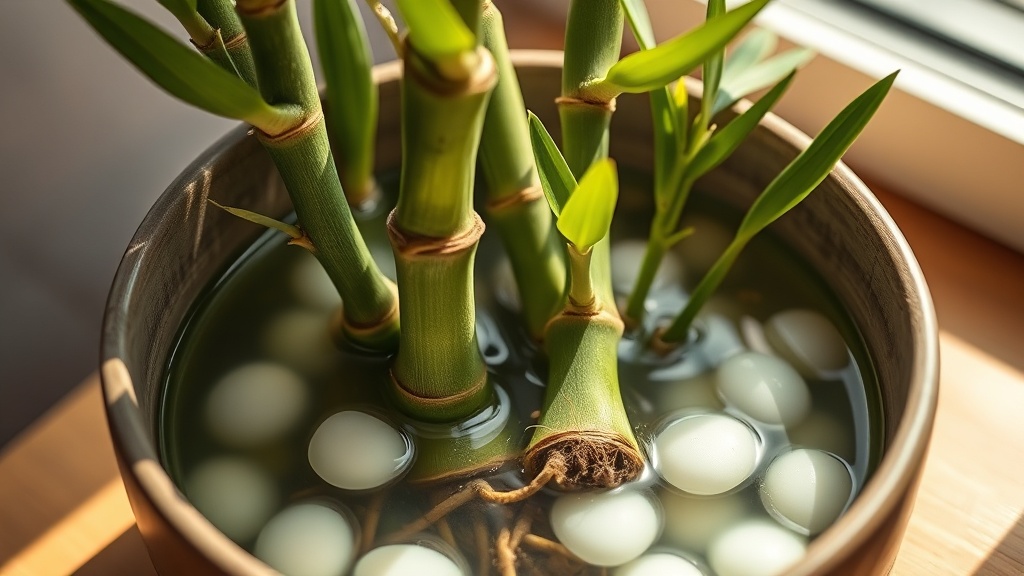
💡 Did you know?
Bamboo appears in one of the oldest Chinese texts on symbolic plants, the Hua Jing (Classic of Flowers), compiled during the Tang Dynasty. It is listed among the "Four Gentlemen" of traditional painting alongside plum blossom, orchid, and chrysanthemum, each representing a virtuous character trait. Lucky bamboo carries this inherited symbolism, even though it is a completely different species.
Feng Shui Foundations: Why Bamboo Fits the System
Classical feng shui is a system for arranging space in relation to qi, the vital energy described in Taoist cosmology. The tradition draws on several frameworks simultaneously: the five elements (wood, fire, earth, metal, water), the bagua (an octagonal map of life areas), yin and yang dynamics, and directional correspondence. Any object placed in a space is read within this framework.
Bamboo belongs unambiguously to the Wood element. In five-element theory, Wood governs growth, expansion, upward movement, and new beginnings. It corresponds to the east and southeast directions on the bagua map. East relates to health, family, and long-term vitality; southeast relates to wealth and material abundance. Placing a Wood element plant in either of these sectors reinforces the qi associated with those life areas, according to classical feng shui logic.
Water, the growing medium for lucky bamboo, feeds Wood in the five-element generative cycle (water nourishes wood). A bamboo arrangement grown in water therefore carries two compatible elements simultaneously, which is why feng shui practitioners generally consider it a particularly coherent symbolic choice rather than an arbitrary decorative one.
The Meaning of Stalk Count: A Precise Symbolic Language
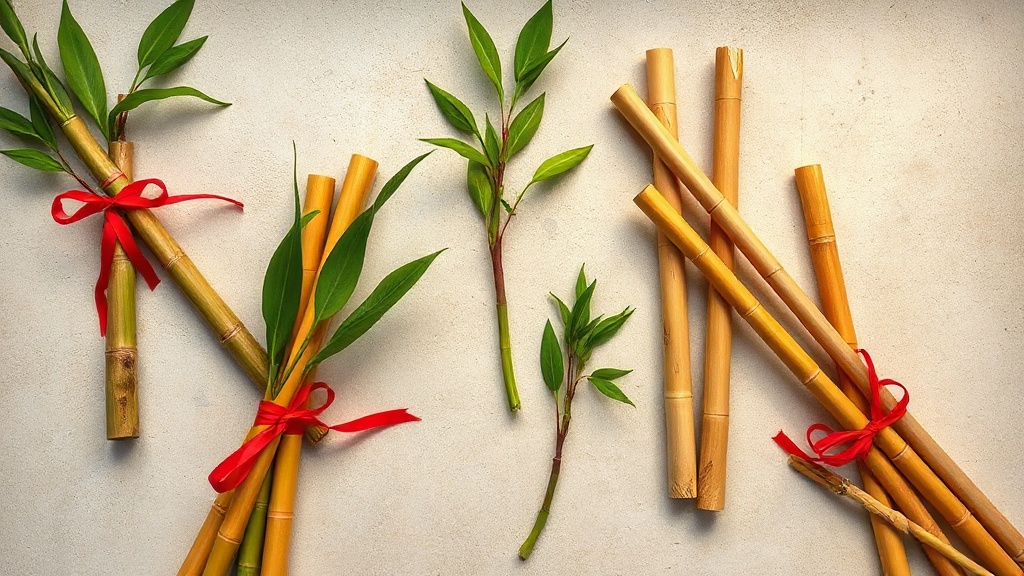
Choosing the number of stalks in a lucky bamboo feng shui arrangement is not decorative guesswork. Each count carries a specific meaning rooted in Chinese numerology, where numbers carry cosmological weight rather than being arithmetically neutral.
| Stalk count | Traditional meaning | Recommended placement |
|---|---|---|
| 1 stalk | Truth, clarity, simplicity | Study, meditation space |
| 2 stalks | Love, partnership, good fortune between two people | Bedroom, relationship corner (southwest) |
| 3 stalks | Happiness, longevity, prosperity (the three gifts) | Living room, east or southeast sector |
| 4 stalks | Traditionally avoided - the word for "four" (四, sì) is a near-homophone of the word for "death" (死, sǐ) in Mandarin | Not recommended in Chinese tradition |
| 5 stalks | The five elements in balance; health and wholeness | Health and family area (east) |
| 6 stalks | Luck and prosperity flowing smoothly | Wealth corner (southeast) |
| 7 stalks | Good health; togetherness in relationships | Living room or bedroom |
| 8 stalks | Prosperity and abundance (eight is considered the most auspicious number in Chinese culture, in part because the Cantonese pronunciation of eight, baat, sounds like the word for "to prosper") | Business space, office, southeast sector |
| 9 stalks | Great luck; completeness | Any central area of the home |
| 21 stalks | Powerful blessing across all life areas | Entrance hall, main receiving room |
Four stalks are the clearest example of how numerological sensitivity operates in Chinese culture. The avoidance of four is widespread enough to have its own term, tetraphobia, and it shapes everything from building floor numbering in Taiwan, Hong Kong, and mainland China to gift-giving conventions. Giving someone a four-stalk bamboo arrangement in a traditional Chinese household is considered deeply inauspicious. The same sensitivity extends to hospital room numbers, car license plates, and phone numbers across much of East and Southeast Asia, which illustrates how deeply embedded this layer of meaning is in daily life.
Placement by Bagua: Matching the Plant to the Room
The bagua map divides any floor plan into eight sectors plus a central area, each corresponding to a life area and a compass direction. Aligning furniture and objects with the bagua is the core spatial practice of feng shui. Feng shui lucky bamboo placement follows the same logic.
To apply the bagua to your home, stand at the main entrance facing inward. The sector directly in front of you and slightly left is traditionally north, associated with career and life path. The far left (from the entrance perspective) corresponds to wealth and abundance. Far right corresponds to relationships. The specific coordinates vary between the Black Hat Tantric (BTB) school, which uses the entrance orientation, and classical Form and Compass school, which uses true compass directions. Both are legitimate interpretive frameworks with long histories of practice.
- East sector (health, family): A 5-stalk or 3-stalk arrangement. The Wood element is at home here, reinforcing vitality and family cohesion.
- Southeast sector (wealth, abundance): Six or eight stalks in this corner is the most commonly cited lucky bamboo feng shui placement for material prosperity. According to tradition, this amplifies the Wood-feeding-wealth dynamic.
- North sector (career, life path): Water element governs the north. Since lucky bamboo grows in water, it carries natural correspondence here. Three or one stalk works well.
- South sector (fame, reputation): The south is governed by Fire, which is weakened by Wood in the five-element destructive cycle. Some practitioners avoid bamboo here; others argue the vitality of a healthy plant overrides this concern.
- Southwest sector (relationships, partnership): Two stalks, representing paired harmony. A common gift for couples.
Rooms to Avoid and Why
Feng shui tradition is consistent on a few placements to sidestep. The bathroom sits at the top of the list. Water flow in the bathroom is considered draining rather than nurturing in classical feng shui; placing a prosperity symbol here is thought to symbolically flush away the qi it carries. The kitchen involves Fire energy at the cooking area, which conflicts with Wood.
Bedrooms are a nuanced case. Some practitioners place two-stalk arrangements in the southwest bedroom corner for relationship energy. However, any fast-growing, actively vital plant introduces yang energy, which can interfere with the yin, restful quality a bedroom ideally maintains. A single small stalk in still water is more appropriate here than a large spiraling multi-stalk arrangement.
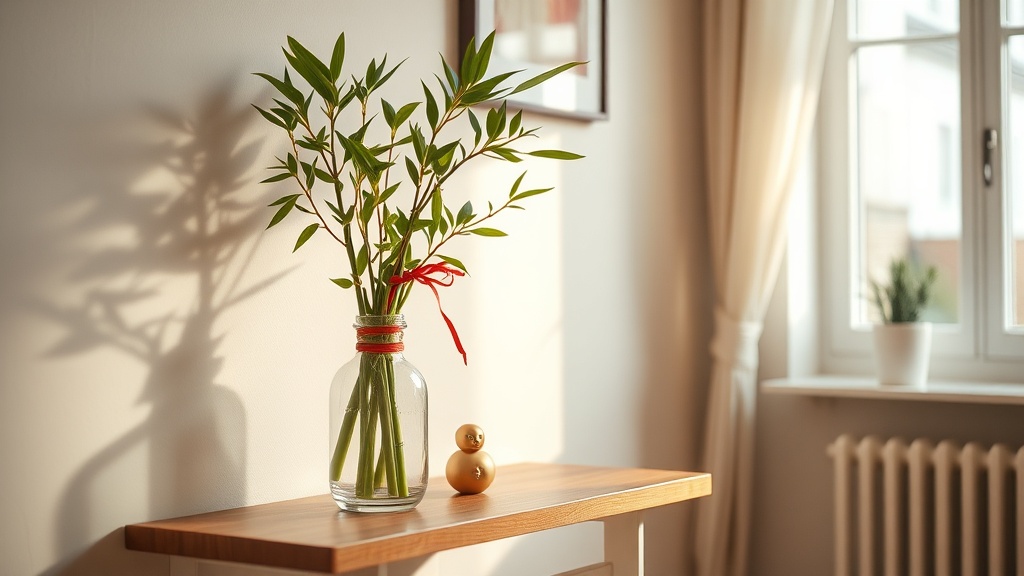
Placing lucky bamboo directly on the floor is generally discouraged, not for mystical reasons but because floor-level positioning in feng shui often signals stagnant or low energy. A shelf, console table, or dedicated stand keeps the arrangement at a height that reads as active and cared-for.

🗂️ Explore the collection
Feng Shui Decor
Complement your lucky bamboo arrangement with statues, figurines, and symbols chosen for cultural grounding and craft quality.
81 references
Browse the collection →Container, Water, and Light: The Physical Conditions That Actually Determine Success
A feng shui lucky bamboo arrangement that sits yellowing in a dark corner carries none of its intended symbolic weight. Traditional feng shui is explicit on this point: a dead or dying plant is considered inauspicious. The health of the plant is inseparable from the symbolic function it is meant to serve.
Water is the growing medium of choice. Lucky bamboo grown in water rather than soil requires less maintenance but more precision. Use filtered water or let tap water sit uncovered for 24 hours before use, which allows chlorine to dissipate. Change the water every seven to ten days. Fluoride accumulates in the roots over time and causes tip browning, a common problem that most people misdiagnose as underwatering.
Light requirements are specific. Lucky bamboo tolerates low light better than most houseplants, but it grows most vigorously in bright, indirect light. Direct sun bleaches the leaves yellow within days. A north-facing windowsill or a position several feet from an east-facing window covers the plant's needs without scorching it.
Container choice carries symbolic and practical weight simultaneously. Red and gold containers are traditional in Chinese feng shui, as red is associated with yang energy and vitality, while gold corresponds to wealth. Ceramic and glazed pottery work well. Clear glass is popular in contemporary interiors and allows you to monitor root health directly, which is a practical advantage. Avoid metal containers if following five-element logic strictly, since metal is destructive to wood in the generative cycle.

🌱 Tenzin's pick
Laughing Buddha Statue Resin Hand-Painted 4.7"
Budai, the rotund figure known in the West as the "Laughing Buddha," is a Chinese folkloric figure associated with contentment and generosity. In Chinese folk tradition, placing a Budai figurine near a lucky bamboo arrangement is a common pairing for the southeast wealth corner. Note that Budai is a figure from Chinese folk religion, distinct from the historical Shakyamuni Buddha of Buddhist tradition.
29.90 USD
View product →Spiral Bamboo: The Shaped Stalks and What They Represent
The spiraling, curled stalks sold widely in florist shops and garden centers are not a natural growth form. They are produced by rotating the plants under directional light over a period of weeks to months, using phototropism (the plant's tendency to grow toward light) to bend the stalk in controlled curves. The result is entirely artificial, but it has become the most recognizable form of lucky bamboo in Western markets.
In classical Chinese feng shui, the spiral form is associated with continuous movement and the circular flow of qi. A single spiraling stalk placed near the entrance of a room is thought to encourage qi to circulate inward rather than passing straight through. Straight stalks carry associations of upward growth and directness, which suits placements related to career and clarity of purpose.
"The bamboo that bends is stronger than the oak that resists."
Traditional Chinese proverb, widely cited in Taoist and feng shui literature
Combining Lucky Bamboo with Other Feng Shui Symbols
Lucky bamboo works within a larger symbolic vocabulary. Placing it alongside other feng shui objects compounds the intended effect according to tradition, provided the objects share elemental compatibility. A Budai figurine (the Chinese folkloric figure of contentment, commonly called the Laughing Buddha in Western contexts) placed beside a six or eight-stalk bamboo in the southeast sector is one of the most common combinations in Chinese households. In Chinese folk tradition, Budai represents generosity and contentment, while the bamboo represents growth. Both carry associations with material comfort in that tradition, and their pairing is a matter of cultural symbolism rather than a claim about guaranteed outcomes.
Golden elephant statues, drawn from both Buddhist and Hindu iconography, also pair naturally with lucky bamboo. In the Chinese and Southeast Asian feng shui context, the elephant is associated with strength, stability, and the protective qualities of the Earth element. A golden elephant placed beside bamboo in the east sector combines Wood (growth) and Earth (stability), which according to five-element theory can support grounded, sustainable development rather than rapid but unstable expansion.

🌱 Tenzin's pick
Golden Elephant Statue Feng Shui Decor
Pairs naturally with a bamboo arrangement in the east sector, bringing the grounding quality of the Earth element alongside Wood's upward energy. In Chinese and Southeast Asian folk traditions, the elephant is regarded as a symbol of strength and steady protection.
À partir de 47.75 USD
View product →Lucky Bamboo as a Gift: Conventions and Practicalities
Lucky bamboo is one of the most common housewarming and new year gifts in Chinese and Chinese-diaspora communities. The conventions around gifting it are worth knowing if you are buying it for someone else.
Eight stalks are the standard business gift, particularly for a shop opening or office move. Three stalks are appropriate for a housewarming. Two stalks are given to couples, especially around weddings or anniversaries. Avoid four stalks in any context involving a Chinese recipient, for the reasons outlined above.
The color of the ribbon or wrapping matters. Red is the default choice, associated with vitality, celebration, and yang energy. Gold reinforces wealth symbolism. White is used in mourning contexts in Chinese tradition, so it is not appropriate for celebratory gifts.
When giving bamboo to someone outside the Chinese tradition, a brief note explaining the stalk count and its meaning often transforms the gift from a houseplant into something with genuine cultural depth. Most people appreciate the context, and it gives the recipient a reason to place the plant deliberately rather than defaulting to wherever there is a free surface.
When the Plant Turns Yellow: What to Check First
Yellow leaves are the most common complaint about lucky bamboo, and they have a short list of causes. Working through them systematically saves the plant in most cases.
- Fluoride toxicity: The most common cause of yellowing leaf tips and margins in water-grown lucky bamboo. Switch to filtered or rain water and trim the damaged tips with clean scissors.
- Direct sunlight: Even a few hours of direct sun will bleach the leaves. Move the plant back from the window.
- Temperature extremes: Lucky bamboo is a tropical plant. Below 10°C (50°F) it goes dormant and yellows. It also dislikes cold drafts from air conditioning units positioned directly overhead.
- Nutrient depletion: In water without any added nutrition, the plant eventually exhausts the minerals available. A single drop of diluted liquid fertilizer every two months is sufficient. More causes root burn.
- Root crowding: If multiple stalks have been growing in the same narrow vase for more than a year, root congestion can choke the plant. Transfer to a wider container.
A stalk that has turned entirely yellow from base to tip is not recoverable. Remove it cleanly so the remaining stalks are not affected. In feng shui terms, a dead stalk is generally replaced promptly rather than left in the arrangement. If you replace a stalk, check whether the new count aligns with the placement intention: going from five stalks to four by removing one dead stalk, for example, warrants immediate attention.
FAQ
Does lucky bamboo need to be a gift to work in feng shui, or can I buy it for myself?+
This is a popular belief but not a requirement of classical feng shui. The symbolic value of the plant in the tradition depends on its placement, condition, and stalk count, not on how it was acquired. Buying it yourself is perfectly consistent with lucky bamboo feng shui practice.
Can I use lucky bamboo in a feng shui water fountain?+
Some people do add a single stalk to a tabletop fountain, and the combination of Wood and Water elements is symbolically coherent. Practically, the roots need to be secured so they are not damaged by the pump. The water circulation also helps keep the water fresh, which benefits the plant. Check the roots every few weeks to confirm they are not tangled in the pump mechanism.
What does it mean if my lucky bamboo flowers?+
Flowering in Dracaena sanderiana is rare under typical indoor conditions and usually signals the plant is under stress, such as extreme temperature shifts or drought. In Chinese tradition, a blooming lucky bamboo is sometimes considered a sign of rare good fortune because of how infrequently it occurs. Botanically, however, it is more useful as a prompt to check whether the plant's care conditions have shifted.
Is lucky bamboo safe for pets and children?+
Dracaena sanderiana is listed as toxic to cats and dogs by the ASPCA. Ingestion causes vomiting, drooling, and dilated pupils in cats, and vomiting and hypersalivation in dogs. It is not considered toxic to humans. If you have cats or dogs that chew on plants, keep the arrangement out of their reach, regardless of its feng shui placement.
How long does lucky bamboo live?+
With consistent care, a well-maintained lucky bamboo arrangement can live for ten years or more. The most common cause of premature failure is fluoride accumulation in the water over time, followed by inadequate light. Plants grown in quality potting soil tend to outlast those grown in water alone, since the soil buffers mineral imbalances more effectively.
Which direction should lucky bamboo face according to feng shui?+
In lucky bamboo feng shui, the plant itself does not have a facing direction the way a statue or mirror does. What matters is the sector of the room in which it is placed (southeast for wealth, east for health, north for career) and that it receives adequate indirect light from whatever direction that requires. If a spiral stalk is used, some practitioners orient the open end of the spiral toward the center of the room to encourage qi to circulate inward rather than outward.


