

The Money Frog in Feng Shui: Origins, Meaning, and Placement
Walk into almost any Chinese restaurant, family-run shop, or traditional home in East Asia, and there is a good chance you will spot a small three-legged toad sitting near the entrance, a coin gripped in its mouth. This is the money frog, one of the most widely recognized symbols in feng shui practice. Known in Mandarin as Chan Chu (蟾蜍), it has been present in Chinese decorative and cosmological tradition for well over a thousand years, and its meaning is both more layered and more grounded than the novelty figurine aisle might suggest.
Understanding where the money frog comes from, what it actually represents, and how placement principles work gives the symbol a great deal more weight. Whether you are new to feng shui or you have been arranging your space with intention for years, the Chan Chu rewards a closer look.
⭐ Key Points
- The money frog (Chan Chu) is a three-legged toad, not a standard frog, rooted in Taoist mythology
- It traditionally symbolizes the flow of abundance and the protection of household prosperity
- Placement follows specific feng shui logic: direction, room, and height all matter
- The coin in its mouth is a deliberate detail with its own symbolic layer
- Multiple figurines in one space follow a distinct set of rules
Where the Three-Legged Toad Comes From
The Chan Chu appears in Taoist mythology as a transformed version of a figure named Liu Hai, a deity associated with wealth and spiritual cultivation. In the legend, Liu Hai befriends a three-legged toad that has fallen into a well, luring it back to the surface with a string of coins. Over time, the toad and the coins became inseparable in popular iconography, and the image crystallized into the figurine form we recognize today.
The three legs are significant. In Chinese cosmological thought, the number three connects to the trinity of heaven, earth, and humanity, as well as to the lunar cycle, since the toad was traditionally associated with the moon. The moon connection runs deep: ancient texts describe a three-legged toad living on the moon, and that lunar symbolism folded into the broader concept of cycles, time, and the renewal of resources.
💡 Did You Know?
In classical Chinese poetry and art, the moon was sometimes called "the toad palace" (蟾宫, chán gōng). Passing the imperial civil service examination was poetically described as "ascending to the toad palace", a phrase that carried the combined sense of achievement, good fortune, and the reward of sustained effort.
What the Money Frog Actually Represents
The Chan Chu is not simply a good-luck charm in the Western sense. Within the feng shui framework, it is understood as a symbol that draws and concentrates positive qi (vital energy) related to material sufficiency and household wellbeing. The operative concept is not passive luck but the active flow of energy through a space.
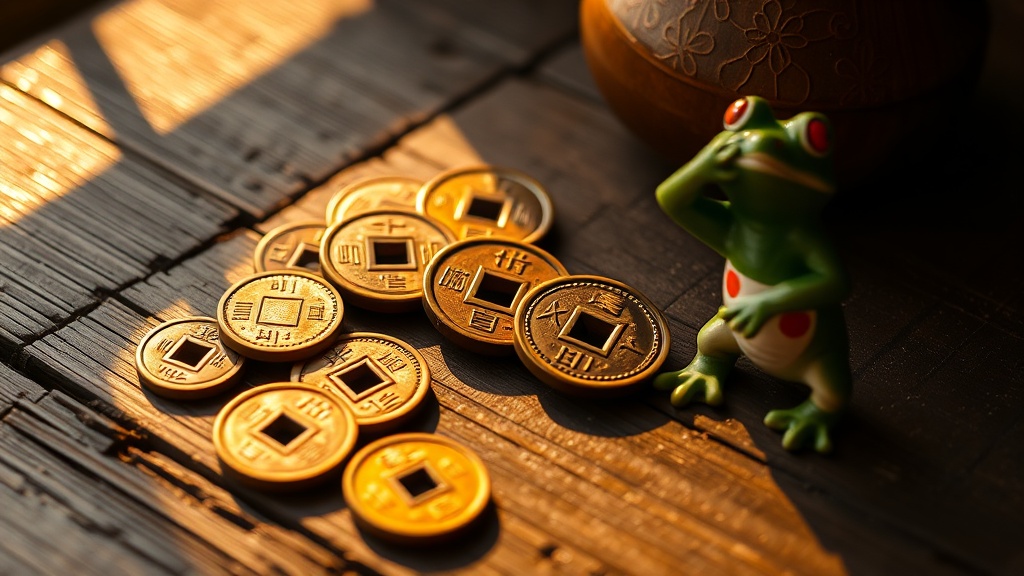
The coin in the figurine's mouth is typically a replica of a Chinese round coin with a square hole, a design dating to the Qin dynasty and later refined under the Tang and Song dynasties. The square represents the earth; the circle represents heaven. Holding this coin, the toad is pictured as a mediator between cosmological forces and the practical domain of everyday life.
The red eyes, which appear on many traditional versions, are a protective detail: red in Chinese tradition is associated with warding off harmful influences. The lotus-leaf or rock base the toad often sits on grounds it in natural imagery, connecting it to the earth element in the five-element system (wood, fire, earth, metal, water) that underpins much of feng shui theory.
"Fortune does not come through the door; it must be invited, positioned, and sustained."
Common saying in Chinese feng shui tradition
Placement: The Logic Behind Where It Goes
Placement is where feng shui practice becomes genuinely precise, and the money frog is no exception. General guidelines circulate widely, but the underlying reasoning matters more than any single rule.
Near the entrance, but not in it
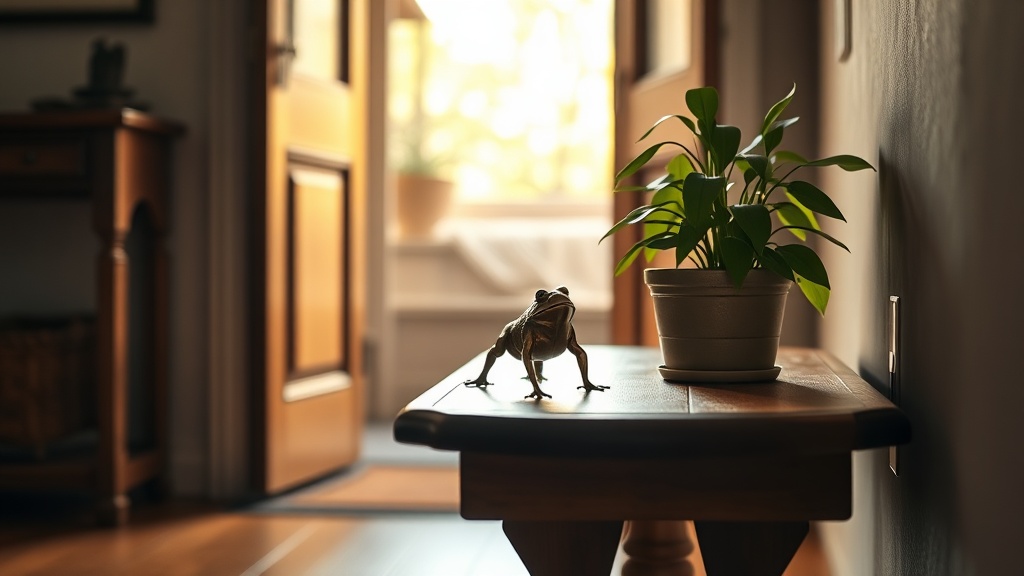
The most common placement is near the front door of a home or business, typically in the entrance hall or foyer. The idea is that the toad sits at the threshold where energy enters the space, helping to concentrate and retain it rather than letting it flow straight out again. It should not, however, sit directly in the doorway or on the threshold itself, as that positioning is thought to disrupt the flow rather than support it.
Facing inward, not outward
A frequently cited and practically sound guideline: the figurine should face into the room, not toward the door. The logic is directional, you want the symbolic energy drawn inward, toward the household. A toad facing the door is read as directing that energy back outside.
Low to the ground, not elevated
The Chan Chu is associated with the earth element. Placing it at floor level or on a low surface (a low shelf, a console table close to the ground, the corner of a room) is considered more harmonious than placing it on a high bookshelf. Some practitioners specifically avoid putting it on the floor itself, preferring a surface of a few inches to keep it clean and visually distinct.
Rooms to favor and rooms to avoid
Living rooms, home offices, and reception areas of businesses are considered appropriate placements. Kitchens and bathrooms are generally avoided: the former because of fire energy that conflicts with the water-associated toad, the latter because of associations with waste and outflow. Bedrooms are also typically excluded from placement recommendations, as the energy associated with the Chan Chu is considered too active for a space intended for rest.
The Coin in the Mouth: To Remove or Not?
Many Chan Chu figurines arrive with a coin either already in the mouth or placed alongside the figurine. A common question is whether the coin should stay in or be removed. Traditional practice suggests the coin should remain in the figurine's mouth during the day, when the household is active, and can be symbolically removed at night. Some practitioners keep it in permanently; others follow the day/night distinction as a mindful ritual.
The type of coin matters in some interpretations. Replicas of historic Chinese coins, round with a square hole, typically bearing the era name of a Tang or Qing dynasty emperor, are considered most appropriate. Modern coins or coins from unrelated traditions are generally substituted only when originals are unavailable. The coin is ideally placed with the side bearing characters facing upward.
| Placement Detail | Recommended | Generally Avoided |
|---|---|---|
| Room | Living room, entrance hall, home office | Bathroom, kitchen, bedroom |
| Direction faced | Inward, toward center of room | Toward the front door |
| Height | Low surface, floor-level shelf | High shelves, above eye level |
| Coin position | In the mouth, characters facing up | Removed and left separately |
| Number of figurines | Odd numbers (1, 3, 5, 9) | Even numbers |
Choosing a Money Frog: Material and Craftsmanship
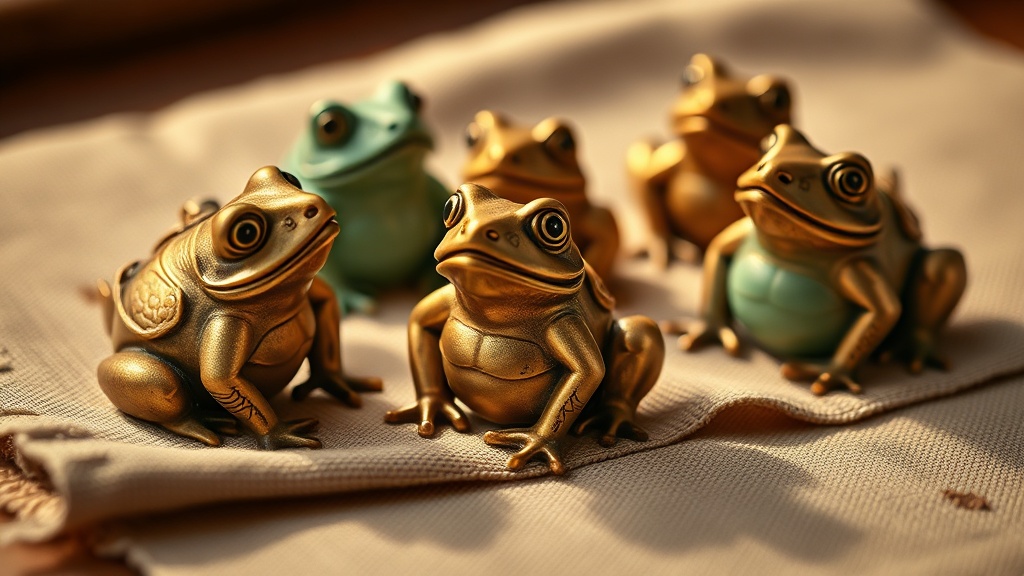
Chan Chu figurines are made in a wide range of materials, and the choice has both aesthetic and symbolic dimensions. Resin figures are the most affordable and widely available; they allow for fine detail and consistent coloration but carry less material weight than cast pieces. Brass and bronze versions are considered more durable and are associated with the metal element, which in five-element theory supports clarity and focus. Jade and nephrite versions exist but are rarer and considerably more expensive.
Whatever material you choose, the condition of the figurine matters. A chipped or damaged Chan Chu is generally replaced rather than repaired in traditional practice, the reasoning being that a broken symbol disrupts rather than concentrates qi. Keep the figurine dusted and clean; neglect is read as symbolic of inattention to the energies the piece is meant to represent.

🗂️ Explore the Collection
Feng Shui Decor
Statues, figurines, and symbolic objects selected for craft quality and cultural grounding in Chinese and East Asian tradition.
81 références
Browse the Collection →The Money Frog and the Broader Feng Shui Framework
The Chan Chu does not exist in isolation within feng shui. It is one element within a larger system that includes the bagua (the eight-trigram map used to analyze spatial energy), the five elements, and the flow of qi through architecture and arrangement. Practitioners who use the bagua map overlay it on their floor plan to identify the "wealth corner" (xun position, typically the far-left corner from the main entrance), and often place the money frog there as a reinforcing element.
It is worth being clear about what feng shui is and is not. It is a classical Chinese system of spatial organization rooted in Taoist cosmology, developed and refined over more than two thousand years, with a rich body of written tradition including texts such as the Zang Shu (Book of Burial) attributed to Guo Pu (4th century CE) and later the elaborate compass school (Luan Tou Pai) literature. It is not a religion, not a branch of Buddhist doctrine, and not a guaranteed system of results. Practitioners approach it as a thoughtful method of organizing space with awareness of symbolic and directional principles.

🗂️ Explore the Collection
Feng Shui
Coins, wind chimes, symbolic objects, and more, a focused selection of feng shui tools rooted in classical Chinese cosmological tradition.
23 références
Browse the Collection →Caring for Your Chan Chu Over Time
A money frog placed with care is also one maintained with care. In Chinese household tradition, the figurine is cleaned regularly, a soft dry cloth is sufficient for resin and metal pieces, and ideally repositioned mindfully rather than moved casually. Some practitioners perform a simple intention-setting gesture when first placing the piece, holding it for a moment before setting it down, as a way of marking the act as deliberate rather than decorative.
If you travel and bring back a Chan Chu from a market in Hong Kong, Taiwan, or mainland China, you may notice regional variations: some versions omit the coin entirely, others add ingots or additional coins at the base, and Cantonese versions often differ slightly in proportion from Mandarin-tradition pieces. These variations are regional folk interpretations, not doctrinal differences. The core symbolism, three legs, a coin, an inward-facing posture, remains consistent across the tradition.
The money frog in feng shui is, at its most considered, a material anchor for intentional thinking about one's relationship to abundance, household order, and the energy of a living space. Whether you engage with it as cosmological practice or simply as a beautifully made object with centuries of cultural meaning behind it, the Chan Chu repays the attention you bring to it.
Frequently Asked Questions
What is the difference between a money frog and a regular frog figurine?+
The money frog (Chan Chu) has three legs, not four, which distinguishes it from a realistic frog. This three-legged toad is a specific mythological creature from Taoist tradition and should not be confused with decorative amphibian figurines that have no symbolic connection to feng shui practice.
Can I place a money frog in my office or workplace?+
Yes. Offices, reception desks, and business entrances are considered appropriate placements. The same directional rules apply: face the figurine inward, keep it on a low surface, and place it diagonal to the main entrance rather than directly in front of it.
Does the material of the Chan Chu figurine matter?+
In five-element feng shui, material has elemental associations: brass and bronze connect to the metal element, ceramic to earth, wood to the wood element. Since the Chan Chu is itself a water-associated symbol, metal and earth materials are considered compatible. Resin figures are widely used and considered acceptable when the craftsmanship and intention are sound.
Is the money frog part of Buddhist practice?+
No. The Chan Chu belongs to Taoist cosmology and Chinese folk tradition, not to Buddhist doctrine. Buddhism and Taoism have coexisted and influenced each other in Chinese culture for centuries, which is why feng shui objects sometimes appear alongside Buddhist decor in the same home, but they come from distinct philosophical lineages.
What should I do if my Chan Chu figurine gets damaged?+
Traditional practice recommends replacing a chipped or broken figurine rather than repairing it. A damaged symbol is generally seen as disrupting rather than supporting the intended energy. Dispose of the broken piece respectfully, wrapping it and placing it in the bin rather than leaving it exposed, and source a replacement when you are ready.


