

Amethyst and Meditation: Tradition, Symbolism, and Practice
Amethyst is one of the most widely recognized stones in contemplative and spiritual traditions across Asia and the West. Its deep violet color, ranging from pale lavender to near-indigo, has drawn the attention of meditators, monastics, and artisans for centuries. Whether you place a raw cluster on your altar, hold a tumbled piece during sitting practice, or wear it as jewelry, the relationship between amethyst and meditation is rooted in something older than modern wellness culture: a long-standing symbolic association between the color purple, stillness, and inward focus.
Understanding that relationship honestly, what it is, where it comes from, and how practitioners actually use amethyst, makes for a more grounded practice than simply following contemporary trends.
⭐ Key points
- Amethyst's role in meditation is grounded in cultural and symbolic tradition, not scientific fact
- Its violet color carries historical associations with contemplation across multiple traditions
- The stone is used as a focal point, an anchor for intention, or simply as a meaningful physical object
- Authentic amethyst ranges from pale lilac to deep purple, saturation alone does not determine quality
- Pairing amethyst with a structured practice matters far more than the stone itself
The Color That Cultures Called Sacred
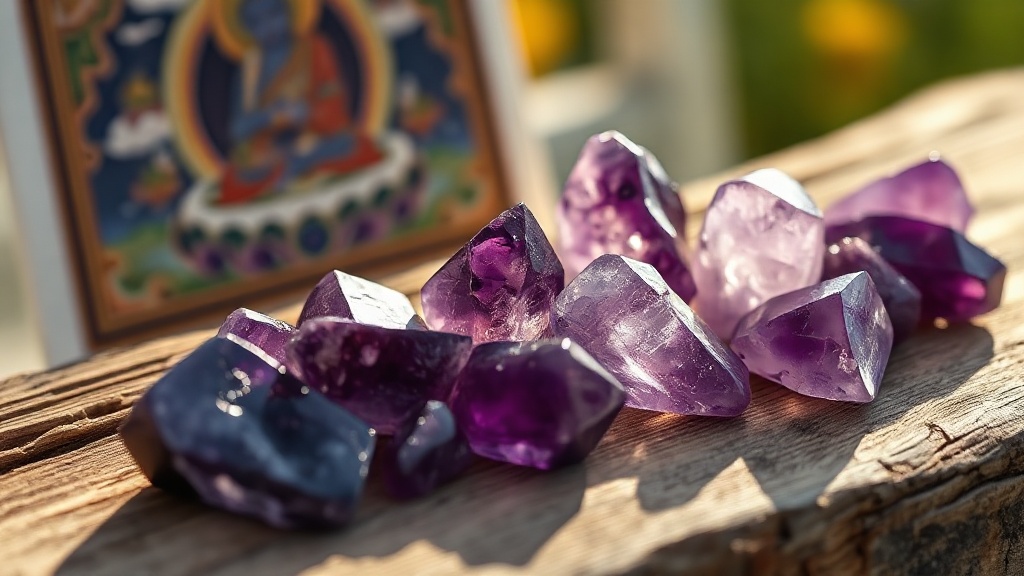
Purple dye was extraordinarily expensive in the ancient world. Tyrian purple, extracted from sea snails, cost more than gold by weight in some periods. As a result, violet and purple tones became associated almost universally with elevated status: royalty, priesthood, spiritual authority. This cultural weight did not disappear when amethyst became more widely available, it transferred onto the stone itself.
In Tibetan Buddhism, the color purple is relatively rare in iconography compared to the vivid reds, golds, and blues of thangka painting, but violet does appear in certain depictions of Vajrayana deities and in the representation of transformed states of consciousness. The broader Buddhist color symbolism system, in which each hue corresponds to a quality of mind or a Buddha family, places purple adjacent to white and blue, the colors most often linked to clarity and wisdom.
In Chinese spiritual culture, amethyst (紫水晶, zǐ shuǐ jīng, "purple water crystal") has been used in carved amulets and altar pieces for centuries. The purple tone is associated in Taoist and folk traditions with the flow of spiritual energy and with protection during inward practices.
💡 Did you know?
The word "amethyst" comes from the ancient Greek amethystos, meaning "not drunk." Greeks carved amethyst into drinking vessels and wore it as an amulet, believing it kept the mind clear and sober. The connection between amethyst and mental clarity is, in that sense, over 2,500 years old, though the ancient Greeks would have been surprised to see it on a meditation altar.
How Amethyst Actually Enters Meditation Practice
There is no canonical Buddhist text that prescribes amethyst for meditation. The Sutta Pitaka, the Bardo Thodol, and the major Mahayana sutras do not identify specific gemstones as meditation aids. What exists instead is a layered folk tradition, found across Tibetan, Chinese, and Japanese practice contexts, in which natural materials are used as anchors for attention, markers of intention, or supports for altar arrangements.
In practical terms, amethyst tends to enter meditation in three ways.
As a focal point
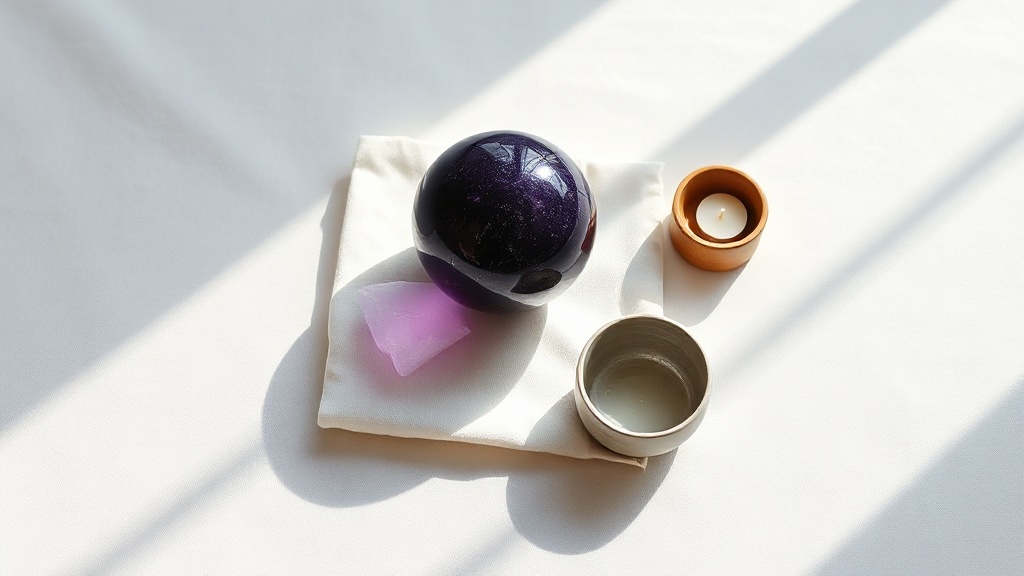
A polished sphere or cluster placed at eye level gives the practitioner something to rest the gaze on during open-eye concentration practice. The stone's internal structure, the natural crystalline formations visible inside a geode, or the play of light across a faceted surface, provides enough visual complexity to hold attention without demanding active interpretation. This is similar in function to a candle flame, a yantra, or a small Buddha figure used in trataka-style practices.
As a hand object
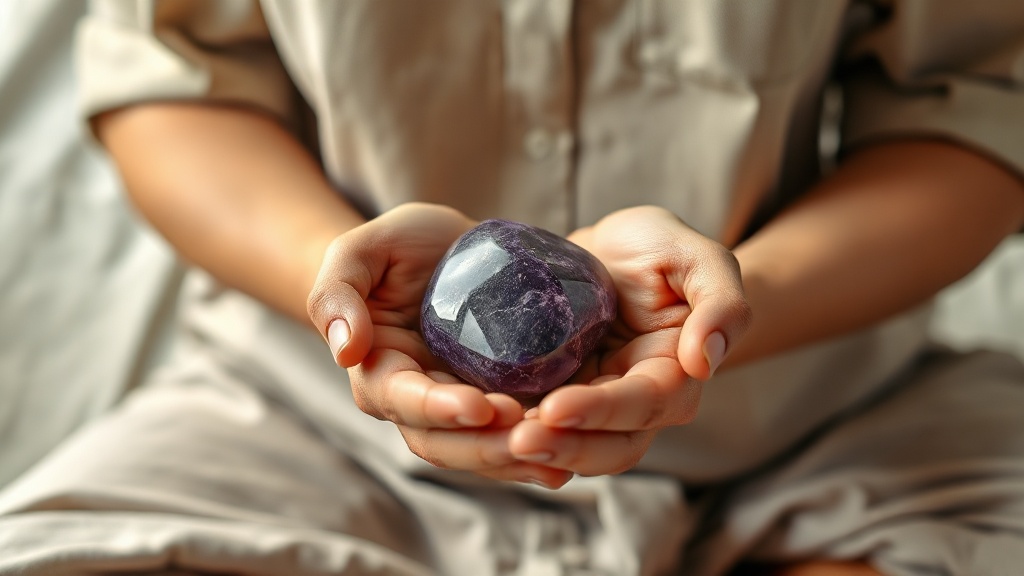
A smooth tumbled amethyst, held lightly in the palm during seated practice, provides a mild tactile anchor. When attention wanders, the weight and texture of the stone can serve as a prompt to return, similar to the way a mala bead functions between the fingers during mantra recitation. The stone itself does nothing; the practitioner does the work.
As an altar object
On a home altar, amethyst clusters or points are placed as part of a deliberate arrangement alongside statues, candles, or incense. The altar functions as a visual declaration of intention, a space set apart from ordinary life. Within that context, amethyst is chosen for its color, its mineral beauty, and its cultural resonance rather than for any inherent power.
Choosing Amethyst: What to Look For
The amethyst market is large, and quality varies considerably. Understanding what you are actually looking at makes you a more informed buyer.
| Type | Characteristics | Best Use |
|---|---|---|
| Raw cluster / geode | Natural crystal points, deep color zoning, visible inclusions | Altar centerpiece, focal object |
| Tumbled stone | Smooth, palm-sized, translucent; color ranges from pale lilac to violet | Hand object during seated practice |
| Carved sphere or point | Machine or hand-shaped; assess clarity and natural color against light | Focal point, display piece |
| Beaded jewelry | 6, 10 mm beads, natural stone vs. dyed quartz, verify with seller | Daily wear, mala-style bracelet |
| Heat-treated citrine (caution) | Burnt orange-yellow, often sold as "citrine" but is baked amethyst | Not amethyst, a different stone entirely |
Natural amethyst shows color zoning, bands of deeper and lighter purple within the same piece. Uniformly saturated stones of very deep color may have been heat-treated or, in some cases, dyed. Neither treatment is necessarily a problem if you are buying for aesthetic reasons, but you should know what you are purchasing. Reputable sellers will tell you. When buying beads or bracelets, ask directly whether the material is natural amethyst or dyed quartz.

🗂️ Explore the collection
Gemstone Bracelet
Natural stone bracelets rooted in Buddhist and Tibetan craft traditions, a grounded way to carry amethyst into daily life.
64 references
Explore the collection →Amethyst in the Context of Buddhist Altar-Setting
A home altar in the Tibetan Buddhist tradition typically includes a representation of the Buddha or a bodhisattva, offerings of water, light (candles or butter lamps), incense, and sometimes flowers or grain. Natural stones are not a formal requirement of this arrangement, but they have long been used as decorative and symbolic additions, particularly in traditions that emphasize the beauty of the offering space as a reflection of respect and intention.
Placing amethyst on an altar follows the same logic as choosing a well-crafted incense holder or a hand-painted thangka: the quality and care of the objects reflects the practitioner's sincerity, not the objects' innate power. The Dharma makes clear that liberation comes from practice and understanding, not from material objects. Stones, statues, and ritual items are supports, skillful means, not sources.
"Just as a candle cannot burn without fire, men cannot live without a spiritual life."
Attributed to the Buddha in popular tradition; reflects the broader Dhamma emphasis on inner cultivation over external means.
Within Zen and Chan traditions, altar arrangements tend to be more austere, fewer objects, greater emphasis on negative space. A single amethyst point, placed without fanfare, fits this aesthetic better than an elaborate crystal arrangement. The stone earns its place through restraint, not display.
An Honest Note on Stone Qualities and Tradition
⚠️ Important
The qualities attributed to stones, including amethyst, belong to spiritual traditions and cultural beliefs. No therapeutic or healing effect is scientifically recognized for gemstones or crystals. These objects are not substitutes for medical advice, psychological support, or medical treatment. If you are dealing with a health concern, please consult a qualified professional.
In Tibetan folk medicine and certain esoteric Vajrayana contexts, specific minerals and stones do appear in formulations and ritual use, but this is a highly specialized domain, practiced by trained lineage holders, not a general recommendation to hold crystals. The popular association between amethyst and "calming the mind" or "enhancing intuition" reflects a Western synthesis of Ayurvedic, Taoist, and New Age ideas that developed primarily in the late 20th century. It is worth knowing this genealogy.
None of this means amethyst is without value in a contemplative context. Objects that carry meaning, that we treat with care, that mark a space as intentional, do have a real effect on practice. But that effect comes from the practitioner's relationship with the object, not from the mineral itself.

🗂️ Explore the collection
Buddhist Decor
Statues, altar pieces, and ritual objects crafted with care, the kind of meaningful surroundings that support a genuine practice.
57 references
Explore the collection →Building a Practice That Uses Amethyst Well
If you want amethyst to play a real role in your amethyst meditation practice, the structure matters more than the stone. A few principles that hold regardless of your tradition or experience level:
- Consistency over ceremony. Meditating for twenty minutes every morning with a tumbled amethyst in your palm is more valuable than an elaborate monthly ritual. Repetition builds the association.
- Simplicity in the altar. One well-chosen piece has more visual power than a crowded collection. If amethyst is your anchor stone, let it have space.
- Know what you are doing and why. If you place amethyst on your altar because you find the color settling and it reminds you to sit, that is a sound reason. If you expect it to do the sitting for you, no stone will help.
- Source consciously. The amethyst trade, like most gemstone markets, includes significant unethical extraction. Where possible, buy from sellers who can speak to origin and supply chain.
Questions about amethyst meditation
Does amethyst actually help with meditation?+
Amethyst has no scientifically documented effect on the mind or meditation quality. What it can do is serve as a meaningful tactile or visual anchor, an object you associate, through repeated use, with the intention to sit and focus. That psychological conditioning is real, but it comes from your practice, not from the mineral.
Where should I place amethyst during meditation?+
Common placements include: in the palm of your hand (as a tactile anchor), at eye level on your altar (as a focal point for open-eye practice), or simply nearby on a shelf as part of your intentional space. There is no single correct position, choose what feels practical and settled for your body and posture.
Is amethyst used in traditional Buddhist practice?+
Amethyst is not prescribed in canonical Buddhist texts such as the Sutta Pitaka or the major Mahayana sutras. Natural stones do appear in Tibetan folk practice and in the decorative traditions of Chinese Buddhist altars, but their role is symbolic and aesthetic rather than doctrinal. The association between amethyst and meditation developed largely through modern syncretic spiritual culture.
How do I know if my amethyst is genuine?+
Natural amethyst typically shows color zoning, bands of lighter and darker purple within the same piece. It will feel cool to the touch initially (glass and plastic warm up faster). Very uniform, deeply saturated stones at low prices are often dyed quartz or heat-treated. When in doubt, ask the seller directly about origin and treatment, and buy from suppliers who can answer clearly.
Can I use an amethyst bracelet during meditation?+
Yes. An amethyst bead bracelet worn during seated practice adds a mild tactile element, each bead can serve a function similar to a mala, returning wandering attention to the present moment. If you also wear it outside of practice, the physical object can act as a gentle reminder of your intention to meditate throughout the day.


