

Carnelian: The Sacred Fire Stone of Buddhist and Eastern Tradition
Carnelian is one of the oldest stones in human ornamental history. Warm, translucent, ranging from pale amber to deep burnt sienna, it has turned up in Mesopotamian burial chambers, ancient Egyptian amulets, Tibetan reliquaries, and Sanskrit texts. Long before modern gemstone culture attached wellness labels to every mineral, civilizations on three continents were carving, wearing, and trading this stone with intention. Understanding what carnelian actually is, where it comes from, and how Buddhist and Eastern traditions have related to it gives this stone far more depth than any contemporary label can offer.
⭐ Key takeaways
- Carnelian is a variety of chalcedony, a microcrystalline quartz, colored by iron oxide impurities
- It has been used in Buddhist rosaries (malas), reliquaries, and ritual jewelry across Tibet, Nepal, and Southeast Asia for centuries
- In Tibetan tradition, carnelian is one of the seven precious substances referenced in tantric texts
- The qualities attributed to carnelian belong to spiritual tradition and belief, not scientific consensus
- Major deposits come from India (Khambhat), Brazil, Madagascar, and parts of Germany
What Carnelian Actually Is: Mineral Anatomy of a Warm Stone
Carnelian belongs to the chalcedony family, a subcategory of microcrystalline quartz. Its color comes from iron oxide, specifically hematite or limonite inclusions distributed through the silica matrix. The percentage and distribution of these iron compounds determine whether a stone sits closer to pale peach, vibrant orange, or a deep reddish brown. The name itself traces back to the Latin corneolus, likely derived from the cornel cherry whose ripe fruit shares the same warm hue.
Mineralogically, carnelian scores 6.5 to 7 on the Mohs hardness scale. That durability made it ideal for engraving. Ancient craftspeople used it for cylinder seals, signet rings, and carved amulets precisely because the stone holds fine detail without fracturing easily. A lapis lazuli bead might flake; carnelian took a blade cleanly.
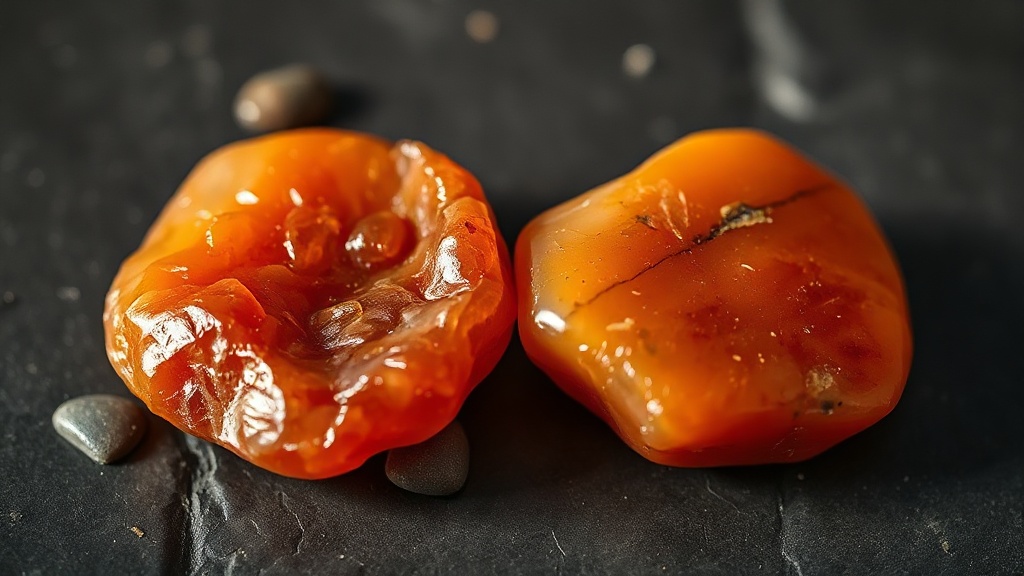
Not all carnelian in today's market is entirely natural. A common trade practice involves heating agate, a closely related chalcedony, to transform pale grays and browns into vivid oranges through controlled oxidation of iron minerals. The result is chemically identical to naturally colored carnelian. Reputable dealers distinguish between natural-color and heat-treated material, though the visual difference is sometimes imperceptible. When origin and treatment matter to you, ask for provenance documentation before purchasing.
Carnelian in Buddhist Tradition: From the Seven Treasures to the Mala Bead
Buddhist canonical literature contains multiple lists of precious substances, and carnelian appears in several Mahayana and Vajrayana enumerations. The *Saptaratna*, or "seven treasures," referenced across various sutras includes different minerals depending on the school and text, but carnelian (sometimes rendered as "red agate" or "sard" in older English translations) appears consistently in Tibetan Vajrayana contexts. The Avatamsaka Sutra and several Tibetan tantric texts describe offering bowls, reliquaries, and shrine ornaments set with these seven substances as expressions of generosity and devotion, not because the stones themselves hold intrinsic power, but because offering something beautiful and precious is itself a practice of non-attachment.
💡 Did you know?
The Prophet Muhammad's seal ring, according to Islamic historical sources, was set with an engraved carnelian. The stone's engraving properties made it the preferred material for official seals across the ancient world, from Babylon to the Mughal courts, cutting across religious and cultural boundaries.
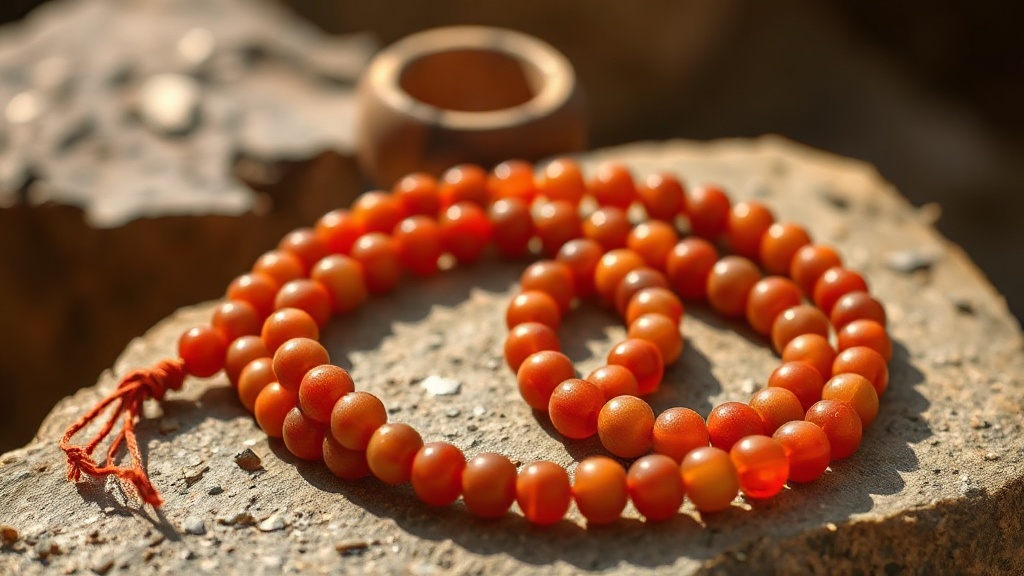
In Tibetan Buddhist practice, carnelian mala beads occupy a specific place. A *mala* (Sanskrit: "garland") is a string of 108 beads used for counting repetitions of mantras or prayers. Different materials carry different traditional associations. Bone and *rudraksha* beads appear frequently in Shaiva and some Buddhist contexts; crystal and mother-of-pearl in Theravada traditions. In Tibetan Vajrayana, carnelian beads are traditionally associated with wrathful and semi-wrathful deity practices, where the stone's deep red-orange color corresponds to the fire quality in Tantric symbolism. This is a cultural and symbolic correspondence, not a physical property of the mineral.
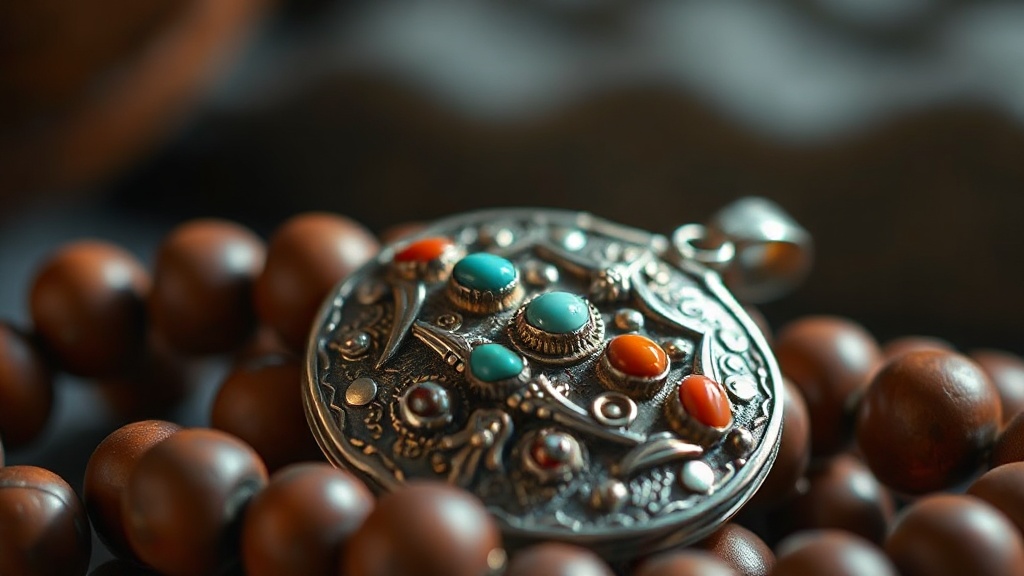
Tibetan reliquaries (*tsa-tsas*) and *ghau* boxes, the portable shrine lockets worn as pendants, frequently feature carnelian inlays alongside turquoise and coral. These three stones together form a color triad that recurs throughout Tibetan decorative metalwork: turquoise for sky and wisdom, coral for vitality, carnelian for fire and spiritual warmth. The combination is aesthetic and symbolic before it is anything else.

🗂️ See the collection
Gemstone Jewelry
Natural stone necklaces, bracelets, and sets grounded in Buddhist symbolism, for practitioners who want more than decoration.
114 références
Discover the category →Geography of the Stone: Where Carnelian Comes From
India has supplied carnelian to global trade routes for at least four thousand years. The workshops of **Khambhat** (formerly Cambay) in Gujarat remain the most historically significant source, producing both raw material and finished beads that traveled the ancient Silk Road to Central Asia, Tibet, and East Africa. Khambhat carnelian ranges from a translucent honey-orange to deep brick red, and the city's craftspeople developed polishing techniques still in use today.
Brazil became a major commercial source in the twentieth century, particularly from Minas Gerais. Much of what appears in modern jewelry markets as carnelian originates here, often as heat-treated agate. Madagascar produces fine-quality natural material, appreciated for its even coloration. Smaller deposits exist in Germany's Idar-Oberstein region (historically significant for European lapidary craft), Uruguay, and parts of the American Pacific Northwest.
For Buddhist-context pieces, the material origin matters. A Tibetan prayer bead mala made with Khambhat carnelian carries a different weight of cultural continuity than one produced with Brazilian heat-treated agate, even if both look similar at first glance. Neither is wrong; they simply represent different relationships between craft and tradition.
Color Symbolism of Carnelian in Buddhist and Tantric Iconography
Color in Vajrayana Buddhism is not decorative. Each of the five Buddha families in the Tantric mandala corresponds to a color, a direction, an element, a poison, and its corresponding wisdom. Red, the color range where carnelian sits, belongs primarily to the Buddha family of Amitabha in the western direction, associated with the transformation of attachment into discriminating wisdom. The element is fire.
This correspondence explains why carnelian appears in certain ritual contexts and not others. In practices centered on Amitabha or the Pure Land, red materials carry symbolic coherence. In wrathful protector practices, the deep red-orange of carnelian aligns with the fierce energy these deities represent, again as symbol, not as mechanism. Buddhist practice relies on intention, visualization, and the cultivation of mental qualities. The stone provides a tangible focal point and a culturally grounded reminder, nothing more and nothing less.
It is also worth noting that the five-color symbolic system extends to fabric, paint, thangka borders, and butter lamp flames, not only stones. Carnelian's place in this system is part of a much larger visual grammar that Tibetan and Himalayan artists have refined over a thousand years of practice. Recognizing that grammar when you encounter a shrine object or an altar piece enriches the experience considerably.
| Color in Tantra | Buddha Family | Associated Wisdom | Common Stone |
|---|---|---|---|
| Red / Orange | Amitabha (West) | Discriminating Awareness | Carnelian, coral |
| Blue | Akshobhya (East) | Mirror-like Wisdom | Lapis lazuli, sapphire |
| Yellow / Gold | Ratnasambhava (South) | Equality Wisdom | Citrine, gold |
| Green | Amoghasiddhi (North) | All-Accomplishing Wisdom | Emerald, jade |
| White | Vairochana (Center) | Dharmadhatu Wisdom | Crystal, pearl |
Carnelian Across Asian Traditions: The Stone Beyond Tibet
Carnelian's presence in Buddhist Asia extends well beyond Tibet. In Sri Lanka and Myanmar, Theravada traditions have long incorporated gemstones into amulet culture, and carnelian appears in protective amulet tablets and cast metal pendants alongside rubies and sapphires. The intent in these contexts is typically protective and devotional: the object serves as a physical reminder of one's practice and refuge in the Three Jewels (Buddha, Dharma, Sangha).
In ancient Indian Buddhist stupas, excavations have revealed carnelian beads and inlaid stonework. The stupa at Sanchi and excavations at Taxila have both yielded carnelian objects from the early centuries of the common era. The stone's availability through Gujarat trade routes and its durability made it a natural choice for votive deposits. Japanese Buddhist metalwork, while less reliant on colored stones than Tibetan craft, occasionally incorporates carnelian in altar objects and temple jewelry.
In Chinese cosmology, carnelian does not occupy the same prominent ritual position it holds in Vajrayana contexts. Red stones in Chinese tradition more often center on cinnabar, red jade (a reddish feldspar or jasper), and coral. That said, carnelian beads appear in court jewelry from the Ming and Qing dynasties, valued for color and craftwork rather than specific symbolic function. The stone moves differently through different traditions, and tracking those differences reveals how material culture and religious practice interact across geography.
How to Use Carnelian in Practice: Malas, Jewelry, and Shrine Objects
If you want to incorporate carnelian into your practice in a way that respects its cultural context, a few practical approaches stand out. A carnelian mala used for mantra recitation keeps you grounded in a long tradition: fingers moving across beads is one of the most consistent physical gestures across Buddhist lineages. The choice of carnelian over other materials can reflect either a teacher's instruction, an affinity with the Amitabha or fire symbolism, or simply a visual preference. All three are legitimate starting points.
As a pendant or bracelet stone, carnelian in Buddhist contexts most often appears carved or set alongside silver metalwork. Tibetan-style silver pendants with inset carnelian, turquoise, and coral are among the most common forms of devotional jewelry from Nepal and the Himalayan region. These pieces typically require a silversmith, a stone cutter, and sometimes a painter or engraver, which is why authentic handmade examples carry a meaningful price premium over factory-produced alternatives.

🗂️ See the collection
Carnelian Mala Bracelets
From Tibetan-style carnelian mala bracelets to inlaid stone cuffs rooted in Buddhist craft traditions, worn daily as a quiet anchor for practice.
64 références
Discover the category →For shrine use, carnelian appears in offering bowls, as inlay on statues, and in the decorative borders of thangka paintings. If you are setting up a home altar with Tibetan influences, a small carnelian stone placed in one of the seven offering bowls (traditionally filled with water, but sometimes with meaningful objects) is consistent with *Saptaratna* tradition. It functions as a gesture of generosity and an acknowledgment of the stone's place in that lineage.
A Word on Claims: What the Stone Does and Does Not Do
⚠️ Important
The qualities attributed to carnelian, including associations with vitality, courage, focus, or protection, belong to spiritual traditions and cultural beliefs. No therapeutic effect is scientifically recognized for this or any other gemstone. Carnelian is not a substitute for medical advice or treatment. If you are dealing with a health issue, consult a qualified medical professional.
This distinction matters not because spiritual tradition is without value, but precisely because it has real value when approached honestly. Buddhist practice at its core is about seeing things clearly, *yatha-bhutam* in Pali: "as they actually are." Attributing mechanisms to a stone that it does not possess runs counter to that orientation. The carnelian bead in your mala works as a counter, a tactile anchor for attention, and a carrier of cultural memory. That is already a great deal. It does not need to be more.
"Form is emptiness, emptiness is form."
Heart Sutra (Prajnaparamita Hridaya), Mahayana canon
The Heart Sutra's observation applies here in a practical sense. The stone is form: real, tactile, historically layered. Its spiritual significance is the meaning communities have built around it over centuries. Both things are true at once, and neither cancels the other. Using carnelian well means holding both realities without collapsing one into the other.
Caring for Carnelian: Practical Guidance for Long-Term Use
Carnelian is durable enough for daily wear under most conditions, but a few habits extend the life of beads and set pieces. At 6.5 to 7 on the Mohs scale, it resists scratching from most everyday surfaces but can be marked by harder minerals like topaz or corundum. Store carnelian separately from harder stones if you keep multiple pieces together.
Clean with lukewarm water and a soft cloth. Mild, unscented soap is fine for occasional deeper cleaning. Avoid ultrasonic cleaners, steam cleaning, and prolonged exposure to harsh chemicals, which can damage surface polish or loosen settings in older metalwork. For carnelian mala beads strung on silk or cotton cord, avoid extended immersion in water, which weakens the string over time. Restringing a mala every two to three years of regular use is standard practice.
Direct sunlight for brief periods (as in the cleansing gesture mentioned above) is harmless. Extended exposure over months can gradually fade the color of some heat-treated specimens, though natural carnelian is more resistant to light-induced color change. Keep pieces away from high heat, which can cause surface fractures in any chalcedony.
🗂️ See the collection
Gemstone Jewelry
Natural stone necklaces, bracelets, and sets grounded in Buddhist symbolism, for practitioners who want more than decoration.
114 références
Discover the category →Carnelian as a Gift: What to Consider Before Choosing
Carnelian pieces make thoughtful gifts for people with an interest in Buddhist practice, Eastern art, or gemstone jewelry, provided a few things are considered first. Know roughly whether the recipient is drawn to Tibetan Vajrayana, Theravada, Zen, or a more broadly spiritual orientation. A carnelian mala in the Tibetan style carries specific practice associations that may or may not resonate depending on their path. A pendant or bracelet with carnelian as the primary stone is more open-ended and crosses lineage boundaries easily.
For someone newer to practice or exploration, a single high-quality carnelian gemstone piece accompanied by a brief written explanation of the stone's cultural history is more meaningful than an object handed over without context. The explanation does not need to be long, two or three sentences about the stone's place in Tibetan tradition and the *Saptaratna* give the recipient something real to hold alongside the object.
For a practiced Buddhist, the choice of material in a mala sometimes reflects a teacher's recommendation or a specific *sadhana* (practice text). It is worth asking subtly whether they have a preferred bead material before selecting. A carnelian stone necklace or gemstone bracelet sidesteps this entirely and tends to be received well across different practice backgrounds.
FAQ
Is carnelian the same as red agate?+
Both are varieties of chalcedony, a microcrystalline quartz. Carnelian is specifically colored by iron oxide impurities in orange to reddish-brown tones. Red agate is a broader term that can describe similar colors but also refers to banded specimens with a distinct pattern. In Buddhist literature, older translations sometimes use "red agate" or "sard" where the original likely referred to carnelian or a closely related chalcedony.
How do I tell real carnelian from dyed or synthetic material?+
Hold the stone up to a bright light source. Natural carnelian shows gradated, slightly uneven translucency with color that shifts softly from surface to core. Dyed material (usually dyed chalcedony or glass) often shows unnaturally uniform saturation or visible color concentrating in surface cracks. Heat-treated agate is harder to distinguish without a gemological loupe. When buying, ask the seller directly about treatment and origin.
What mantra practices traditionally use carnelian malas?+
In Tibetan Vajrayana, carnelian malas are traditionally associated with practices centered on wrathful or semi-wrathful deities, and with Amitabha practices given the stone's red-orange color correspondence. That said, practice guidelines vary by lineage and teacher. If you follow a specific Vajrayana tradition, ask your teacher or consult a practice text (*sadhana*) for the recommended mala material for your particular practice.
Can I wear carnelian jewelry without being Buddhist?+
Yes. Carnelian has a long history across multiple cultures and religions, including ancient Egyptian, Islamic, Greco-Roman, and Hindu traditions. Wearing a carnelian piece does not require adherence to any religious practice. Many people wear it simply for its color, its historical resonance, or because they appreciate the craft of the object. Context and intention are personal.
Does carnelian appear in any specific Buddhist sutras by name?+
Carnelian (or a stone identified as it in translation) appears in enumerations of the *Saptaratna*, the seven precious substances referenced in Mahayana texts including the Avatamsaka Sutra and various Tibetan Vajrayana sadhanas. Translation varies: older English versions use "sard," "red agate," or "carnelian" interchangeably for what the Tibetan texts call *rdo dmar* (red stone) or *snying po* depending on the context. The exact mineral correspondence was less important to the original authors than the symbolic value of offering something rare and beautiful.
How does carnelian differ from other stones in a Tibetan mala?+
Each mala material carries distinct symbolic associations in Tibetan Vajrayana practice. Crystal beads are commonly used for purification and peaceful practices; bone malas appear in certain advanced Vajrayana contexts as a reminder of impermanence; *rudraksha* seeds are common across Hindu-influenced traditions. Carnelian is most often linked, according to Tibetan tradition, to wrathful deity practices and to the Amitabha family through its red-orange color. The choice is ultimately guided by your practice lineage and your teacher's instructions, not by the stone's intrinsic properties.


