

Citrine: The Golden Stone of Buddhist Tradition and Everyday Meaning
What Citrine Actually Is
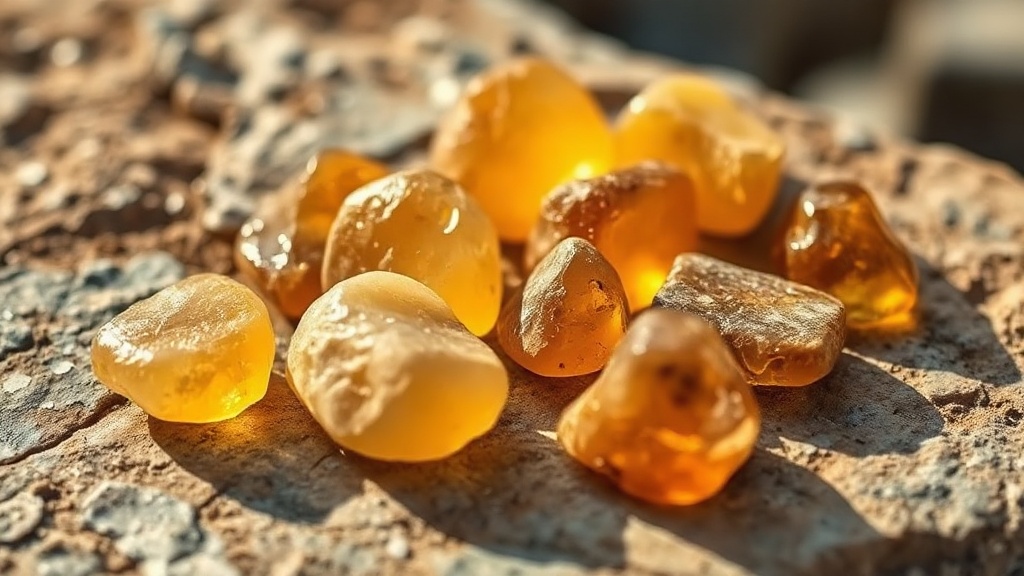
Citrine is a variety of macrocrystalline quartz, the same mineral family as amethyst, rose quartz, and smoky quartz, whose colour ranges from a faint straw yellow to a deep, almost cognac-like amber. That colour comes from traces of iron within the silicon dioxide lattice, altered by natural heat and radiation over geological time. On the Mohs hardness scale it sits at 7, making it durable enough for everyday wear in jewellery.
True natural citrine is far rarer than the market suggests. The vast majority of commercial citrine is actually heat-treated amethyst or smoky quartz: when these purple or grey stones are baked at controlled temperatures (typically between 470°C and 560°C), the iron compounds shift oxidation state and the colour turns yellow or orange-brown. The result is chemically identical to natural citrine but geologically distinct. Brazil, Madagascar, and Russia are the primary sources of both natural material and treated stones.
💡 Did you know?
The name "citrine" derives from the Latin citrina, meaning lemon or lemon-coloured. Historically, the stone was so rarely distinguished from topaz that many antique yellow jewels described as "topaz", including some in Scottish clan jewellery, are now confirmed to be citrine upon modern gemological analysis.
Citrine in Buddhist and Asian Spiritual Traditions
Citrine does not occupy the same canonical position in Buddhist doctrine that certain ritual metals or colours do. The Pali Canon (Sutta Pitaka) and the Sanskrit Mahayana sutras make no specific mention of it. What exists instead is a rich layer of folk practice, regional craft tradition, and material symbolism that has accumulated over centuries, particularly across Tibet, China, and Southeast Asia.
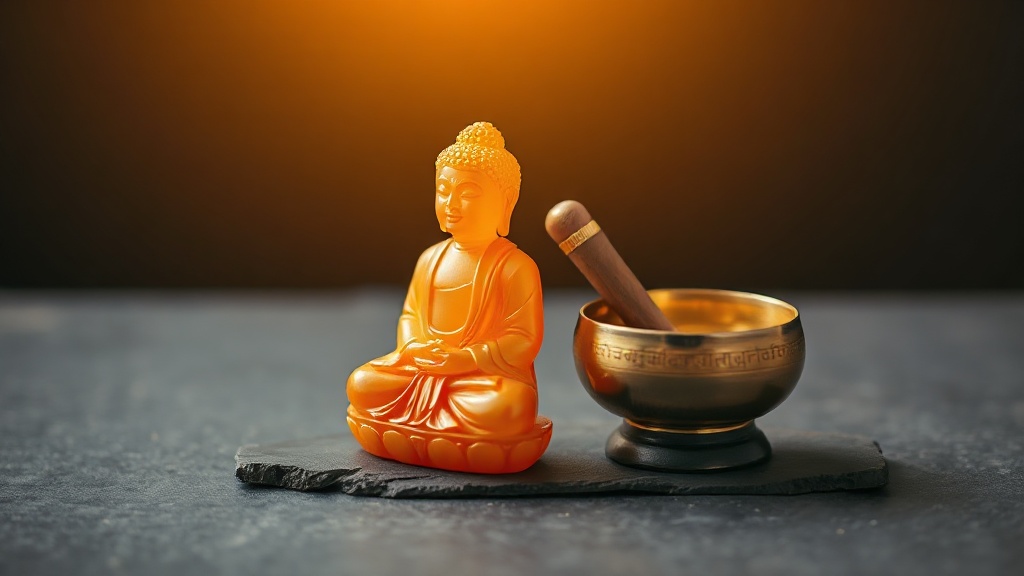
In Tibetan Buddhism, yellow and gold hues are strongly associated with the earth element, with the Ratnasambhava buddha of the southern direction, and with qualities of generosity and enrichment. Stones carrying that warm golden register, citrine included, have therefore found a natural home in devotional objects: prayer beads, carved pendants, small figurines, and altar decorations. This is cultural and visual logic, not doctrinal prescription. A practitioner choosing a citrine mala is drawing on aesthetic and symbolic resonance, not following a scriptural injunction.
In Chinese cosmology and Feng Shui, the association is more explicit. Yellow stones are linked to the Earth element in the Five Phase system (Wu Xing), and the Earth element governs stability, nourishment, and the centre of a space. Citrine's warm yellow is therefore considered tonally aligned with these qualities, which explains its persistent presence in Feng Shui decor, from polished clusters placed on desks to carved citrine trees used as ornamental focal points.
⭐ Key points about citrine
- Citrine is a yellow-to-amber variety of quartz coloured by iron traces; most commercial stones are heat-treated amethyst or smoky quartz.
- It has no direct doctrinal role in canonical Buddhist texts, but plays a well-established part in Tibetan, Chinese, and Southeast Asian craft and folk practice.
- In Feng Shui, its yellow hue aligns it with the Earth element and the qualities of stability and nourishment in the Wu Xing system.
- Natural citrine commands significantly higher prices than heat-treated material; both are geologically valid quartz varieties.
- Any therapeutic or energetic properties attributed to citrine belong to spiritual tradition and personal belief, not scientific evidence.
Natural vs. Heat-Treated: A Practical Guide for Buyers
Understanding the distinction between natural and treated citrine matters when you are buying deliberately. It is not that treated stones are inferior as objects, they are real quartz, but if you are purchasing for a specific intention or collecting for material value, knowing what you have is useful.
| Criterion | Natural Citrine | Heat-Treated Amethyst / Smoky Quartz |
|---|---|---|
| Colour range | Pale straw to light golden yellow | Vivid orange-yellow, deep amber, occasionally reddish |
| Colour distribution | Even, subtle gradations | Often concentrated at crystal tips, whitish base visible |
| Rarity | Genuinely rare; found mainly in Brazil, Russia | Widely available; most market supply is treated |
| Price | Significantly higher per carat | Lower; widely accessible |
| Identification | Gemological certificate required for certainty | Experienced eye or spectroscopy can detect treatment |
If a vendor cannot tell you whether their citrine is natural or treated, that itself is information. Reputable suppliers label heat treatment transparently. For devotional jewellery where the material symbolism matters to you, rather than the geological pedigree, treated citrine serves the purpose equally well.
Citrine in Jewellery: Cultural Context and Craft
Citrine has appeared in jewellery across many cultures for at least two millennia. Ancient Greek and Roman craftsmen set it in rings and intaglios. Scottish silversmiths favoured large cairngorm-style yellow quartz in Highland brooches and dirk handles from the 17th century onward. In South and East Asia, its use in devotional jewellery draws from the broader tradition of coloured stone beads in mala practice.
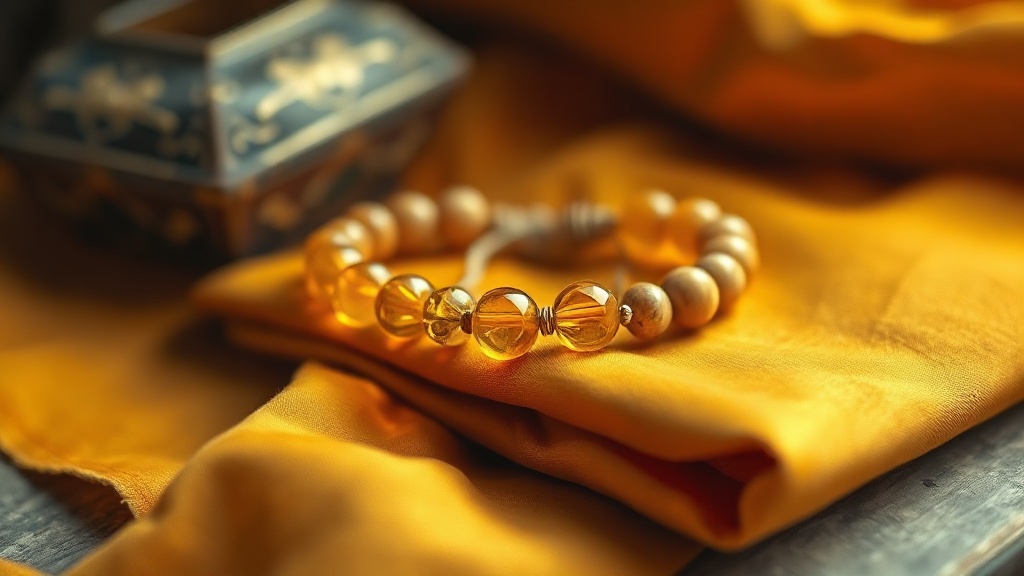
In contemporary Buddhist-inspired jewellery, citrine most commonly appears as faceted or tumbled beads in mala bracelets, as oval or round cabochons in pendant settings, and as carved forms, the lotus, the Dorje, the Om syllable, in pendants intended for altar or personal use. The stone's hardness (Mohs 7) makes it suitable for daily wear without excessive care, though like all quartz varieties it will scratch glass and can be scratched by harder minerals such as topaz or corundum.

🗂️ Explore the collection
Gemstone Jewelry
Natural stone jewellery rooted in Buddhist and Eastern tradition, a considered place to look for citrine and other gemstone pieces crafted with care.
114 références
Discover the collection →The Disclaimer That Belongs Here
⚠️ Important
The qualities attributed to citrine, and to stones generally, belong to spiritual traditions and systems of belief. No therapeutic or energetic effect is scientifically recognised. These objects are not substitutes for medical advice or treatment. Everything described in this article regarding the stone's symbolism reflects traditional and cultural frameworks, not empirical health claims.
How to Choose and Care for a Citrine Stone
Whether you are drawn to citrine for its place in Buddhist or Feng Shui tradition, for its warm colour in a piece of jewellery, or simply as a collected mineral specimen, a few practical points are worth keeping in mind.
For jewellery, look for consistent colour saturation and clean transparency if you want a faceted gem quality stone. If you prefer a more natural, earthy look, tumbled citrine beads with visible inclusions can be equally appealing and are typically more affordable. For clusters intended as room ornaments, a common use in Feng Shui practice, size, base stability, and colour depth across the crystal points are the main criteria.
Citrine is relatively easy to care for. Clean it with warm water and mild soap; avoid prolonged exposure to direct sunlight, as sustained UV exposure can gradually fade colour in some yellow quartz varieties over years. Store it away from harder stones (diamonds, sapphires, topaz) to prevent surface scratching. Unlike softer stones such as malachite or selenite, it does not require special handling.
"Form is emptiness, emptiness is form."
Heart Sutra (Prajnaparamita Hridaya Sutra), a reminder that the value of an object lies in how we hold it, not in the object itself.
Citrine as a Gift: What to Look For
Citrine is a thoughtful gift for someone with an interest in Buddhism, meditation, or Eastern aesthetics precisely because it carries genuine cultural grounding without being overly esoteric. A well-made citrine bracelet, a carved pendant, or a small polished specimen communicates care and intention without requiring the recipient to hold any particular belief.
When choosing citrine as a gift, prioritise craft quality over size, and look for transparent sourcing. A piece from an artisan who can tell you the stone's origin, whether natural Bolivian citrine or heat-treated Brazilian material, is a more honest gift than an unmarked mass-produced piece. Pair it, if the occasion allows, with a brief note on the stone's cultural symbolism: the association with the Ratnasambhava buddha, with the Earth element in Wu Xing, with the warm register of generosity and groundedness in Tibetan visual tradition. That context transforms a pretty stone into a meaningful object.

🗂️ Explore the collection
Gemstone Bracelets
Handpicked bracelets in natural stone, the format most associated with mala practice and Buddhist-inspired everyday wear, including citrine pieces.
64 références
Discover the collection →Frequently Asked Questions
Is citrine mentioned in Buddhist scriptures?+
No. Neither the Pali Canon (Sutta Pitaka) nor the principal Mahayana sutras name citrine specifically. Its role in Buddhist material culture comes from regional craft tradition and visual symbolism, particularly its golden yellow colour connecting it to earth element associations and certain buddha forms, rather than from doctrinal prescription.
How can I tell if my citrine is natural or heat-treated?+
The most reliable method is a gemological certificate from a recognised laboratory (GIA, IGI, or equivalent). As a first visual check, natural citrine tends toward pale straw yellow with even colour distribution, while heat-treated material is typically more vivid orange or amber and often shows a white or pale zone near the crystal base. A reputable seller should disclose treatment status upfront.
Does citrine have any scientifically proven health effects?+
No. The qualities attributed to citrine in lithotherapy and crystal healing traditions belong to systems of spiritual belief, not to evidence-based medicine. No therapeutic effect of citrine has been scientifically demonstrated. If you are dealing with a health condition, consult a qualified medical professional. Citrine is a beautiful stone with genuine cultural symbolism, that is sufficient reason to appreciate it.
Where does citrine fit in Feng Shui practice?+
In Feng Shui, citrine's yellow colour aligns it with the Earth element in the Wu Xing (Five Phase) system. The Earth element is associated with the centre of a space, stability, and nourishment. Citrine clusters, carved trees, and polished spheres are therefore commonly placed in central living areas or on work surfaces. As with all Feng Shui practice, these are traditional frameworks of spatial intention rather than proven physical mechanisms.
How should I care for citrine jewellery?+
Clean citrine with warm water and a small amount of mild soap, using a soft brush if needed. Rinse and dry thoroughly. Avoid prolonged exposure to direct sunlight, which can gradually fade colour in some yellow quartz varieties over time. Store away from harder gemstones to prevent scratching. Citrine does not require soaking in water or exposure to salt, despite some popular recommendations, plain soap and water is sufficient.


