

Dzi Beads: The Sacred Stones of the Himalayas
Few objects in Tibetan Buddhist culture carry as much weight, literal and symbolic, as the dzi bead. Worn on the wrist, strung into a mala, or kept wrapped in silk in a family's innermost chest, these patterned stone beads have circulated across the Himalayan plateau for centuries. They appear in ancient texts, in monastery inventories, in the personal belongings of lamas and nomads alike. And yet, outside that world, they remain largely unknown.
Understanding dzi beads means stepping into a crossroads: archaeology, trade history, Tibetan religious cosmology, and a living craft tradition that continues today. What follows lays out what is actually known, what remains debated, and why these small objects continue to matter to the people who keep them.
⭐ À retenir
- Dzi beads are etched agate stones originating from a region spanning Tibet, Bhutan, Ladakh, and parts of Central Asia.
- Their characteristic eye patterns are created through an ancient etching process; the exact original technique is still debated among scholars.
- In Tibetan Buddhist tradition, the number and type of eyes on a dzi carry distinct symbolic meanings rooted in dharmic cosmology.
- Antique dzi beads are among the most valued objects in Tibetan material culture; prices can be extraordinary for authenticated pieces.
- Modern reproductions are widespread, knowing how to distinguish them matters before any purchase.
Origins: Where Do Dzi Beads Come From?
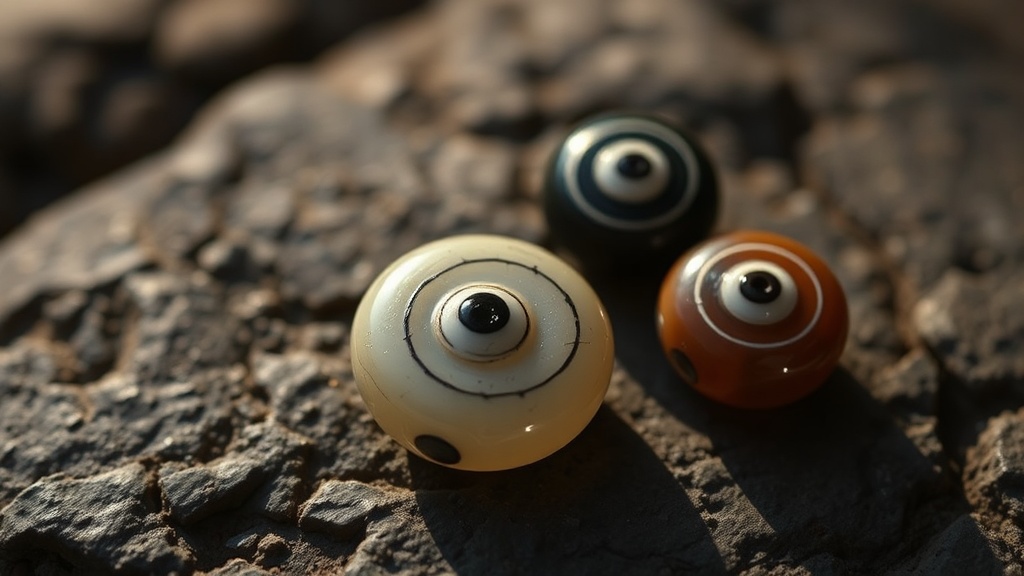
The word dzi (གཟི) in Tibetan translates roughly as "shine" or "brightness," though the etymology is contested. The beads themselves are made from chalcedony or agate, a silica-based stone found across Central Asia. Their defining feature is a surface pattern, most commonly concentric circles or ovals resembling eyes, produced by a chemical etching process applied before a final firing.
Archaeological evidence places the earliest dzi-type beads in the broader Bactria-Margiana cultural zone, roughly spanning present-day Afghanistan, Turkmenistan, and northern Pakistan, somewhere between 2000 and 1000 BCE. Similar etched carnelian and agate beads from the Indus Valley civilization share technical characteristics. From there, trade routes carried them northward into the Tibetan plateau, where they became embedded in local religious and social life in a way that did not happen elsewhere.
Within Tibetan oral tradition, the origin stories are different. Many accounts describe dzi as not being made by human hands at all, they are said to have fallen from the sky, been spat out by serpent spirits (lu, the Tibetan equivalent of nāga), or to have existed since before recorded time. These narratives are not meant as geological claims; they speak to the beads' status as objects outside ordinary categories.
💡 Did you know?
The etching technique used to decorate dzi beads, applying an alkaline solution to bleach specific areas of the stone before firing, was a sophisticated chemical process. Some researchers believe knowledge of this exact method was lost and later partially rediscovered. Workshops in Tibet, India, and Taiwan have spent decades reverse-engineering the original craft.
The Eye Patterns: Reading a Dzi Bead
The most immediately recognizable feature of a dzi bead is its eye pattern. Beads are classified first by the number of eyes they bear, from one to twenty-one, and occasionally beyond, and each count carries a specific meaning within Tibetan Buddhist and Bon cosmological frameworks.
A single-eye dzi is associated with clarity of mind and the light of awareness. The two-eye dzi connects to harmonious relationships, evoking the partnership between wisdom (prajna) and compassionate action (karuna). Nine-eye dzi are considered especially significant in the Tibetan tradition, associated with the nine planetary influences recognized in Tibetan astrology and the accumulation of merit across multiple spheres of existence. The twenty-one-eye dzi corresponds to the twenty-one emanations of Tara, the female bodhisattva of compassion.
Beyond the eyes, other patterns carry their own meanings. The "tiger stripe" or wavy line pattern is considered protective. A dzi bearing a pattern resembling a lotus represents spiritual purity. Some beads combine multiple motifs, eyes alongside stripes, dots, or geometric forms, making their symbolic reading a layered process that draws on both iconographic knowledge and the specific tradition (Vajrayana Buddhist or Bon) of the person interpreting them.
| Number of Eyes | Associated Symbolism | Tradition |
|---|---|---|
| 1 eye | Clarity of awareness, illumination | Tibetan Buddhist / Bon |
| 2 eyes | Harmonious relationships, wisdom-compassion balance | Tibetan Buddhist |
| 3 eyes | Wealth, abundance, the three jewels (Buddha, Dharma, Sangha) | Tibetan Buddhist |
| 9 eyes | Nine planetary influences, accumulation of merit | Tibetan astrology |
| 21 eyes | The 21 emanations of Tara | Vajrayana Buddhist |
Dzi Beads in Tibetan Religious Life
In Tibetan households, dzi beads are not merely decorative. They are treated as phurba-adjacent objects, items with a ritual charge, kept with care and intention. A family's collection of dzi may be worn during important ceremonies, presented to a monastery as an offering, or passed down through generations as part of inheritance alongside land and livestock. In some regions of Kham and Amdo, a woman's wealth was traditionally measured in part by the quality of the dzi beads on her headdress.
Within the Vajrayana tradition, the bead's potency is understood to accumulate through time and through the intentions of those who have kept it. A bead worn by a recognized lama carries a different weight than a new bead, not because the stone itself changes, but because of what has passed through the relationship between practitioner and object. This logic mirrors how relics function in the broader Buddhist world, sacred status is conferred, sustained, and transmitted through lineage and practice.
Antique vs. Modern: Navigating the Market
The demand for authentic antique dzi beads far outstrips supply, which makes the market one of the most complex in the world of Asian art and material culture. A single high-grade, multi-eye antique dzi can command prices in the tens of thousands of dollars at auction. In Tibet and among Himalayan diaspora communities, certain beads are considered priceless, not for sale at any price, because of their genealogy within a family or monastery.
This situation has created an enormous secondary market in reproductions. These fall into several categories:
- Tibetan workshop reproductions: Made using methods that approximate the traditional etching process, often on natural agate. These are openly sold as "new dzi" and can be quite beautiful objects in their own right.
- Chinese factory beads: Mass-produced, often from glass or low-grade agate, with patterns printed or laser-etched rather than chemically applied. Usually distinguishable under magnification.
- Deliberate fakes: Crafted to deceive buyers looking for antiques. Often artificially aged using acids, heat, or mechanical abrasion.
For anyone interested in acquiring a dzi bead, whether for practice or collection, the honest advice is this: buy from a reputable specialist, ask for provenance documentation, and do not let symbolic desire override due diligence. A new, well-made dzi from a skilled artisan is a genuine object with real cultural roots; it simply isn't antique.

🗂️ Explore the Collection
Chakra Bracelets
Beaded bracelets rooted in the same Himalayan and South Asian traditions that gave dzi their symbolic vocabulary, worn intentionally, not just decoratively.
24 références
Discover the Category →The Bon Connection: Dzi Before Buddhism
Tibetan Buddhism as it is practiced today grew from a meeting of Indian Buddhist thought with the indigenous Bon tradition of the Tibetan plateau. Dzi beads predate the formal transmission of Buddhism to Tibet, a process that unfolded primarily between the 7th and 11th centuries CE, and are rooted at least in part in Bon cosmology.
In the Bon worldview, the natural and spiritual worlds are populated by numerous classes of beings: lu (water and earth spirits), tsen (mountain guardians), sadak (local earth owners). Objects with unusual power, stones with strange markings, bones from rare animals, meteoritic iron, were understood as bridges between these layers of reality. Dzi beads fit this category: their patterned surfaces seemed to indicate that they carried something beyond ordinary stone.
When Buddhism absorbed and transformed many Bon practices across the plateau, dzi beads were reinterpreted rather than discarded. The symbolism of the eye, prominent in Buddhist iconography, think of the eyes of the Buddha painted on stupas across Nepal and Bhutan, gave the beads' patterns a new framework of meaning. Today, both Bon practitioners and Tibetan Buddhists regard dzi as significant objects, though the specific interpretations differ at the margins.
"A dzi bead is not worn, it is carried. Like a person, it has a history before you."
Traditional Tibetan saying, widely cited among collectors and practitioners
How Dzi Beads Are Worn and Used in Practice Today
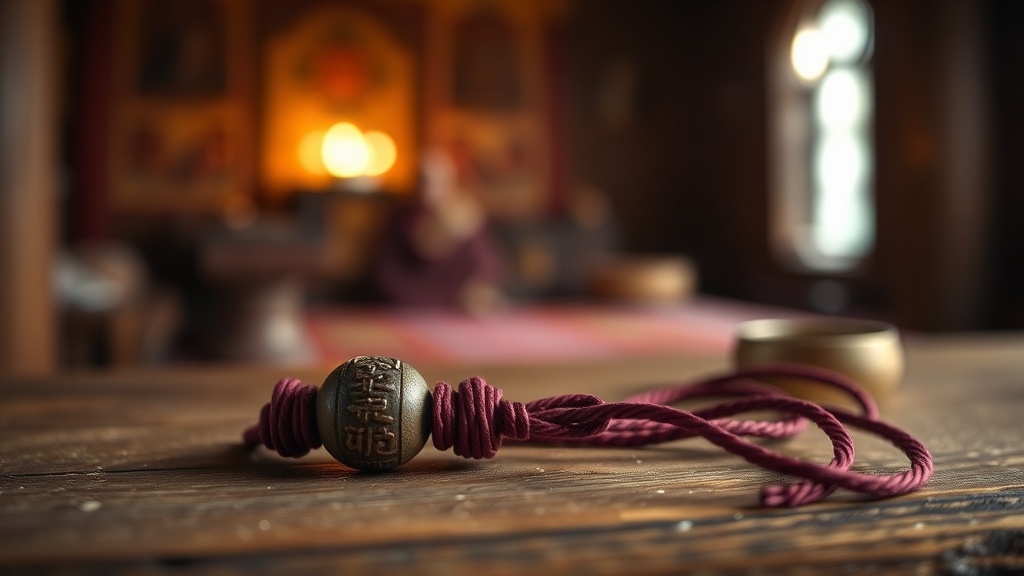
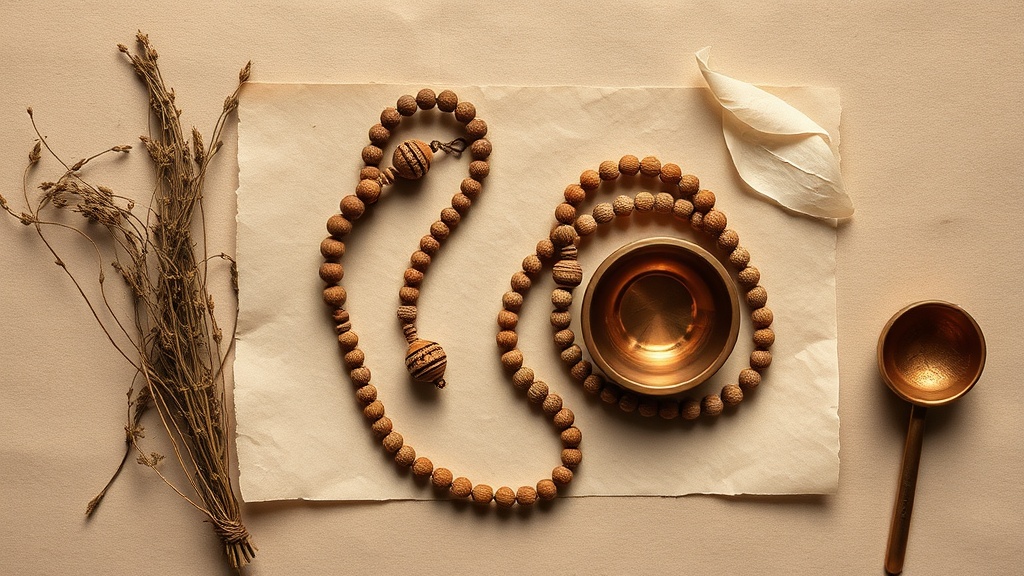
In contemporary Tibetan communities, both on the plateau and in diaspora in India, Nepal, Europe, and North America, dzi beads continue to be worn as part of daily dress and practice. The most common configuration is a single bead strung on a cord or set into a silver or copper mounting and worn at the wrist or neck. Some practitioners incorporate a dzi into a mala alongside other beads; others keep a single bead on the altar alongside statues and offerings.
The decision of which dzi to wear, and when, is often made in consultation with a lama or an astrologer familiar with Tibetan systems of divination. The nine-eye dzi, for instance, might be recommended for someone navigating a period of significant change; the two-eye dzi for someone in a new partnership. These recommendations draw on the same corpus of knowledge used in jyotish-influenced Tibetan astrology (kartsi), which calculates auspicious times and object-person compatibility based on birth year, element, and circumstance.
It should be said plainly: the qualities attributed to dzi beads belong to spiritual tradition and belief. No therapeutic or protective effect is scientifically recognized. Dzi beads are not substitutes for medical advice, mental health support, or professional guidance of any kind. Their value lies in their cultural depth, their craftsmanship, and their place within a living tradition, and that is considerable enough.

🗂️ Explore the Collection
Thangka
Painted Tibetan scrolls that share the same devotional world as dzi beads, objects made to anchor practice in a specific place and lineage.
26 références
Discover the Category →Bringing a Dzi Bead Into Your Practice: What to Know First
For practitioners outside the Tibetan tradition who are drawn to dzi beads, a few grounding points are worth holding onto. The bead you find in a shop or online market is almost certainly a modern reproduction unless explicitly authenticated otherwise, and that is fine. Many contemporary Tibetan craftspeople produce dzi using time-honored methods, and a new bead made with care and knowledge is a legitimate object.
Before buying, it helps to learn at least the basics of the pattern vocabulary: how many eyes a bead has, whether it shows stripes or lotus motifs, and what tradition-based meanings those patterns carry. This is not about believing in the cosmology, it is about understanding the object you are engaging with. A dzi bead worn without any knowledge of what its pattern signifies is simply a striped stone. The same bead worn with even a basic understanding of its cultural context becomes a point of connection to something larger.
If you are a practitioner within a Tibetan Buddhist lineage, consulting your teacher before incorporating a dzi into your practice objects is the most direct path. The teacher-student relationship (guru-shishya) remains the primary channel through which objects, practices, and transmissions are given meaning in Vajrayana Buddhism. No article replaces that.
Questions About Dzi Beads
What exactly are dzi beads made of?+
Authentic dzi beads are made from chalcedony or agate, both varieties of microcrystalline silica. The characteristic black-and-white patterns are produced by applying an alkaline solution to selected areas of the stone before a firing process bleaches those areas. The base stone is typically sourced from regions across Central Asia, including parts of Tibet, Afghanistan, and what is now Pakistan.
How can I tell if a dzi bead is antique or a reproduction?+
Antique dzi beads typically show a surface patina called "skin", a fine milky or waxy film that builds up over centuries of contact with skin, oils, and air. The drilling holes on old beads are often worn smooth and slightly wider at the ends. Modern reproductions, even skilled ones, tend to have sharper pattern edges and a more uniform surface under magnification. For a purchase of significant value, seek a specialist appraiser with documented experience in Himalayan material culture.
Do you have to be a Buddhist to wear a dzi bead?+
No. Dzi beads are worn by Tibetan Buddhists, Bon practitioners, and by people with no formal religious affiliation. That said, understanding the cultural and symbolic context of what you are wearing is a form of respect for the tradition. Many people wear dzi simply as a reminder of a broader orientation toward awareness and intention, which aligns with the spirit of how they have always been used, even if the cosmological framework differs.
Which number of eyes is considered most significant?+
There is no single answer, as significance depends on context, tradition, and the specific person wearing the bead. The nine-eye dzi is among the most widely prized within Tibetan Buddhist frameworks, associated with nine planetary influences and broad merit accumulation. The three-eye dzi is closely linked to the Three Jewels, Buddha, Dharma, and Sangha, making it particularly meaningful for dedicated practitioners. Ultimately, the "right" dzi is the one that connects most directly with your practice or intention, ideally chosen with guidance from someone knowledgeable in the tradition.
Are dzi beads connected to the Bon religion or to Buddhism?+
Both. Dzi beads predate the formal arrival of Buddhism on the Tibetan plateau and are rooted in the indigenous Bon tradition, which populated the landscape with spirits, guardians, and ritual objects. When Buddhism arrived in Tibet from the 7th century onward, dzi were reinterpreted within the new framework rather than discarded. Today, both Bon practitioners and Tibetan Buddhist communities regard dzi beads as significant, the specific symbolic readings differ at the margins, but the core sense of the bead as a charged, meaningful object is shared.


