

Hematite: The Iron Stone Behind Buddhism, Grounding Practices, and Gemstone Jewelry
Pick up a polished hematite stone and you notice something immediately: it is heavier than it looks. That density is not incidental. Hematite is essentially iron oxide, Fe₂O₃, and its specific gravity (around 5.3 g/cm³) is nearly twice that of most common stones. When ancient peoples first worked it into pigment, amulets, and burial offerings, they were handling one of earth's most iron-rich minerals. That fact alone gives the stone a kind of biography worth tracing.
⭐ Key Points
- Hematite is iron oxide (Fe₂O₃) with a specific gravity near 5.3 g/cm³, making it unusually dense for a stone of its size.
- Its name derives from the Greek haima (blood), a reference to the red streak left when the mineral is scratched across a ceramic plate.
- Across Buddhist, Tibetan, and broader Asian traditions, the stone appears in prayer beads, amulets, and ritual objects, primarily valued for its density, durability, and tactile weight during meditation.
- Hematite jewelry (bracelets, malas, necklaces) has grown significantly in popularity; quality varies by polish, bead uniformity, and clasp construction.
- No therapeutic or healing effect of hematite has been validated by clinical research. Any properties attributed to it belong to cultural and spiritual tradition.
What Hematite Actually Is: Mineralogy Without the Mystery
Hematite belongs to the trigonal crystal system and forms in a wide range of geological environments: sedimentary beds, hydrothermal veins, volcanic rock. Its color at the surface ranges from silver-gray to black in its compact, polished form, to red-brown in its powdered or earthy variants. That color difference is not two separate minerals. It is the same compound caught in different physical states.
The red streak hematite leaves on an unglazed ceramic tile has misled more than a few beginners who assumed the shiny metallic stone could not possibly be "red." In fact, the metallic luster of polished hematite comes from its high reflectivity, not its actual color. Scratch it, and iron red appears immediately.
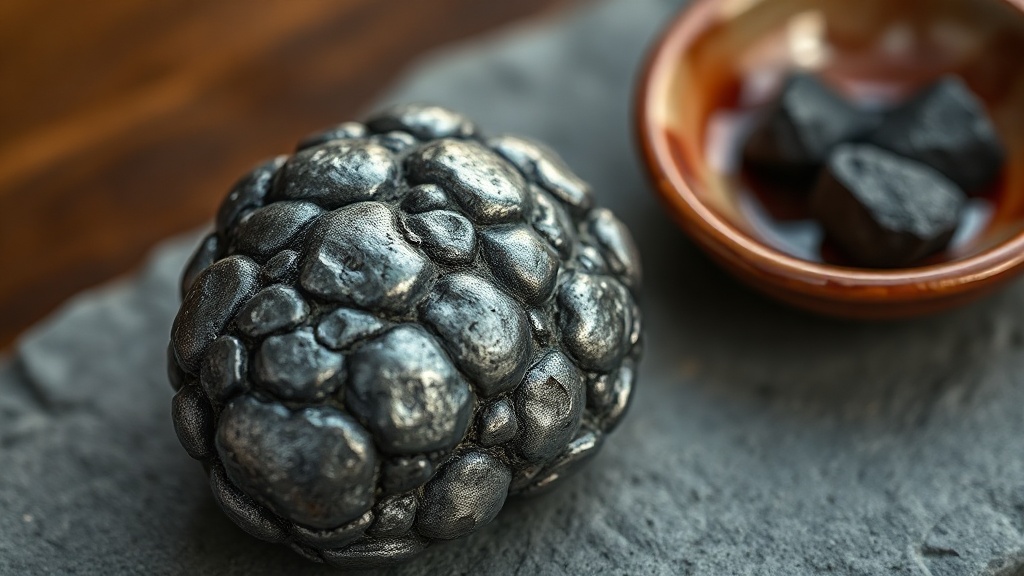
Major deposits sit in Brazil (particularly in the "Iron Quadrangle" of Minas Gerais), Australia's Pilbara region, India, South Africa, and smaller veins across the United States and Europe. Most beads and polished pieces sold in the gemstone trade today originate from Brazil or India. Synthetic hematite (sometimes marketed as "hemalyke" or "magnetic hematite") is also common in jewelry; it is manufactured from iron oxide powder under pressure, and is strongly magnetic, unlike genuine hematite, which is only weakly magnetic or not magnetic at all.
💡 Did You Know?
Hematite was the red pigment in ochre used in some of the oldest known cave paintings in Europe, including sites dated to over 40,000 years ago. The same iron oxide that gives polished jewelry its silver sheen produced the deep rust-red lines drawn by hands that predate writing by tens of thousands of years.
Hematite in Buddhist and Tibetan Tradition
The intersection of hematite and Buddhist practice is less about doctrine and more about material culture. Across Tibetan, Chinese, and Japanese Buddhist contexts, stones selected for prayer beads and ritual objects were chosen based on availability, durability, and the symbolic meanings that accumulated in local tradition over centuries.
In Tibetan practice specifically, the mala (a string of 108 beads used for counting mantras) is made from a variety of materials. Bodhi seeds, bone, crystal, sandalwood, and gemstones including hematite all appear in documented mala traditions. The density of hematite makes it particularly suitable for practitioners who prefer a weighted bead that gives tactile feedback during recitation. The weight keeps attention anchored in the hand.
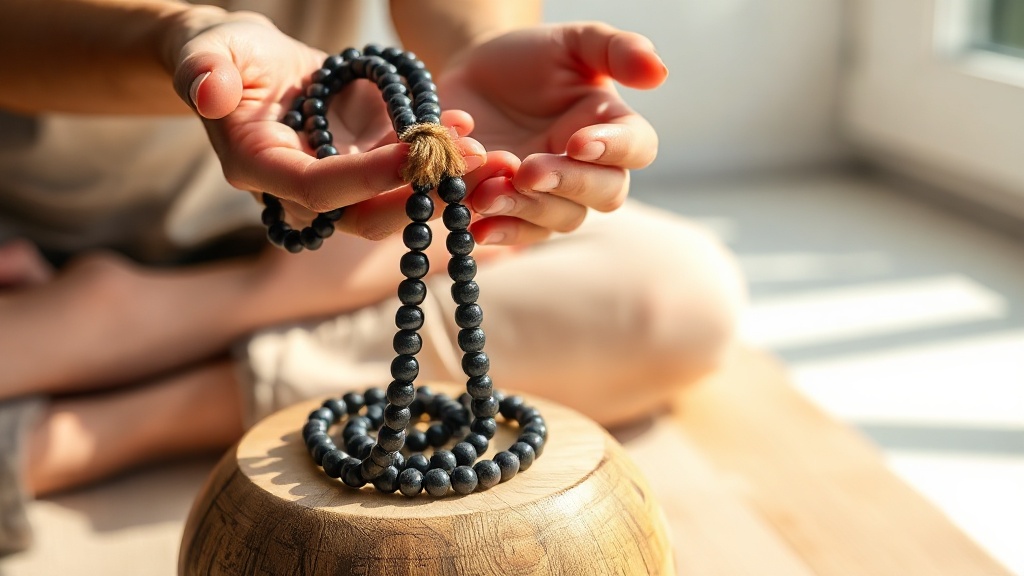
Hematite is not assigned a major role in canonical Buddhist texts such as the Sutta Pitaka or the Abhidharma literature. Its significance is primarily folk-traditional and devotional, not doctrinal. In the Tibetan system of elements and symbolic correspondences, iron-bearing stones have sometimes been associated with the earth element, which is linked to stability and steadiness of mind. According to Tibetan belief, this quality makes hematite a reasonable choice for practitioners working with concentration-based meditations (*samatha*, calm-abiding) rather than expansive visualization practices (*Vajrayana* deity yoga, for instance).
In Chinese Buddhist contexts, hematite appears less frequently in ritual objects but more commonly in feng shui applications, where its density and dark color are associated with the earth element and, in some popular-religion schools, with a protective function. These are folk and lay-religion interpretations, not part of any canonical Buddhist philosophy such as Theravada, Mahayana, or Vajrayana doctrine.
Hematite Jewelry: Bracelets, Malas, and Necklaces
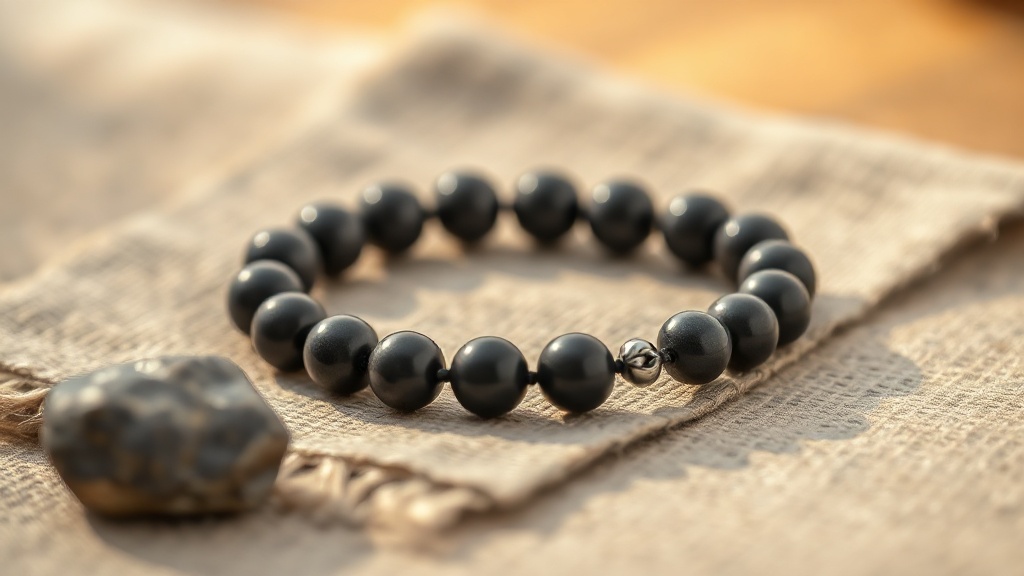
The modern hematite jewelry market spans a wide range in quality. At the lower end, beads are often synthetic (the "magnetic hematite" variety), strung on elastic cord with minimal finishing. At the higher end, natural hematite beads are hand-ground, polished to a consistent sheen, and strung on nylon-coated steel wire or knotted silk with proper closures.
Knowing which you are buying matters, both for durability and for honesty about what you own. A quick test: hold a bead next to a standard refrigerator magnet. Natural hematite will show weak or no attraction. A strongly magnetic bead is almost certainly synthetic. That is not necessarily a problem for decorative purposes, but it is worth knowing.
| Feature | Natural Hematite | Synthetic "Magnetic" Hematite |
|---|---|---|
| Composition | Fe₂O₃ (iron oxide), naturally formed | Compressed iron oxide powder, barium ferrite added |
| Magnetism | Weak or none | Strongly magnetic |
| Streak color | Red-brown (on ceramic) | Black or dark gray |
| Durability | Hardness 5.5-6.5 on Mohs scale; can chip | Often more brittle; cracks under impact |
| Typical use | Malas, fine jewelry, collector pieces | Fashion jewelry, novelty items |
| Price range | Moderate to high depending on grade | Generally low |
Hematite beads are also commonly paired with other stones in gemstone bracelets and necklaces. Combinations with black tourmaline, obsidian, or onyx are popular in protective-themed jewelry. Combinations with rose quartz, labradorite, or lapis lazuli follow more traditional Buddhist and Himalayan aesthetic lines. The pairing matters for visual contrast and for the symbolic language of the piece.

🗂️ Explore the collection
Gemstone Bracelet
Natural stone bracelets rooted in Buddhist practice, including pieces that pair well with hematite's grounding weight.
64 références
Discover the collection →What Tradition Says: Grounding, Protection, and Mental Clarity
Across folk traditions in East Asia, South Asia, and the Western esoteric tradition, hematite has been associated with grounding, focus, and protection from scattered mental states. In the Tibetan context, this framing maps loosely onto the *samatha* (calm-abiding) practice: the idea that a stable, quiet mind is a prerequisite for any deeper contemplative work. According to Buddhist teaching across both the Theravada and Mahayana traditions, stabilizing the mind is not an optional preliminary but the foundation upon which insight (vipassana in Pali) is built.
"The mind settled in calm is like still water. In still water, you see the bottom clearly."
Traditional Tibetan contemplative saying, widely cited in samatha instruction
Whether hematite contributes to that stillness is a matter of personal practice and belief, not verified science. What is true is that the weight and cool surface of the stone provide a distinct sensory anchor during meditation, one that many practitioners report finding useful precisely because it differs from lighter materials. Tactile distinctiveness can support attention. That is physiology, not metaphysics.
⚠️ Important Note
The qualities attributed to hematite belong to spiritual traditions and cultural beliefs. No therapeutic effect of hematite has been scientifically recognized. Hematite objects are not substitutes for medical advice or treatment. If you are dealing with a health condition, consult a qualified healthcare professional.
How to Choose and Care for Hematite Pieces
Choosing a hematite bracelet, mala, or pendant comes down to three things: material authenticity, bead quality, and construction. Here is what to check before buying.
- Test for magnetism. Natural hematite is not strongly magnetic. If the beads snap hard onto any iron surface, they are most likely synthetic. Neither is inherently bad, but know what you are buying.
- Inspect the polish. Quality hematite beads have a uniform, deep mirror-like surface without flat spots or scratches. Inconsistent polish usually signals low-grade rough material or rushed production.
- Check bead uniformity. On a good mala or bracelet, beads are matched for size and shape. Significant variation in diameter or roundness suggests the beads were not sorted after grinding.
- Examine the stringing material. Elastic alone stretches and snaps. Look for nylon-coated wire, knotted silk (on malas), or a secure metal clasp. This matters most for daily-wear pieces.
- Consider the finish. Hematite comes in round, faceted, disc, and tube bead forms. Faceted beads catch more light but are slightly more prone to chipping on edges. Round beads are the most durable for daily wear.
For care: hematite is a 5.5 to 6.5 on the Mohs hardness scale, which means it will scratch softer stones and be scratched by quartz. Store it separately from harder stones like sapphire or topaz. Wipe with a dry or barely damp cloth. Avoid prolonged contact with water, especially for strung pieces, as moisture can degrade the cord or wire over time. The metallic surface can lose its sheen if exposed to acidic substances. A soft jeweler's cloth is the safest tool for restoring the mirror-like polish between wears.
Hematite in History: From Neolithic Pigment to Roman Armor
The use of hematite predates any organized religion. Ground into ochre, it colored burial sites across Europe and Africa tens of thousands of years ago. The Neolithic site of Çatalhöyük in modern Turkey shows hematite pigment used in wall paintings dated to around 7,000 BCE, making it one of the earliest documented applications of the mineral as a pigment in architectural contexts. Egyptian craftsmen used it in cosmetics. Greek and Roman physicians wrote about it as a blood-staunching agent applied to wounds, a use informed by its blood-red streak.
Roman soldiers reportedly carried hematite amulets into battle, believing the iron-rich stone offered protection. This is early evidence of a persistent pattern: dense, metallic-looking stones with iron content get associated with strength and protection across cultures that had no contact with each other. The same material logic appears in early Japanese ritual contexts and in West African traditional craft.
By the medieval period, hematite appears in European lapidaries (manuscripts cataloguing the properties of stones) as a stone believed to stop bleeding, strengthen the voice, and sharpen the mind. These texts draw on Greek sources, particularly Dioscorides and Pliny the Elder, neither of whom was particularly scientific by modern standards. But the cultural weight accumulated across those sources is substantial, and it explains why hematite carries such a strong symbolic charge in traditions that inherited parts of that literature.
💡 Did You Know?
The word "hematite" comes directly from the Greek haimatites lithos, meaning "blood stone." This is distinct from bloodstone (heliotrope), a green chalcedony with red jasper inclusions. The two stones get confused frequently, but they are entirely different minerals. Hematite's "blood" reference is to its streak, not its body color.
Pairing Hematite with Your Practice or Home Space
Hematite works as a standalone meditation object, but it also integrates naturally into a broader altar or practice space. Its dark, grounding visual weight balances well against lighter materials: natural linen, pale sandstone, unbleached wood. In altar arrangements drawing on Buddhist symbolism, hematite pieces fit alongside statues, incense holders, and offering bowls without competing for visual attention.
As a grounding stone in gemstone jewelry, hematite is particularly suited to people who prefer understated, quietly weighted pieces over colorful or decorative ones. It reads as serious without being severe. That tone fits both a dedicated practice room and a contemporary minimal living space. Practitioners working within the Dharma community (Sangha) often note that the objects surrounding a meditation seat matter: they set a visual and tactile register that either supports or disrupts the transition into practice.

🌱 Tenzin's Recommendation
Gemstone Necklace Collection
Natural stone necklaces grounded in Buddhist craft tradition, including dark stone pieces that pair with hematite's sober aesthetic.
74 références
Discover the collection →For home altars with a Buddhist focus, hematite pairs naturally with statues worked in stone or wood. The tactile and visual weight of the stone echoes the gravity of carved stone Buddha figures. A few polished hematite pieces placed near a seated Buddha figurine or meditation cushion create a quietly coherent material language.

🌱 Tenzin's Recommendation
Green Sandstone Buddha Statue
A hand-carved stone Buddha that shares hematite's grounded, earthy material quality, suited to a calm, intentional altar space.
44.90 USD
Discover the product →Buying Hematite: What the Market Looks Like in 2026
The hematite market sits at an interesting intersection. It is inexpensive enough that low-quality pieces flood online marketplaces, but distinct enough mineralogically that quality pieces stand clearly apart once you know what to look for. Prices for natural hematite beads in bracelet form run from a few dollars for synthetic elastic-strung pieces to $30-$80 for well-constructed natural bead bracelets with proper closures. Mala-format hematite bead strings with knotting and tassels sit in the $25-$100 range depending on bead size and finishing quality.
Loose hematite spheres or palm stones, popular for meditation, run $5-$25 depending on diameter and polish quality. Collector-grade natural hematite crystals in their raw botryoidal form (clusters of small bubble-like surfaces) or as kidney-ore formations can command considerably higher prices from mineral collectors.
When buying online, look for sellers who explicitly state whether the hematite is natural or synthetic, provide close-up photographs of the actual product rather than stock renders, and offer a return policy. The lack of any of those three points is a reasonable reason to look elsewhere. Reputable sellers in the Buddhist and meditation supply space will also typically describe the provenance of their beads (Brazil, India, or Pilbara region, for example) rather than listing only a vague "natural stone" description.
Hematite: Frequently Asked Questions
Is hematite a crystal or a stone?+
Hematite is a mineral, technically an iron oxide (Fe₂O₃). In common use, "stone" and "crystal" are both used loosely to describe it, but hematite does crystallize in the trigonal system and natural specimens can form well-defined crystals. The polished, opaque beads most people encounter in jewelry are compact crystalline material, not single large crystals.
Is hematite magnetic?+
Natural hematite is only weakly magnetic, or not measurably magnetic at all in most polished bead form. The strongly magnetic pieces sold as "magnetic hematite" in many retail and online stores are synthetic: they are manufactured from compressed iron oxide powder with barium ferrite added, which creates strong magnetism. If a bead snaps firmly to a standard household magnet, it is almost certainly synthetic. This is an easy and reliable test before buying.
How do I tell real hematite from magnetic (synthetic) hematite?+
Hold a bead near a standard magnet. Natural hematite is weakly magnetic at most; synthetic "magnetic hematite" or "hemalyke" snaps strongly to magnets because it contains barium ferrite. A scratch test on unglazed ceramic also helps: natural hematite leaves a red-brown streak, while synthetic pieces leave a dark gray or black streak.
Is hematite used in Buddhist practice?+
Yes, though its role is primarily material and folk-traditional rather than canonical. Hematite beads appear in Tibetan mala strings alongside bone, crystal, and seed materials. The stone's density gives it distinct tactile qualities during mantra recitation. In Chinese Buddhist folk tradition, it appears in protective amulets and feng shui objects. No major Buddhist canonical text within the Theravada, Mahayana, or Vajrayana traditions assigns specific doctrinal significance to hematite.
Does hematite have healing properties?+
The qualities attributed to hematite belong to spiritual traditions and cultural beliefs, not to verified science. No therapeutic or healing effect of hematite has been clinically demonstrated. These objects are not substitutes for medical advice or treatment. Historical traditions (Greco-Roman, Tibetan, medieval European) ascribed various properties to hematite, and those traditions are interesting cultural history, but they do not constitute evidence of physical health effects.
How do I care for hematite jewelry and malas?+
Wipe hematite pieces with a dry or barely damp soft cloth after wear. Avoid prolonged water exposure: hematite is iron oxide, and moisture penetrating micro-cracks can cause surface oxidation over time. More critically, water degrades the cords, wire, and elastic used in bracelets and malas. Store hematite separately from harder stones such as sapphire or quartz, which can scratch its surface. A soft jeweler's cloth restores the mirror polish between wears. Avoid contact with acidic substances, perfumes, and cleaning products.
Can hematite get wet?+
Brief contact with water will not damage a polished hematite stone. However, prolonged exposure can cause surface rust because hematite is iron oxide: the same process that makes rust also affects hematite's surface if moisture penetrates micro-cracks. More critically, water degrades the cords, wire, and elastic used in bracelets and malas. Dry your hematite jewelry after any contact with water and store it away from humid environments.


