

Jade Buddha: History, Symbolism, and How to Choose One That Lasts
Few objects sit at the intersection of Buddhist tradition, material culture, and everyday devotion quite like a jade Buddha. Whether encountered in a monastery courtyard in Chiang Mai, displayed on a home altar in Taipei, or resting on a desk in London, these small carved figures carry centuries of layered meaning. The stone itself has been revered across East and Southeast Asia for millennia. The figure it takes the shape of carries one of the world's most recognizable spiritual teachings. Together, they form an object that repays careful attention.
Understanding what you are looking at, the type of jade, the pose of the figure, the tradition it comes from, transforms a decorative piece into something far more interesting. This is a guide for anyone who wants to look closer.
⭐ Key takeaways
- "Jade" covers two distinct minerals, nephrite and jadeite, with different origins, hardness, and cultural histories.
- The pose (mudra) of a jade Buddha figure is as meaningful as the material itself.
- Nephrite jade has been used in Chinese Buddhist art for over 3,000 years; jadeite arrived from Burma much later.
- Quality is assessed through color consistency, translucency, surface finish, and carving detail, not price alone.
- A jade Buddha carries cultural and spiritual significance; knowing that context shapes how you receive and care for it.
Two Stones, One Name: Nephrite and Jadeite
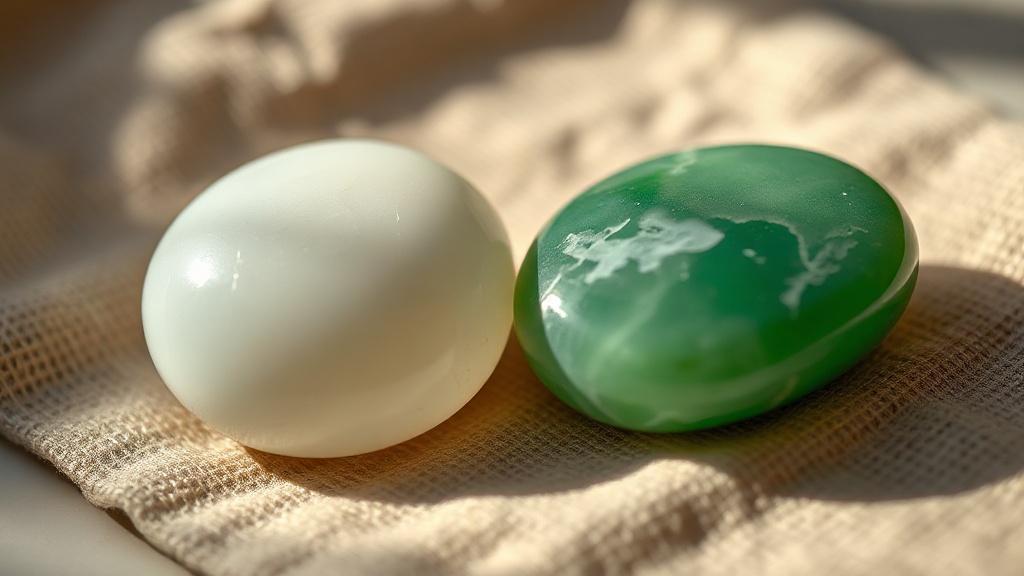
The word "jade" is commonly used for two chemically distinct minerals. Nephrite (a calcium magnesium silicate) and jadeite (a sodium aluminum silicate) share a similar appearance but differ in composition, hardness, and origin. Both have been carved into devotional objects for centuries, yet they come from separate geological and cultural histories.
Nephrite is the older of the two in East Asian craft tradition. Deposits in Hetian (Khotan), in present-day Xinjiang, China, supplied imperial workshops for thousands of years. Its colors range from creamy white through pale green to deep spinach green, and its surface has a characteristic subtle sheen rather than a high gloss. Nephrite rates around 6 to 6.5 on the Mohs hardness scale.
Jadeite, by contrast, is harder (6.5 to 7 on the Mohs scale), more intensely colored, and was introduced to Chinese craftsmen primarily via Burma (present-day Myanmar) during the 18th century under the Qing dynasty. Its most prized variety, "imperial green", is a vivid, semi-transparent emerald green. It is generally rarer and commands higher prices in contemporary markets.
💡 Did you know?
The word "jade" entered European languages through the Spanish piedra de ijada, "stone of the flank", because Spanish colonizers in the Americas observed indigenous peoples pressing the green stone against their sides to relieve pain. The term had nothing to do with East Asian traditions; it was applied retroactively to Chinese nephrite by Western traders.
Why Jade and the Buddha Figure Belong Together
Jade's place in Buddhist visual culture is not accidental. Across Chinese, Vietnamese, Thai, and Tibetan traditions, jade has long been associated with virtue, endurance, and purity, qualities that map naturally onto Buddhist ethical ideals. The Confucian philosopher Xunzi enumerated eleven virtues corresponding to jade's physical properties: its warmth with benevolence, its translucency with knowledge, its hardness with courage. Buddhist craftsmen working within Chinese culture inherited this symbolic vocabulary.
The Buddha figure itself represents Siddhartha Gautama, the historical teacher who attained enlightenment (bodhi) under the Bodhi tree at Bodh Gaya in the 5th century BCE. In Buddhist iconography, carved representations of the Buddha are not idols in the Western theological sense, they are reminders. The Pali Canon (Sutta Pitaka) does not prescribe image worship, but the tradition of venerating Buddha images developed early, particularly in the Mahayana schools, as a way to cultivate mindfulness of the Buddha's qualities.
When that figure is carved in jade, a material already freighted with ideas of moral excellence, the combination concentrates two distinct systems of meaning into a single object.

🗂️ See the collection
Buddhist Decor
Buddha figures, altar pieces, and devotional objects chosen for craft quality and cultural grounding.
57 références
Explore the collection →Reading the Pose: What Each Mudra Tells You
Before buying or receiving a jade Buddha, it is worth being able to read the figure's pose. In Buddhist iconography, the position of the hands (mudra) and the posture of the body are precise visual languages, not decorative choices. Each configuration refers to a specific moment in the Buddha's life or a particular quality of mind.
Bhumisparsha Mudra, Calling the Earth to Witness
The right hand touches or points toward the ground while the left rests in the lap. This is the mudra of the moment of enlightenment at Bodh Gaya, when Siddhartha called the earth itself to witness his awakening against Mara's challenge. It is the most common pose in Southeast Asian Buddha figures, particularly in Thai and Burmese traditions. A jade Buddha in this pose is often used as a focal point for meditation practice.
Dhyana Mudra, Meditation
Both hands rest in the lap, palms facing upward, one resting in the other. This posture represents deep meditative absorption (samadhi). It appears frequently in Zen-influenced Japanese Buddhist art and in Tibetan representations of specific meditating deities. A jade figure in this pose is well-suited to a home meditation space.
Abhaya Mudra, No Fear
The right hand is raised to shoulder height, palm facing outward. In the Pali texts, this gesture is associated with the Buddha's act of calming a charging elephant, a demonstration of fearlessness and compassion. In Chinese Buddhist tradition, standing jade Buddha figures often display this mudra combined with the varada (gift-giving) mudra in the left hand.
The Laughing Buddha, A Separate Figure
The round, laughing figure often sold as a "jade Buddha" in tourist markets is not a representation of Siddhartha Gautama. He is Budai (or Hotei in Japanese), a 10th-century Chinese monk who became a folk deity associated with contentment and abundance. Revered in Chinese popular religion and Chan Buddhism, Budai is a distinct figure. Both have their place, but they are not the same person or tradition.
The Famous Jade Buddha Temples: Objects That Shaped a Tradition
Some jade Buddha figures are not objects you can own, they are pilgrimage destinations in their own right. Understanding these famous examples helps contextualize the wider tradition.
The Emerald Buddha (Phra Kaeo Morakot) at Wat Phra Kaeo in Bangkok is arguably the most politically significant Buddha image in Southeast Asia. Despite its name, it is carved from a single block of green jadeite, approximately 66 centimeters tall in the seated position. Its precise origin remains debated by scholars, with dates ranging from the 14th to the 15th century. The Thai king personally changes its gold seasonal costume three times per year. It is not publicly touchable; devotion takes place from a distance, on the floor of the bot.
The Jade Buddha Temple (Yù Fó Sì) in Shanghai houses two Burmese white jade Buddha figures brought to China in 1882 by the monk Huigen. The seated figure, approximately 190 centimeters tall, is carved from a single piece of white nephrite and is regarded as one of the finest examples of Burmese Buddhist jade carving. The temple remains active, and the figures are venerated daily.
"The image of the Buddha is not the Buddha. But it is not nothing."
A frequently cited observation in Zen teaching on the role of devotional objects
How to Assess Quality in a Jade Buddha Figure
The market for jade Buddha figures ranges from mass-produced resin pieces dyed to look like stone, to hand-carved nephrite of genuine geological and artisanal value. Knowing what to look for keeps you from paying jade prices for something that is neither.
| Criterion | Nephrite | Jadeite |
|---|---|---|
| Hardness (Mohs) | 6, 6.5 | 6.5, 7 |
| Typical color range | Creamy white, pale to dark green, grey | Vivid green, white, lavender, black |
| Surface luster | Waxy, soft sheen | Vitreous, glassy |
| Main origin | China (Hetian), Russia, Canada | Myanmar (Burma), Guatemala |
| Price range | Moderate to high | High to very high (imperial grade) |
| Common imitations | Serpentine, aventurine, dyed marble | Glass, resin, polymer-treated B-grade jadeite |
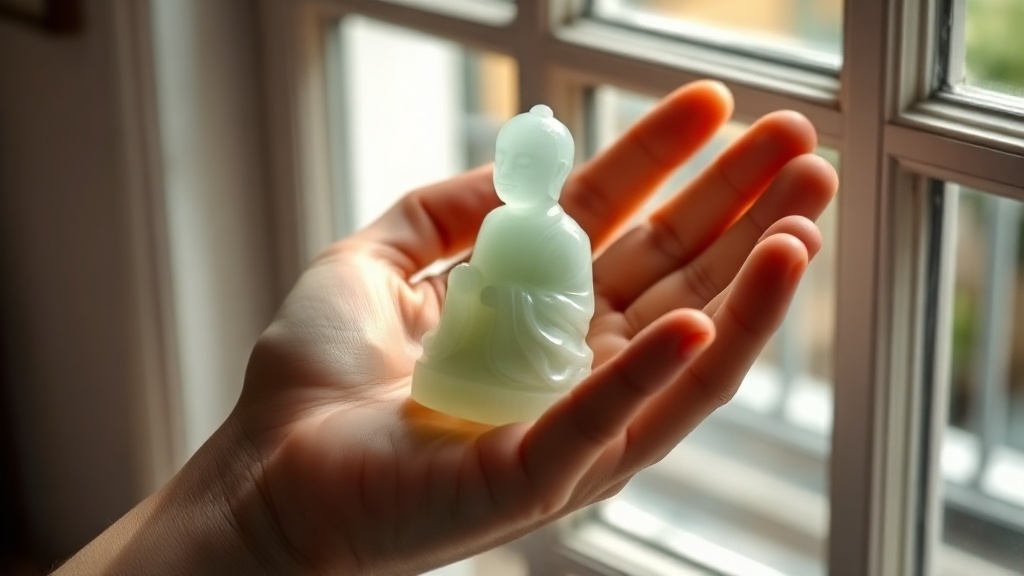
When examining a piece in person, hold it briefly in your hand: genuine nephrite and jadeite stay cool to the touch longer than glass or resin. Look at the carving detail around the fingers, the face, the folds of the robe, these are where shortcuts show. A fine piece will have crisp, clean edges and consistent surface treatment even in recessed areas. Color should be natural and slightly uneven; artificially dyed pieces tend toward an unrealistically uniform hue.
For pieces sold online, always ask for the geological origin, carving method (hand-carved vs. machine-cut), and any certification from a recognized gemological laboratory (GIA, GIC, or equivalent) if the price reflects investment-grade material.
💡 Did you know?
A significant portion of commercial "jade" on the international market is serpentine, a softer magnesium silicate mineral that can look convincingly green but scratches easily with a steel blade. Another common substitute is aventurine quartz, which has a characteristic glitter not found in true jade. Neither is without its own appeal, but they should be sold and priced accurately for what they are.
Caring for a Jade Buddha: Practical Guidance
Jade is durable but not indestructible. A carved jade Buddha figure, whether placed on an altar or a shelf, benefits from minimal but attentive care. Dust with a soft, dry cloth, microfiber works well. Avoid chemical cleaners, which can damage the surface finish, particularly on treated or polished pieces. If the figure needs deeper cleaning, plain lukewarm water with a very small amount of mild soap, followed by thorough drying, is sufficient.
Keep jade figures away from prolonged direct sunlight. While jade itself does not fade, lacquered wooden bases and any painted or gilded details on the figure will degrade over time with UV exposure. If the figure is displayed outdoors or in a very humid environment, check periodically for any surface pitting, which can indicate lower-quality stone with natural fractures.
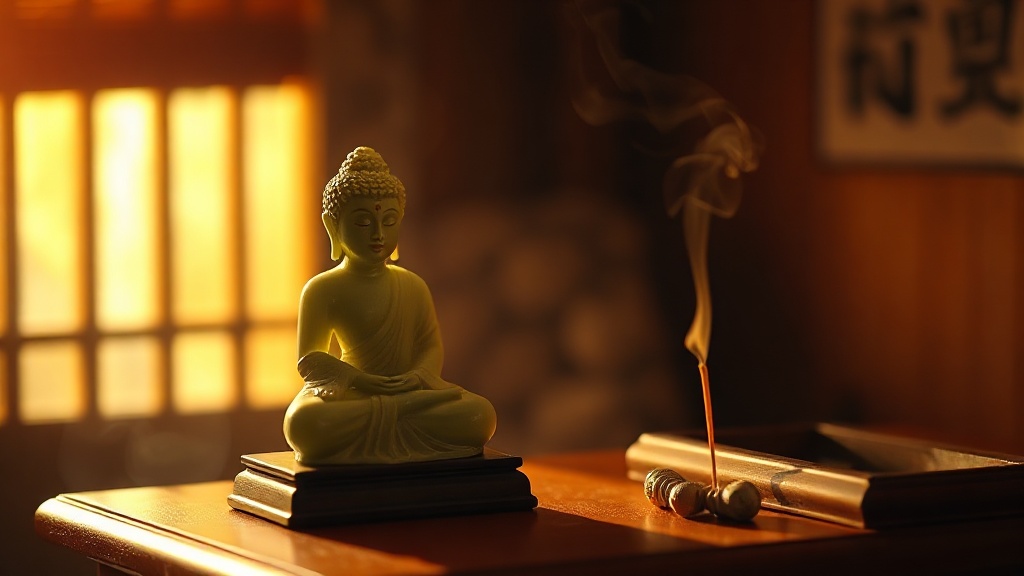
For those placing a jade Buddha on a home altar: in most Chinese and Southeast Asian Buddhist household traditions, the figure is placed at a height above eye level when seated, facing the room or entrance, on a clean, dedicated surface. Fresh water, seasonal flowers, or incense may be offered, though this depends on the practitioner's own tradition and preference. There is no single correct ritual, what matters is intentionality and consistency.

🗂️ See the collection
Zen Decor
Create a calm, intentional altar space with objects rooted in Buddhist and contemplative Asian tradition.
206 références
Explore the collection →Jade Buddha as a Gift: What to Consider
A jade Buddha is among the more considered gifts you can give someone with an interest in Buddhism, meditation, or East Asian culture, but a few things are worth thinking through before you choose.
First, consider the recipient's tradition. Someone rooted in Theravada Buddhism may relate differently to a figure in a Chinese iconographic style than someone practicing within a Mahayana or Chan framework. The Laughing Buddha (Budai) is a joyful, culturally rich figure, but it is not appropriate as a devotional image for someone whose practice centers on the historical Buddha. When in doubt, a simple seated figure in dhyana or bhumisparsha mudra is the most broadly understood and appreciated.
Second, consider scale. A small piece (5 to 10 centimeters) is suited to a desk, a travel altar, or a pocket of contemplative space. A larger figure (20 centimeters and above) makes more sense as a room or altar centerpiece. Proportionality matters both aesthetically and practically.
Third, include the provenance. If you know the type of jade, the approximate origin of the stone, and the carving tradition (Chinese, Burmese, Vietnamese), share that information with the gift. It transforms the object from a decorative item into something with a traceable story, and that, for most people who care about this material, is the real value.
⚠️ A note on attributed properties
In Chinese and some Southeast Asian traditions, jade is believed to carry protective and purifying properties. These are cultural and spiritual attributions rooted in long historical usage. The qualities attributed to stones belong to spiritual traditions and beliefs. No therapeutic effect is scientifically recognized. These objects are not substitutes for medical advice or treatment.
Where Jade Buddha Figures Sit Within the Broader Tradition
A jade Buddha is a specific intersection: a material from the earth with a long history of human attention, shaped into a figure that has served as a focus for contemplative practice across more than two millennia and half a dozen distinct Buddhist schools. It is not a magical object. It is not an investment vehicle (though some pieces have investment value). It is, at its most useful, an anchor, something that pulls attention back toward a particular quality of awareness each time you see it.
The material matters because jade endures. Unlike clay or wood, it resists the ordinary wear of years. A well-made jade Buddha passed between generations carries not just symbolic meaning but tangible continuity, a physical object that outlasts individual lives, accumulating the attention of everyone who has paused in front of it. That is the quiet argument for taking it seriously, whatever your relationship to Buddhist practice.
Frequently asked questions
Is the Emerald Buddha actually made of jade?+
Yes, despite its name, the Emerald Buddha at Wat Phra Kaeo in Bangkok is carved from green jadeite, not emerald. The name refers to its vivid color. It is approximately 66 cm tall in the seated position and remains the most sacred Buddha image in Thailand.
What is the difference between nephrite and jadeite jade?+
They are two chemically distinct minerals that share the name "jade." Nephrite is a calcium magnesium silicate, slightly softer, with a waxy luster, historically associated with Chinese craft traditions. Jadeite is a sodium aluminum silicate, harder and more vividly colored, and became prominent in Chinese culture after Burmese sources were opened up in the 18th century. Both are used to carve Buddha figures.
Is the Laughing Buddha the same as the historical Buddha?+
No. The round, jovial figure commonly called the Laughing Buddha is Budai (Hotei in Japanese), a 10th-century Chinese monk who became a folk deity in Chinese popular religion and Chan Buddhism. He is a distinct figure from Siddhartha Gautama, the historical Buddha. Both appear in jade form, but they represent different traditions and meanings.
How can I tell if a jade Buddha is genuine jade or an imitation?+
Common tests include the cold-touch test (real jade stays cool longer than glass or resin), visual inspection for natural color variation (artificial dyes tend to be suspiciously uniform), and examining carving sharpness in fine details. Common imitations include serpentine, aventurine quartz, dyed marble, and polymer-treated stone. For high-value pieces, a certificate from a recognized gemological laboratory (GIA, GIC) provides reliable confirmation.
Where should I place a jade Buddha in my home?+
In most Chinese and Southeast Asian Buddhist household traditions, the figure is placed above eye level when seated, on a clean dedicated surface, facing the room or main entrance. Avoid placing it on the floor, in bathrooms, or in cluttered spaces. Beyond these general conventions, placement depends on your own tradition and practice, a clean, intentional spot that you pass regularly is more meaningful than following any fixed rule.


