

Lapis Lazuli: The Sacred Blue Stone of Buddhist and Ancient Traditions
Lapis lazuli has colored human history for more than six thousand years. Crushed into pigment, carved into amulets, ground into the blue robes of Buddhas painted on cave walls in Bamiyan, this deep-blue metamorphic rock carries a symbolic weight that very few minerals match. It is not a gemstone in the conventional sense: no single crystal, no uniform chemistry. It is a rock, a composite of minerals, predominantly lazurite, with veins of white calcite and gold-flecked pyrite. That combination is exactly what makes it so striking, and so charged with meaning across Buddhist, Islamic, Egyptian, and Renaissance traditions alike. In the pages that follow, we trace the full arc of lapis lazuli's journey: from the Badakhshan mines to Tibetan altars, from medieval paint workshops to the jewelry markets of today.
⭐ Key facts at a glance
- Lapis lazuli is a metamorphic rock, not a single mineral. Its blue color comes primarily from lazurite.
- The finest specimens historically came from the Sar-e-Sang mines in Badakhshan, Afghanistan, active for over 6,000 years.
- In Buddhist iconography, lapis blue is the color of the Medicine Buddha (Sangye Menla), making it one of the most symbolically charged stones in Tibetan practice.
- The term "ultramarine" (the most expensive pigment in medieval Europe) derives from lapis lazuli ground into powder.
- The pyrite inclusions often visible in lapis lazuli were traditionally read as representing the night sky.
From the Mines of Badakhshan to the Altars of Tibet
The Sar-e-Sang mines in the Kokcha Valley of northeastern Afghanistan are the oldest continuously worked source of lapis lazuli on record. Archaeological evidence places their use at around 4000 BCE. From there, raw blocks and finished objects traveled along trade routes that predate the Silk Road, reaching Mesopotamia, Egypt, the Indus Valley, and eventually Central Asia, where Tibetan Buddhist culture would develop its own deep relationship with the stone.
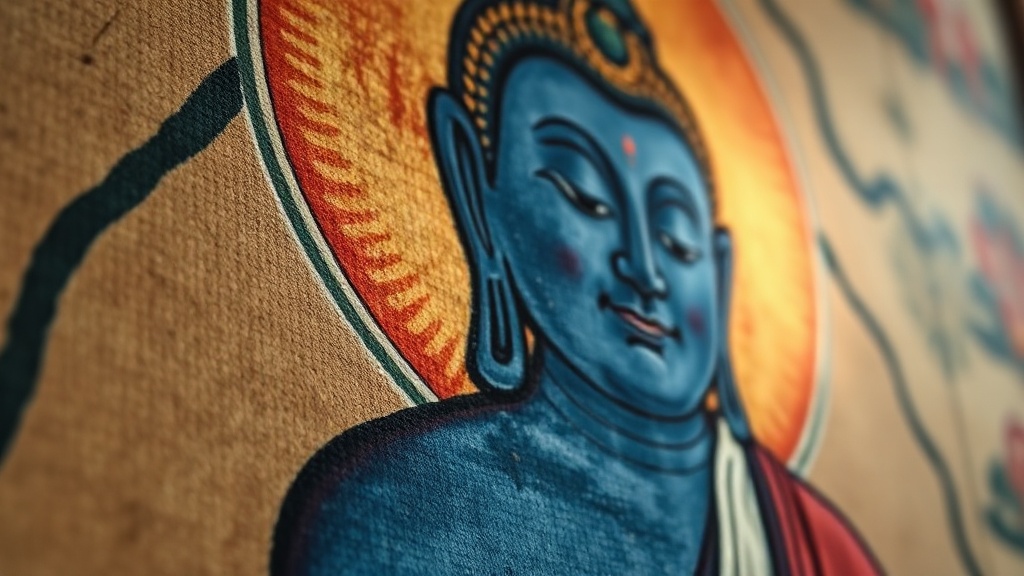
By the time Tibetan Buddhism consolidated its iconographic language, between roughly the 7th and 12th centuries CE, lapis lazuli was already embedded in Buddhist cosmology. The color blue, particularly the saturated, mineral blue of this rock, had become associated with specific qualities: vast open sky, wisdom unclouded by attachment, and the particular radiance of the Medicine Buddha. These associations were not arbitrary. They grew from centuries of visual and ritual use across Buddhist schools, from the Theravada traditions of South and Southeast Asia through the Mahayana and Vajrayana lineages that flourished across the Himalayan arc.
💡 Did you know?
The lapis lazuli used to paint the famous 6th-century Buddhas of Bamiyan (destroyed in 2001) was sourced from the same Badakhshan mines still producing stone today. Researchers studying the pigment traces confirmed the origin after the site was surveyed in the 2000s. The same mountain range has supplied artists, priests, and traders without interruption for at least six millennia.
Lapis Lazuli in Buddhist Iconography: The Color of the Medicine Buddha
In Tibetan Buddhist iconography, color carries doctrinal weight. The five Dhyani Buddhas, for instance, each correspond to a specific color, direction, element, and aspect of awakened mind. Blue, in particular the deep, unbroken blue of lapis, is associated with Akshobhya (the "Unshakeable"), who represents mirror-like wisdom, the transformation of anger into clarity.
But the most direct and sustained association between lapis lazuli and Buddhist practice runs through Sangye Menla, the Medicine Buddha. His body is described in the *Bhaisajyaguru Sutra* (part of the Mahayana canon) as the color of lapis lazuli: a translucent, luminous blue. In Tibetan thangka painting, artists were instructed to grind actual lapis lazuli to render his form. The mineral was not simply a visual stand-in; it was considered materially appropriate, a direct expression of the teaching embedded in his form.
"May all beings be freed from suffering. May the lapis-blue light of Sangye Menla pervade the six realms."
Traditional aspiration prayer associated with Bhaisajyaguru practice, Tibetan Buddhism
This link between lapis and healing intention is not a modern wellness reframing. It is rooted in centuries of canonical practice. Monks performing Menla *sadhana* (meditation practice) would traditionally visualize the Medicine Buddha's body as lapis lazuli light filling space. Prayer beads made from the stone were used in this practice precisely because of that doctrinal association. The color, the material, and the visualization converge in a single act of concentrated attention. That convergence is what makes lapis lazuli distinctive among the stones used in Buddhist ritual objects: it is not decorative choice but iconographic necessity.

🗂️ Explore the collection
Gemstone Jewelry
Natural stone pieces rooted in Buddhist symbolism, including lapis lazuli and other traditionally significant minerals.
114 références
Browse the collection →Identifying Real Lapis Lazuli: What to Look For
The market for lapis lazuli has always included imitations. In antiquity, dyed jasper and blue glass passed as lapis in trade. Today, the common fakes are dyed howlite (a white, porous stone that takes blue dye readily), sodalite (a visually similar blue mineral that lacks pyrite), and synthetic composites sold as "reconstituted lapis." Knowing the difference matters, both for buyers and for anyone who wants to understand what they are holding.
| Feature | Genuine Lapis Lazuli | Common Imitations |
|---|---|---|
| Color | Deep royal blue, uneven, with white calcite patches and gold pyrite flecks | Too uniform blue (dyed howlite); flat medium blue without pyrite (sodalite) |
| Pyrite inclusions | Visible metallic gold flecks, naturally distributed | Absent (sodalite, howlite) or artificially added (composites) |
| White veining | Natural calcite veins, irregular | Absent or looks painted on (dyed stones) |
| Temperature | Feels cool to the touch, like stone | Plastic composites warm up quickly |
| Acetone test | No color transfer on cotton swab | Dyed howlite leaves blue residue on swab |
| Price range (rough) | Grade A Afghan: $5-$20+ per gram for carvable quality | Significantly lower; suspiciously cheap pieces warrant scrutiny |
Grades of Lapis Lazuli and What They Mean for Jewelry and Objects
Not all lapis lazuli is equal, and the grading system, while informal, is widely used by dealers and craftspeople. The key variables are intensity of blue, the proportion of lazurite to calcite, and the distribution of pyrite.
- Grade A (Persian quality): Deep, uniform royal blue with minimal white calcite. Pyrite flecks fine and evenly distributed. This is the material historically favored for thangka pigment and high-quality carved objects. Primarily sourced from Badakhshan, Afghanistan, and from the Pamir deposits in Tajikistan.
- Grade B (Chilean quality): Medium blue with more visible white patches and sometimes greenish undertones due to a higher calcite content. Used widely in jewelry and decorative objects. Chile became a significant source in the 19th century.
- Grade C (denim lapis): Pale blue, heavily veined with white, occasionally mottled. Often used in lower-price bead production and large decorative items where color uniformity is less critical.
For Buddhist ritual objects and malas intended for practice, Grade A Afghan lapis is the traditional choice. The difference in saturation is immediately visible when comparing strands side by side. For purely decorative pieces or gift items, Grade B works well and is considerably more accessible. Whatever the grade, always request confirmation of origin from the seller: the provenance of lapis lazuli carries both aesthetic and ethical weight, particularly given the complex supply chain realities of contemporary Badakhshan mining (discussed further below).
Lapis Lazuli Across Cultures: Egypt, Islam, and European Art
Buddhism is not the only tradition that assigned lapis lazuli a place of cultural authority. The stone's history runs through at least four civilizations before reaching the Tibetan plateau, and understanding those parallel traditions deepens our sense of why the color blue exercised such persistent hold on the human imagination.
In ancient Egypt, lapis lazuli was imported from Afghanistan via Mesopotamian trade networks as early as 3000 BCE. It appeared in the jewelry of pharaohs, in the inlaid eyes of ceremonial masks (including Tutankhamun's famous burial mask), and was ground into kohl used for cosmetic and ritual purposes. Egyptians associated its deep blue color with the sky, with the primordial waters of creation, and with the hair of the gods. The stone was not merely decorative: it occupied a place within a coherent cosmological system, just as it would later do in Tibetan Buddhist practice.
In the Islamic world, lapis lazuli appeared in architectural tilework and in the illuminated manuscripts of Persian and Mughal courts. The cobalt-blue domes of mosques in Samarkand and Isfahan owe part of their visual language to the same cultural reverence for deep blue that drove the demand for the stone itself. The Persian poets made *lajward* (the Persian word for lapis, from which the European term "lazuli" derives) a recurring figure for the night sky and the vault of heaven.
In medieval and Renaissance Europe, ultramarine pigment ground from lapis lazuli was more expensive than gold by weight. It was reserved for the most sacred figures in paintings: the Virgin Mary's robe, the sky behind Christ, the robes of saints in Byzantine icons. The color's rarity and cost gave it a theological charge. Commissioning a painter to use genuine ultramarine was a statement of spiritual seriousness. This remained the case until synthetic ultramarine was developed in 1826, at which point lapis lazuli lost its monopoly on the color blue, but none of its historical weight.
Caring for Lapis Lazuli Objects and Jewelry
Proper care of lapis lazuli pieces requires understanding the stone's physical nature. Lapis lazuli is relatively soft for a stone used in jewelry, sitting at 5 to 6 on the Mohs hardness scale. Calcite (hardness 3) and pyrite (hardness 6 to 6.5) are both present in the matrix, which means the stone can chip or scratch if handled carelessly. Some practical points worth knowing:
- Keep lapis lazuli away from household chemicals, perfume, and cleaning products. The calcite matrix is slightly porous and can absorb liquids over time, which may dull the surface or, in the case of dyed specimens, accelerate color fade.
- Clean with a soft, slightly damp cloth. No ultrasonic cleaners, no steam cleaning. Both can damage the calcite veins.
- Store separately from harder stones (quartz, diamond, sapphire). Quartz, at hardness 7, will scratch lapis with direct contact.
- For mala beads used in regular practice, the natural oils from skin contact actually help develop a gentle patina over time. This is considered desirable rather than problematic in most traditional contexts.
- Extended exposure to direct sunlight can slightly fade the blue over years. Storing ritual objects away from south-facing windows is a small but worthwhile habit.
- If you have a piece of genuine Grade A Afghan lapis lazuli that you use as a practice object, an occasional light polish with a dry microfiber cloth is all that is needed to maintain its surface. Avoid wax-based polishes, which can clog the porous calcite areas and change the stone's appearance over time.

🗂️ Explore the collection
Gemstone Bracelet
Handpicked natural stone bracelets, including pieces that carry the visual weight and symbolic depth of lapis lazuli in Buddhist tradition.
64 références
Browse the collection →The Tradition Behind Lapis Lazuli Jewelry: Malas, Pendants, and Carvings
Lapis lazuli appears in Buddhist material culture in several distinct forms. Each has its own history and practical context within practice.
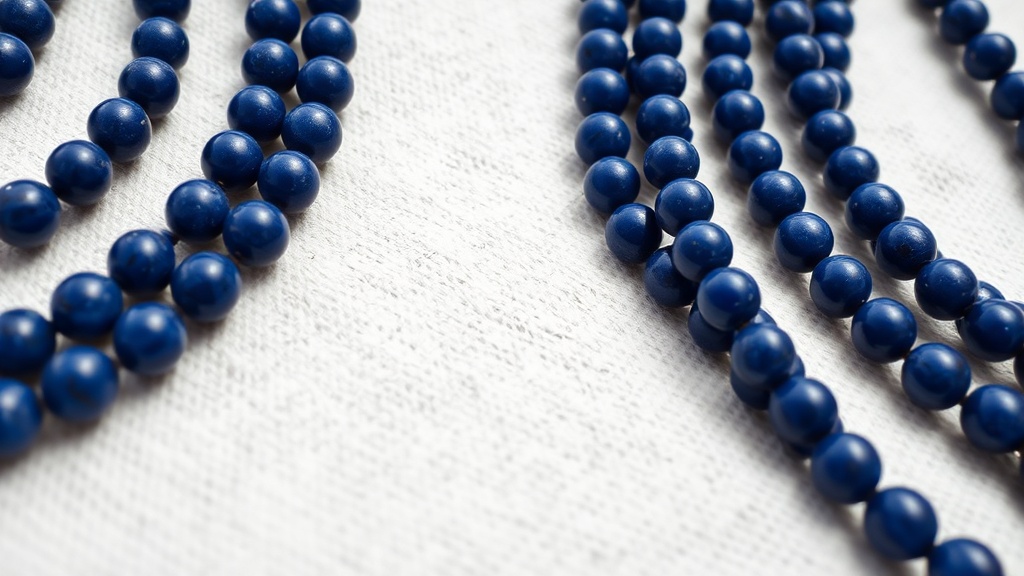
Mala beads made from lapis lazuli are associated primarily with Medicine Buddha practice in Tibetan Buddhism. A traditional mala contains 108 beads, with the number referencing both the 108 defilements described in Theravada texts and the 108 volumes of the *Kangyur* (the Tibetan Buddhist canon). The stone's specific association with Sangye Menla means lapis malas are often used when reciting the Medicine Buddha's mantra: "Tayata Om Bekandze Bekandze Maha Bekandze Radza Samudgate Soha." In Vajrayana practice, according to traditional instruction, the bead itself functions as a tactile anchor for the practice rather than a source of power in its own right. The practitioner's sustained attention and recitation are the substance of the practice; the mala is the support.
If you are looking for a mala rooted in this tradition, the gemstone jewelry collection includes natural stone pieces selected for their material quality and craft finish. For wrist-worn practice pieces, the gemstone bracelet collection offers a range of natural stone bracelets suited to daily wear.
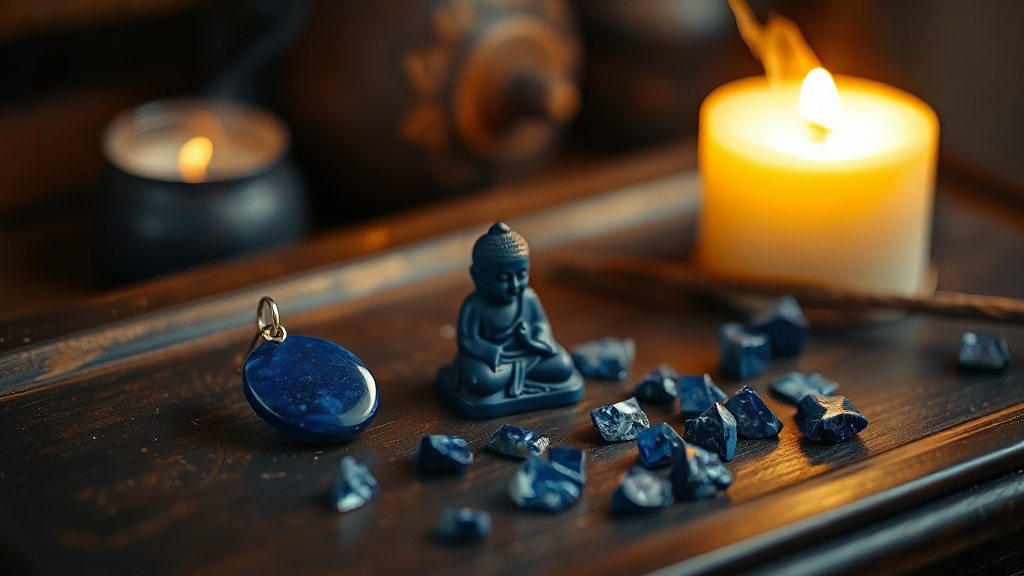
Carved lapis lazuli figures, particularly small seated Buddha forms or Tara statues, have been produced in Afghan and Tibetan workshops for centuries. The material is well-suited to carving at a moderate scale. Small devotional objects between 3 and 10 cm are the most common format. These would typically sit on a home altar alongside other practice supports: a butter lamp, an incense holder, perhaps a text. The carved stone is part of an ensemble; its value is relational and contextual, not isolated.
Pendant forms, most often a simple polished oval or a carved *vajra* (the ritual thunderbolt symbol of Vajrayana Buddhism), are the most widely available lapis objects in contemporary markets. The vajra form in lapis lazuli appears in both Tibetan and Nepalese craft traditions. For necklace forms, the gemstone necklace collection carries natural stone pendants selected with craft quality and symbolic accuracy in mind.
⚠️ A note on attributed properties
The qualities attributed to lapis lazuli in spiritual traditions, including Buddhist and other lineages, belong to the domain of belief and cultural practice. No therapeutic, protective, or other such effect of this stone is scientifically recognized. Lapis lazuli objects are not substitutes for medical advice or treatment. Their significance, where present, is symbolic and devotional.
Lapis Lazuli in Practice Today: Buying, Using, and Honoring the Stone
For anyone approaching lapis lazuli from a Buddhist practice perspective, a few practical considerations help frame what to look for and why it matters.
Source transparency is worth asking about. Afghan lapis lazuli has faced scrutiny over mining conditions and supply chain ethics, particularly from mines operating in conflict-affected areas of Badakhshan. Responsible dealers will often specify the provenance and sourcing context of their stock. This is not a minor concern: the same mines that supplied thangka painters in the 8th century continue to operate, but their contemporary economic and political context is complex. Asking the question is itself a form of engaged attention consistent with Buddhist ethical values around Right Livelihood.
For practice-oriented use, the quality of the material matters less than the intention brought to it. A Grade B bracelet worn with consistent practice attention carries more weight within a Buddhist framework than a Grade A object sitting unused in a drawer. The material supports the practice. It does not replace it.
When purchasing lapis lazuli gemstone jewelry or objects, look for pieces where the craftsmanship respects the material: smooth finishes without visible filling compounds, secure settings that do not stress the stone, and honest description of grade and origin. In the gemstone bracelet category, pieces with elastic or knotted cord construction are generally more durable for daily wear than rigid metal band settings, which can apply pressure that chips the softer calcite areas over time.
FAQ: Lapis Lazuli
What is lapis lazuli exactly, and why is it not called a gemstone?+
Lapis lazuli is a metamorphic rock, not a single mineral. It is composed primarily of lazurite (which gives the blue color), along with calcite (white veins) and pyrite (gold flecks). Gemologists distinguish between minerals (single crystal structures) and rocks (aggregates of minerals). Because lapis lazuli is a rock, it behaves differently than single-crystal gems: it is softer in some areas than others, it can be porous, and its visual character varies from piece to piece.
Where does the best lapis lazuli come from?+
Historically and by most craft standards, the Sar-e-Sang deposits in Badakhshan province, northeastern Afghanistan, produce the finest lapis lazuli. The deep, uniform royal blue of Afghan-origin material, sometimes called "Persian quality" in the trade, is the benchmark. Tajikistan (from the same Pamir geological formation) produces comparable material. Chile has been a significant commercial source since the 19th century; Chilean lapis tends to have more calcite and a slightly greener tone. Russia (Lake Baikal region) also produces lapis, generally with a more mottled appearance.
Why is lapis lazuli associated with the Medicine Buddha in Tibetan Buddhism?+
According to the *Bhaisajyaguru Sutra*, a Mahayana canonical text, the body of Sangye Menla (the Medicine Buddha) is described as having the color and translucency of lapis lazuli. This textual description became the iconographic standard for thangka painters and sculptors across Tibet, Nepal, and Bhutan. Lapis lazuli was not chosen arbitrarily; the stone's color was first described as the quality of a Buddha's body, and the artistic and ritual association followed from there. In Vajrayana practice, using lapis malas during Medicine Buddha recitation connects the practitioner visually and tactilely with that iconographic tradition.
How do I tell real lapis lazuli from sodalite or dyed howlite?+
Three practical checks: first, look for pyrite flecks (metallic gold dots). Sodalite and howlite do not have them. Second, look for white calcite veining. Genuine lapis lazuli has irregular white patches, while dyed howlite may appear too uniformly blue once dyed. Third, do the acetone test: dab a cotton swab lightly soaked in nail polish remover on an inconspicuous surface. Dyed howlite will transfer color; genuine lapis will not. Always examine in natural daylight rather than shop lighting, which tends to flatten color differences.
Can I wear lapis lazuli jewelry every day?+
Yes, with reasonable care. At Mohs 5 to 6, lapis lazuli is softer than quartz (the mineral in most dust and sand particles), so daily wear will gradually dull the surface over years. For bracelets, elastic or knotted cord construction is gentler on the stone than rigid settings. Remove before swimming, showering, or using cleaning products. Wipe clean with a soft dry cloth. For pieces used in practice (mala beads, pendant), the patina that develops over years of use is generally considered a mark of a well-used practice object rather than damage.
What is the difference between lapis lazuli and sodalite as practice objects?+
From a mineralogical standpoint, sodalite is a single mineral with a more uniform blue-grey color, no pyrite flecks, and no calcite veining. It is not compositionally related to lapis lazuli, though the two are visually similar at a glance. From a doctrinal standpoint within Tibetan Buddhism, the canonical association with the Medicine Buddha is specific to lapis lazuli: sodalite has no comparable iconographic or textual history in Tibetan or Mahayana sources. For practice use where the connection to the Bhaisajyaguru tradition matters, lapis lazuli is the materially appropriate choice.


