

Moonstone Meaning: Symbolism, Cultural Roots, and How to Wear It Mindfully
Pick up a moonstone and hold it toward the light. Something shifts inside the stone, a blue-white glow rolls beneath the surface like light caught under shallow water. That optical effect has a name: *adularescence*. It comes from the way light scatters between the thin layers of feldspar that make up the stone's internal structure. The phenomenon is real, measurable, and striking. What people have done with that visual quality across centuries of spiritual tradition is equally fascinating.
Moonstone meaning is not one fixed thing. It varies by culture, historical period, and the tradition that shaped it. What remains consistent is the stone's visual pull and the human instinct to build stories around it.
⭐ Key points
- Moonstone is a feldspar mineral (orthoclase and albite layers) prized for its adularescent glow
- Its symbolism spans Hindu, Roman, Greek, and Buddhist traditions, each reading it differently
- In Indian tradition, it is considered sacred and linked to lunar deities and intuitive awareness
- Properties attributed to stones belong to spiritual traditions and cultural beliefs, not scientific evidence
- Sourced primarily from Sri Lanka, India, and Madagascar; gem quality is assessed on clarity and glow direction
What Moonstone Actually Is: Mineral Composition and the Adularescence Effect
**Moonstone** belongs to the feldspar group, the most abundant mineral family in the Earth's crust. Specifically, it is composed of two types of feldspar, orthoclase and albite, which cool from magma at different rates and form alternating microscopic layers. When light enters the stone, it scatters between those layers rather than passing straight through. The result is a soft, billowing glow that appears to move as the viewing angle changes.
The technical term for this phenomenon, *adularescence*, comes from the Adula mountain range in Switzerland, where fine specimens of the mineral (then called *adularia*) were first documented by European mineralogists. Gem-quality moonstone is graded by the strength and colour of its glow. The most prized stones show a blue sheen over a colourless or very pale body, visible clearly in multiple directions, not just from one fixed angle.
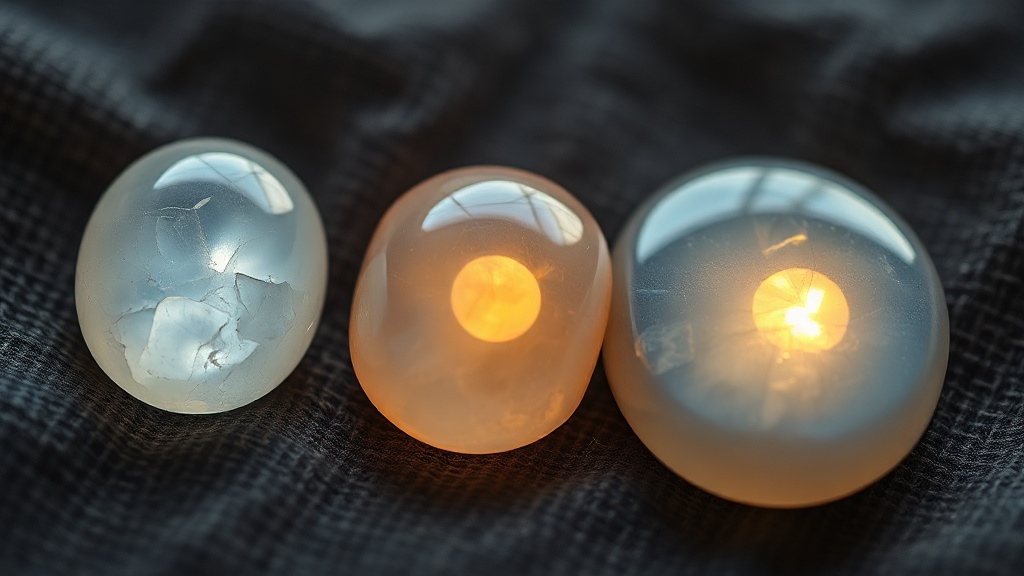
Most high-quality moonstone on the market today comes from Sri Lanka, where it has been mined for centuries. India (particularly Rajasthan) and Madagascar are significant secondary sources. Myanmar produces specimens with stronger body colour. The physical quality varies considerably: some stones are milky-white with a broad, diffused glow; others are near-transparent with an intense blue flash concentrated close to the surface.
💡 Did you know?
Moonstone was used in Art Nouveau jewellery at the turn of the 20th century by designers including René Lalique. Its moody, shifting glow suited the movement's preference for organic, nature-derived forms. This period significantly raised its profile in Western markets, where it had previously been far less known than in South Asia.
Moonstone in Hindu and Indian Tradition
In Hindu tradition, moonstone holds a specific sacred status that other gemstones rarely claim. According to classical Sanskrit texts, it is described as formed from solidified moonbeams, a poetic formulation that carried real doctrinal weight in the tradition. The stone is associated with Chandra, the lunar deity, one of the *Navagraha* (the nine celestial bodies recognised in *Jyotish*, or Vedic astrology).
*Jyotish* assigns each planet a corresponding gemstone believed to mediate that planet's influence on an individual's life. For Chandra, the moon, the primary associated stone is pearl, but moonstone occupies a closely related position, used when pearl is unavailable or as a secondary resonator. Wearing moonstone is, within this framework, understood as a way to align oneself with lunar rhythms: receptivity, introspection, emotional attunement. These are attributions rooted in tradition, not claims of physical effect.
The stone is also associated in some regional traditions with the goddess Parvati and with **Lakshmi**. In Tamil Nadu and Kerala, certain temple ornament traditions incorporate moonstone into ritual jewellery worn by deity statues. The stone was historically considered appropriate for gifts between lovers, particularly at the full moon. This thread remains strong in the contemporary Indian jewellery market, where moonstone is a standard choice for betrothal gifts.

🗂️ Voir la collection
Gemstone Necklace
Natural stone necklaces rooted in Buddhist and Eastern traditions. Moonstone necklaces appear in several styles, from simple Sri Lankan cabochon pendants to Tibetan silver settings with lotus motifs, each grounded in the symbolic vocabulary of the tradition it draws from.
74 références
Découvrir la catégorie →Roman and Greek Readings: The Stone of Diana and Selene
Classical antiquity had its own framework for moonstone. Roman writers associated it with **Diana**, goddess of the moon and the hunt. Pliny the Elder, writing in his Naturalis Historia (c. 77 CE), described a stone he called *astrion* or *selenites* that shifted colour with the lunar cycle, though scholars continue to debate whether he was describing what we now call moonstone, labradorite, or another feldspar variety.
The Greek counterpart was **Selene**, the titaness who personified the moon directly. The stone *selenite* takes its name from the same root, though selenite is a form of gypsum, not feldspar, and is a distinct mineral entirely. The overlap in naming reflects how loosely ancient mineralogical categories were defined. What matters for understanding moonstone meaning in a classical context is the consistent connection: a glowing stone that appeared to contain captured moonlight was naturally linked to lunar deities across cultures that had no direct contact with each other.
Moonstone in Buddhist and Tibetan Context
Buddhism does not have a single canonical teaching on gemstones equivalent to the Hindu *Navagraha* system. The Pali Canon and Mahayana sutras address ethical conduct, meditation practice, and the nature of mind, not mineral correspondences. That said, gemstones appear in Buddhist iconography and material culture in ways that carry symbolic weight.
In **Mahayana** and **Vajrayana** traditions, the wish-fulfilling jewel, *cintamani* in Sanskrit, is one of the Three Jewels symbols (not to be confused with the Three Jewels of the Buddha, Dharma, and Sangha). Depicted as a flaming, glowing sphere in Tibetan *thangka* paintings, the *cintamani* appears in the hands of bodhisattvas including **Ksitigarbha** and Chintamanichakra **Avalokiteshvara**. Some Tibetan teachers have used the metaphor of a glowing stone, a lamp that illuminates from within, to describe the nature of pristine awareness in *Dzogchen* teaching.
Moonstone as a specific mineral is not singled out in any canonical Buddhist source. Where it appears in Buddhist jewellery and altar settings today, it does so through cultural practice rather than textual prescription. Craftspeople in Tibet, Nepal, and Sri Lanka incorporate it into devotional objects because of its beauty and its local cultural resonance with lunar symbolism, not because a sutra mandates it.
What Traditions Attribute to Moonstone: An Honest Account
Different traditions have overlaid moonstone with a consistent cluster of meanings, even without direct cultural exchange. Intuition, inner awareness, receptivity, feminine cycles, and emotional depth come up across Hindu, Roman, and contemporary Western esoteric frameworks. The stone's visual quality, soft, diffuse, inward, lends itself naturally to these associations.
In contemporary lithotherapy and crystal practice, moonstone is often described as a stone that, according to practitioners in these traditions, supports emotional balance and connects the wearer to natural cycles. These attributions come from modern Western esoteric traditions, some of which draw loosely on 19th-century occultism, some on folk healing, and some on more recent texts. They are not uniformly ancient, and they are not consistent across cultures.
The honest position is this: moonstone meaning is culturally constructed, varied, and rich. The stone is beautiful, well-sourced, and carries genuine historical significance in several living traditions. That is a strong enough case to make on its own terms, without adding claims that no tradition can substantiate.
⚠️ Important notice
The qualities attributed to stones, including moonstone, belong to spiritual traditions and cultural beliefs. No therapeutic or physiological effect is scientifically recognised. These objects are not substitutes for medical advice, diagnosis, or treatment. If you are dealing with a health concern, please consult a qualified medical professional.
Varieties of Moonstone: What to Look for When Buying
Not all moonstone is the same. The name covers several related minerals and presentations, and understanding the differences helps when selecting a piece, whether for jewellery, for an altar, or as a gift.
| Type | Origin | Visual character |
|---|---|---|
| Classic white/blue | Sri Lanka | Near-transparent body, strong blue adularescence; most prized for jewellery |
| Peach / orange | India (Rajasthan) | Warm peachy body, softer glow; often cut en cabochon |
| Grey / charcoal | India, Tanzania | Darker body with silver-blue sheen; dramatic in minimal settings |
| Rainbow moonstone | India, Madagascar | Actually a variety of labradorite; multicoloured flash, not true adularescence |
| Cat's eye moonstone | Sri Lanka, India | Shows a single band of light (chatoyancy); rarer and more expensive |
A note on "rainbow moonstone": this term is widely used in the jewellery trade, but the stone it describes is technically white labradorite, a related feldspar mineral but a distinct species. It displays multicoloured *labradorescence* rather than true *adularescence*. The distinction matters if you are buying for traditional or *Jyotish* purposes, where the specific mineral identity is part of the framework. For decorative or contemplative use, it is a striking stone in its own right.
How Moonstone Is Cut and Set in Jewellery
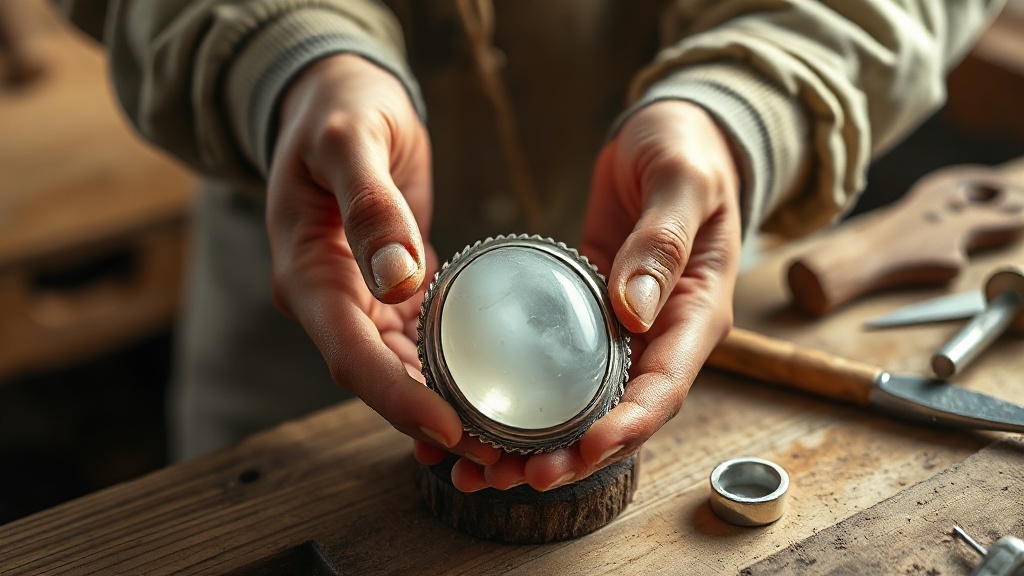
The cabochon cut, a smooth, domed, unfaceted surface, is almost universal for moonstone. Faceting breaks up the stone's internal structure and reduces *adularescence*. The dome shape concentrates the glow toward the viewer's eye and allows the phenomenon to roll across the surface as the stone moves.
The height of the cabochon matters. A too-flat dome pushes the glow toward the edges; a dome with a proper curve (typically at least 4 to 5 mm height for a 10 mm stone) positions it centrally. Quality cutters align the stone's crystal axes carefully before shaping so the glow sits directly at the apex of the dome.
Moonstone jewellery with cultural symbolism, lotus settings, mandala bezels, Tibetan-style silver work, pairs the stone's visual quality with layered meaning. Sterling silver and white gold are the most common metals used, as their cool tone complements the stone's blue-white glow. Yellow gold creates a stronger contrast, which works better for peach or orange varieties.

🗂️ Voir la collection
Gemstone Bracelet
Handcrafted gemstone bracelets rooted in Buddhist practice. Moonstone bracelets in this collection are set in sterling silver or knotted on natural cord, drawing on craft traditions from Nepal and Sri Lanka. The stone's quiet glow translates well to a wrist piece worn during daily practice or quiet reflection.
64 références
Découvrir la catégorie →Caring for Moonstone: Practical Guidance
Moonstone scores 6 to 6.5 on the Mohs hardness scale, significantly softer than quartz (7) or sapphire (9). This places it in a category that requires some care. It can scratch if stored loose with harder stones, and the thin internal layers that create *adularescence* can be disrupted by sharp impact. The mineral also has two directions of cleavage, which means it is somewhat prone to splitting along those planes under direct force.
Practical points worth knowing:
- Store separately from harder gemstones, wrapped in soft cloth or in individual pouches
- Clean with lukewarm water and a soft brush; avoid ultrasonic cleaners, steam, and harsh chemical agents
- Remove before activities involving heavy impact (sport, gardening, moving furniture)
- Avoid prolonged exposure to direct sunlight, which can, over years, affect the stone's body colour in some specimens
- Re-check settings periodically if worn daily; the stone's relative softness means prongs or bezels may need tightening over time
Moonstone as a Gift: What the Choice Communicates
Gifting a moonstone piece carries cultural weight in several traditions. In Indian custom, it appears frequently in gifts marking transitions: an engagement, a new home, the birth of a child. The lunar connection makes it appropriate for gifts tied to cycles, beginnings, and reflection.
In Western jewellery practice, moonstone has long been a June birthstone (alongside pearl and alexandrite in the modern list). This alone makes it a recognised and considered gift for anyone born in that month. Beyond birthstone convention, its visual distinctiveness makes it a strong choice for someone who finds conventional diamond or coloured-stone jewellery too obvious. The stone has a quieter presence. It does not announce itself. That restraint is part of its appeal.
"The moon does not fight. It attacks no one. It does not worry. It does not try to crush others. It keeps to its course, but by its very nature, it gently influences."
Deng Ming-Dao, 365 Tao: Daily Meditations, a reflection that resonates in how many traditions read the stone named for it
Where Moonstone Sits in a Contemplative Practice
For practitioners who work with physical objects as aids to attention, altars, malas, ritual items, moonstone occupies a specific niche. Its glow is subtle. Looking into a quality cabochon for a few seconds genuinely arrests the visual field. Some teachers describe this quality as useful for the early stages of concentration practice (*samatha* in the Pali tradition), where the eye needs a single, soft focal point that neither overstimulates nor bores.
Mala beads incorporating moonstone appear in both Hindu and Buddhist practice contexts, though they are more common in the former. In a Buddhist context, any material used for mala beads is subordinate to the practice itself: the repetition of mantra, the counting of breath, the cultivation of attention. The stone contributes texture, visual interest, and perhaps cultural meaning. It does not alter the practice's efficacy, but it does make the object memorable.
Memorability matters for daily practice. A mala that catches light differently each morning is one you are slightly more likely to pick up. That small engagement threshold is worth something. The same logic applies to a moonstone piece on an altar: its presence is quiet, its invitation to pause is consistent.
🗂️ Voir la collection
Buddhist Decor and Altar Objects
Singing bowls, incense holders, thangkas, and altar accessories sourced from artisan workshops in Nepal and Tibet. A moonstone piece pairs naturally with these objects in a dedicated practice space, creating a coherent visual and material environment for daily sitting.
Explore sacred space accessories
Découvrir la catégorie →If you want to explore how natural stone jewellery intersects with Buddhist symbolism more broadly, the gemstone jewellery collection on this site covers necklaces, bracelets, and sets selected for craft quality and cultural grounding. For altar objects and sacred space decor that complement a moonstone piece, the Buddhist decor collection offers a wider range of traditions and materials.
Frequently asked questions about moonstone
What causes the glow inside a moonstone?+
The glow is called adularescence. It results from light scattering between alternating microscopic layers of two feldspar minerals, orthoclase and albite, inside the stone. The light does not pass straight through; it bounces and diffuses between those layers, producing a soft rolling glow. The quality of the effect depends on the thickness and regularity of those internal layers.
Is rainbow moonstone the same mineral as regular moonstone?+
Not exactly. What is sold as "rainbow moonstone" is technically a white variety of labradorite, a related feldspar mineral but a distinct species. It shows multicoloured labradorescence rather than the blue-white adularescence of true orthoclase moonstone. For decorative purposes, both are attractive. For traditional Jyotish or Vedic astrology use, the distinction matters, as the classical texts reference a specific stone.
What does moonstone represent in Hindu tradition?+
In Hindu tradition and Vedic astrology (Jyotish), moonstone is associated with Chandra, the lunar deity, and linked in the tradition to qualities of emotional sensitivity, intuition, and feminine energy. It is considered sacred in some regional traditions and appears in ritual jewellery. Classical Sanskrit sources describe it as formed from solidified moonbeams, a poetic attribution that reflects the stone's perceived relationship to lunar light.
How hard is moonstone, and can it crack easily?+
Moonstone rates 6 to 6.5 on the Mohs scale, which makes it softer than quartz and considerably softer than sapphire or diamond. It can scratch when in contact with harder materials and may chip if struck sharply on a hard surface. It also has two directions of cleavage, which makes it somewhat prone to splitting along those planes under impact. Handle it with reasonable care, store it separately, and avoid ultrasonic cleaning.
Does moonstone have any connection to Buddhist practice?+
No canonical Buddhist text assigns specific properties to moonstone. The stone appears in Buddhist cultural contexts, altar settings, mala beads, devotional jewellery, through regional practice in Sri Lanka, Nepal, and India, where it carries long cultural resonance. The connection is cultural and aesthetic rather than doctrinal. In Vajrayana iconography, the luminous wish-fulfilling jewel (cintamani) shares some visual metaphorical ground, but they are not the same thing.
Can moonstone be worn every day?+
Yes, with appropriate care. Because moonstone rates 6 to 6.5 on the Mohs scale, daily wear in a ring, which is subject to knocks and abrasion, will eventually produce surface scratches or edge chips. It performs better in pendants, earrings, or bracelets where it is less exposed to hard contact. If you do wear a moonstone ring daily, a bezel setting (which wraps the stone's edge in metal) offers more protection than a prong setting. Inspect the setting every few months and clean gently with lukewarm water.


