

Obsidian and Protection: What the Tradition Actually Says
Few stones carry as much symbolic weight as obsidian. Volcanic in origin, formed when molten lava cools rapidly at the edge of water or air, it has been present in human culture for tens of thousands of years, first as a cutting tool, then as a mirror, then as a ritual object. Today it circulates widely in spiritual communities under the banner of "obsidian protection," a phrase that covers a range of beliefs, traditions, and practices worth looking at carefully and honestly.
What follows isn't a list of promises. It's a grounded look at where the idea of obsidian as a protective stone comes from, how different cultures and spiritual traditions have understood it, and how to work with it in a way that's coherent and intentional, whether you're a dedicated practitioner or simply someone who finds the stone meaningful.
⚠️ Attention
The qualities attributed to stones, including obsidian, belong to spiritual traditions and beliefs. No therapeutic or protective effect is scientifically recognized. These objects are not substitutes for medical advice or treatment. If you are experiencing distress, please consult a qualified healthcare professional.
A Stone Born from Fire and Water
Obsidian is not a mineral in the strict geological sense, it's a naturally occurring volcanic glass. When silica-rich lava is ejected from a volcano and cools faster than crystals can form, the result is this smooth, jet-black (or occasionally banded) glass. Its edges, when fractured, are sharper than surgical steel. This is why it was prized across cultures, from Mesoamerica to Anatolia to the Pacific Islands, as a material for blades, arrowheads, and scrapers long before it became an object of spiritual attention.
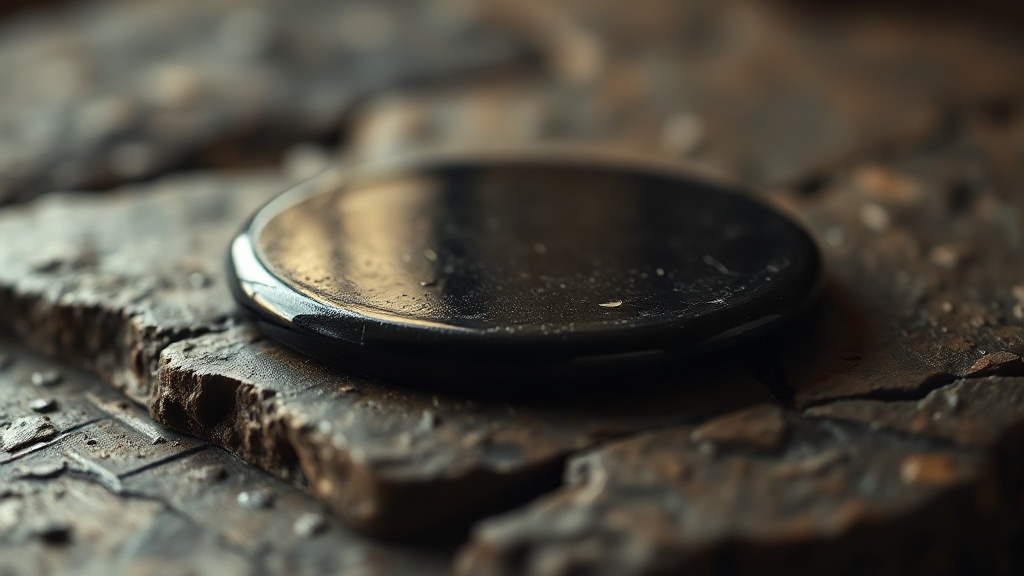
The Aztec and Mexica civilizations fashioned polished obsidian discs into scrying mirrors, surfaces used by priests and diviners to perceive what lay beyond ordinary sight. The Spanish conquistadors brought one such mirror back to Europe, where it became the property of the occultist John Dee in 16th-century England, who called it a "shew stone" and used it in his angelic communications. That single object traces a direct line from Mesoamerican ritual to European esoteric tradition, and gives you a sense of how deep the stone's symbolic roots run.
💡 Did you know?
The Aztec god Tezcatlipoca, whose name translates roughly as "Smoking Mirror", was associated with obsidian mirrors used for divination. His emblems included a black obsidian disc in place of one foot, symbolizing both the darkness of the night sky and the capacity to reveal hidden truths.
How "Protection" Entered the Picture
The association of obsidian with protection doesn't come from a single tradition, it converged gradually from several directions. In many Indigenous American traditions, obsidian blades were buried with the dead or placed at boundaries, not as weapons but as symbolic guardians. The logic was material: something this sharp, this dark, this uncompromising could stand as a ward against unwanted forces.
In Chinese folk traditions, black stones, including black jade (a form of nephrite or jadeite) and occasionally obsidian, have been associated with absorbing negative influences, functioning as a kind of spiritual buffer. This thinking was absorbed into popular Feng Shui practice, where obsidian is sometimes placed near entryways or carried as a pendant to act as what practitioners call a "shield" against disruptive energy.
In Tibetan and broader Vajrayana Buddhist contexts, the emphasis is different. Black stones appear in ritual contexts more rarely, but the concept of protective objects, amulets blessed by lamas, gau boxes containing sacred texts or relics, is well established. The idea isn't that the material itself repels harm, but that it serves as a focal point for intention, blessing, and mindfulness. The protection is relational, not chemical.
⭐ Key points
- Obsidian is volcanic glass, not a crystal, formed by rapid cooling of silica-rich lava.
- Its protective symbolism comes from multiple traditions: Mesoamerican, Chinese folk, Feng Shui, and adjacent to Vajrayana Buddhist practice.
- In most traditions, "protection" refers to spiritual or symbolic function, not physical or medical effect.
- How you work with the stone, your intention, context, and consistency, matters more than the stone itself.
- Cleansing and placement rituals vary by tradition; there is no single "correct" method.
Varieties of Obsidian and Their Symbolic Associations
Not all obsidian looks the same. The most common form is solid black, dense, reflective, occasionally with a faint green or brown iridescence. But several other varieties are well known in both geological and spiritual contexts:
- Rainbow obsidian, displays bands of iridescent color (purple, gold, green) when light catches it at an angle. In contemporary crystal traditions, this variety is associated with gentler introspection.
- Snowflake obsidian, matte black with white or gray "snowflake" patterns formed by clusters of cristobalite. Visually distinctive; often worked into beads and jewelry.
- Mahogany obsidian, streaked with reddish-brown from iron oxide inclusions. Found commonly in Mexico and the western United States.
- Gold sheen obsidian, contains tiny gas bubbles trapped in alignment that create a golden shimmer. Prized for decorative carvings.
For the purpose of obsidian protection symbolism, the solid black variety is the one most consistently referenced across traditions. The others carry their own associations, but the strong, absorptive quality attributed to obsidian in protective contexts tends to be linked specifically to the opaque black form.
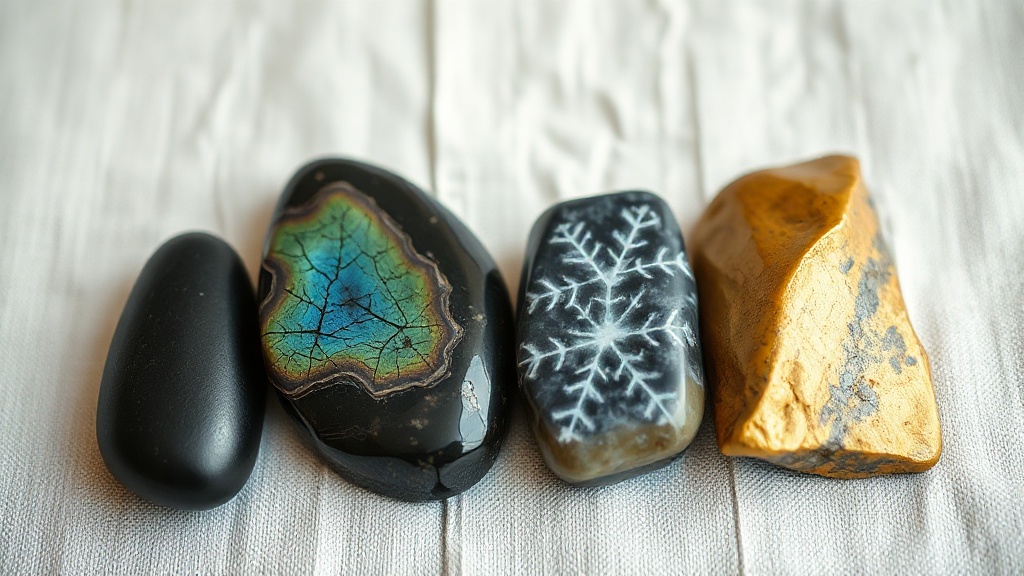
| Variety | Appearance | Common Use |
|---|---|---|
| Black obsidian | Solid, opaque, deep black | Ritual objects, pendants, scrying mirrors |
| Rainbow obsidian | Black with iridescent color play | Jewelry, decorative spheres |
| Snowflake obsidian | Black with white cristobalite patterns | Beads, malas, tumbled stones |
| Gold sheen obsidian | Black with gold shimmer | Carvings, collector pieces |
Obsidian in Contemporary Spiritual Practice
Today, obsidian protection is one of the most frequently cited themes in Western crystal and spirituality communities. The stone appears in meditation spaces, on home altars, worn as pendants or bracelets, and placed at thresholds according to Feng Shui-influenced guidelines. It's worth separating the layers here.
In Feng Shui, placing a black obsidian object near the front entrance of a home is understood to function as a barrier against sha qi, sometimes translated as "killing breath" or disruptive energy. This isn't a modern invention; black objects and mirrors have held this symbolic position in Chinese spatial practice for centuries. The modern form is simplified and adapted for Western interiors, but the underlying logic is coherent within its own system.
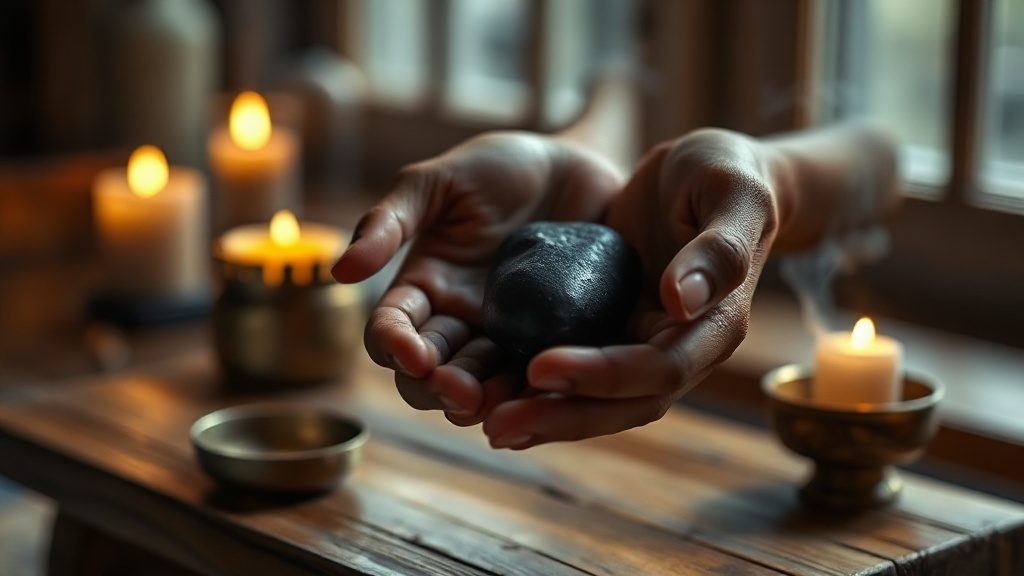
In meditation practice, some practitioners hold or place obsidian nearby as an anchor, a physical object that supports focus and, in their understanding, helps maintain a clear energetic boundary during periods of stillness. This is a contemplative use: the stone functions the way a ritual object does in Buddhist practice, not as a magic talisman but as a support for intention.
Caring for Obsidian: Practical Notes
Obsidian is glass, which means it behaves differently from crystalline stones. It is relatively hard (around 5, 5.5 on the Mohs scale) but brittle, prone to chipping and cracking if struck sharply. Thin pieces, such as arrowheads or carved points, can fracture along conchoidal lines if dropped.
For cleaning, warm water and mild soap are sufficient. Avoid prolonged exposure to direct sunlight if the piece is polished and decorative, some varieties can develop micro-cracks over time. Salt baths, popular in some crystal-care traditions, are safe for obsidian since it's non-porous, but not strictly necessary from a materials standpoint.
Many practitioners in traditions that use ritual cleansing will "clear" an obsidian piece when it's new or after particularly intense periods of use, passing it through incense smoke, placing it outdoors overnight under moonlight, or rinsing it under running water while holding a clear intention. These are ritual acts, not material necessities. Their value lies in what they mean to the practitioner, not in any physical effect on the stone.

🗂️ Explore the collection
Gemstone Bracelets
Natural stone bracelets rooted in Buddhist tradition, a grounded way to carry symbolic intention daily.
64 références
Explore the category →What the Buddhist Tradition Actually Offers on This
Buddhism doesn't center on protective stones as a primary practice, but it has a rich tradition of ritual objects and material supports for the path. In the Theravada tradition, paritta, protective chanting recited by monks, is one of the most common forms of spiritual protection sought by laypeople. The recitation of specific suttas, such as the Metta Sutta (on loving-kindness) or the Ratana Sutta (on the Three Jewels), is understood within that tradition to generate a kind of protective field rooted in virtue and truth.
In Vajrayana Buddhism, phurba daggers (ritual three-sided blades), dorje (thunderbolts), and various amulets blessed through empowerment ceremonies are used as protective ritual objects. Here, the object carries the blessing of the lineage and the practitioner's own commitment to the Dharma, not an intrinsic magical property of the material.
Obsidian doesn't appear as a named substance in canonical Buddhist texts like the Sutta Pitaka or the Bardo Thodol, but the underlying framework, that physical objects can serve as supports for attention, intention, and protection when properly consecrated, is very much part of the tradition. If you work with obsidian within a Buddhist context, that framing is the most honest and coherent one available.
"May all beings be free from danger. May all beings be free from mental suffering. May all beings be free from physical suffering."
From the Metta Sutta (Sutta Nipata 1.8), the canonical Buddhist teaching on loving-kindness as a form of protection

🗂️ Explore the collection
Gemstone Jewelry
Pendants, necklaces, and sets in natural stone, chosen for craft quality and symbolic grounding in contemplative tradition.
114 références
Explore the category →Choosing Obsidian with Intention
If you're drawn to obsidian, whether for its appearance, its history, or its place in a tradition you follow, the most meaningful step is choosing a piece with some care. Mass-produced, dyed, or synthetic "obsidian" pieces do circulate; genuine volcanic obsidian feels cool and weighty, with a glass-like sheen that doesn't scratch easily with a fingernail.
For wearable pieces, pendants, bracelets, rings, the craftsmanship of the setting matters as much as the stone. A well-made piece holds up to daily contact and signals the kind of attention you've brought to the practice. For altar or space use, a tumbled palm stone, a small sphere, or a carved point are the forms most commonly found in ritual contexts. Larger decorative pieces, obsidian obelisks, for instance, can be visually striking but aren't more "effective" in any tradition's terms than a simple, well-chosen smaller piece.
Questions about obsidian protection
What does "obsidian protection" actually mean?+
It refers to the symbolic and ritual role assigned to obsidian in several spiritual traditions, from Mesoamerican divination to Chinese Feng Shui and contemporary crystal practice. In these traditions, obsidian is understood to act as a barrier against disruptive energies or influences. This is a belief rooted in cultural and spiritual tradition, not a scientifically verified property of the stone.
Is obsidian used in Buddhist practice?+
Obsidian is not specifically named in canonical Buddhist texts, but the broader concept of protective ritual objects, amulets, blessed items, ritual tools, is well established especially in Vajrayana Buddhism. If you work with obsidian in a Buddhist context, the meaningful frame is that of an object consecrated through intention and practice, not one with inherent magical properties.
How do I clean and care for an obsidian piece?+
Warm water and mild soap work fine for physical cleaning. Obsidian is glass and is brittle, so avoid sharp impacts and prolonged direct sunlight. For ritual cleansing, passing through smoke, moonlight, or running water, these are traditional practices whose significance is symbolic. They don't alter the material properties of the stone.
Where should I place obsidian in a home according to Feng Shui?+
In Feng Shui practice, black obsidian is commonly placed near the front entrance to act as a symbolic barrier against sha qi (disruptive energy). Some practitioners also place it in the north sector of a room, associated in classical Feng Shui with career and life path. These guidelines belong to a traditional system of spatial arrangement rooted in Taoist cosmology.
What's the difference between black obsidian and black tourmaline?+
Materially, they are very different: obsidian is volcanic glass (amorphous silica), while black tourmaline is a crystalline mineral (schorl). Both appear in contemporary protective stone traditions, but obsidian has the longer documented ritual history. Tourmaline's protective associations are more recent and rooted primarily in 19th and 20th century Western esoteric traditions.


