

Red Jasper: Meaning, Properties, and Uses in Buddhist and Spiritual Traditions
Red jasper is one of the oldest stones in recorded human history. Before it became a popular material for beads, pendants, and altar pieces, it was already being carved into seals and amulets in ancient Mesopotamia, Egypt, and the Indus Valley. The deep brick-red and terracotta tones come from iron oxide inclusions, specifically hematite, distributed through a microcrystalline form of quartz. The result is an opaque, grainy stone with a matte surface and a density that feels immediately substantial in the hand.
In Buddhist, Hindu, and broader Asian spiritual traditions, red jasper carries a long symbolic history. This article covers what the stone actually is, where it comes from, how it appears in contemplative practice, and how to choose and care for pieces made from it. Whether you are a curious beginner, a dedicated practitioner, or someone shopping for a meaningful gift, you will find concrete answers here.
⭐ Key points
- Red jasper is a microcrystalline quartz, colored by iron oxide (hematite) inclusions, with a Mohs hardness of 6.5 to 7.
- Major sources include India, Brazil, Madagascar, Russia, and South Africa; quality varies significantly by origin.
- In Buddhist and Hindu traditions, the stone's red color connects it to grounding symbolism, the root chakra, and protective intent.
- Qualities attributed to red jasper belong to spiritual traditions and beliefs. No therapeutic effect is scientifically recognized.
- It is commonly used in mala beads, pendants, and altar decoration across Tibetan and broader Asian practice.
What Red Jasper Actually Is: Mineralogy and Physical Characteristics
Jasper belongs to the chalcedony family, itself a cryptocrystalline variety of quartz. The individual crystals are too small to see with the naked eye; the stone looks solid and uniform rather than sparkly or transparent. Red jasper specifically gets its coloration from iron-rich inclusions, primarily hematite, that saturate the silica matrix during formation. The concentration and distribution of those inclusions determine whether a piece reads as deep wine-red, brick, terracotta, or a patterned mix.
Hardness sits between 6.5 and 7 on the Mohs scale. That makes it harder than most metals used in jewelry settings, resistant to everyday scratching, and practical for carved pieces intended for frequent handling. The surface takes a good polish, though red jasper almost never achieves the glassy transparency of, say, carnelian. Its opacity is one of its defining visual qualities.
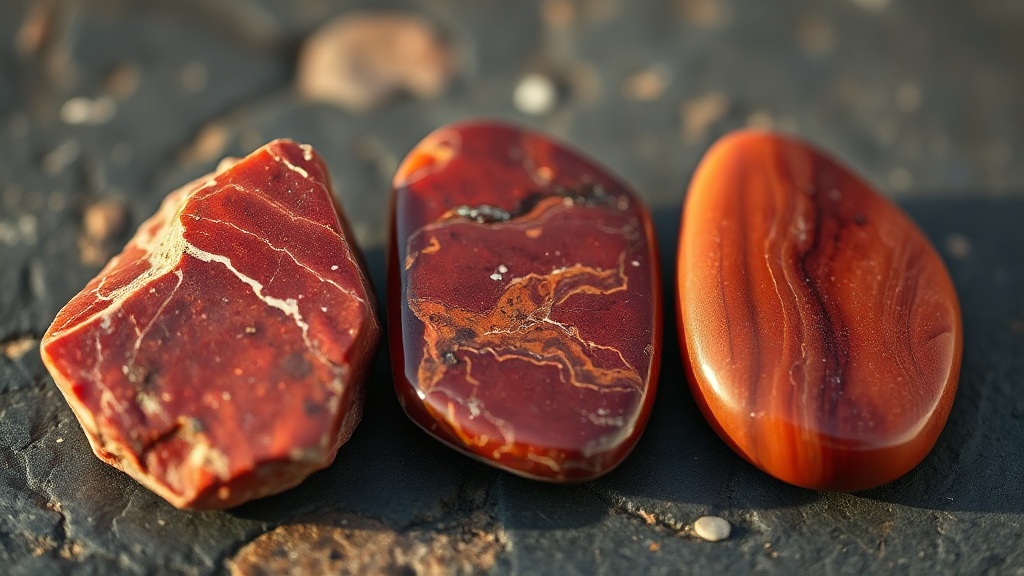
Inclusions and natural banding are common. Pieces labeled "red jasper" can range from near-uniform deep red to stones with cream, yellow, or brown veining. Some traders apply the name loosely to materials that are technically brecciated jasper (fractured and re-cemented), ribbon jasper, or even dyed chalcedony. When buying, uniform color that looks too perfect across a large batch of beads is a signal worth investigating. If you want to cross-reference what genuine stones look like in finished pieces, the gemstone jewelry collection provides useful visual reference across multiple stone types.
💡 Did you know?
The name "jasper" traces back through Old French and Latin to the Greek iaspis, itself borrowed from a Semitic root. Ancient Egyptian priests carved red jasper scarabs as protective amulets, and the stone appears by name in the Book of Revelation as one of the twelve foundation stones of the New Jerusalem. Its recorded use spans at least 4,000 years across three continents.
Origins and Geographic Sources Worth Knowing
The quality and character of red jasper varies considerably depending on where it was mined. India, particularly the Deccan plateau region, produces some of the most consistently deep-red material with fine grain structure. Indian red jasper tends toward rich brick tones with minimal banding, and much of what appears in Buddhist mala beads originates there.
Brazil supplies large quantities, often with more varied patterning. Russian jasper from the Ural Mountains has a longer artisanal history; Russian craftspeople carved it extensively during the 18th and 19th centuries into decorative objects and jewelry. Madagascar and South Africa both produce material, often with more dramatic veining. American deposits exist in Oregon and the Lake Superior region, though commercial quantities are limited.
For pieces sold as spiritual objects, India and Nepal remain the most culturally significant sources. Artisans in Jaipur and Kathmandu have worked with red jasper alongside lapis lazuli, turquoise, and coral for centuries, incorporating it into mala beads, pendant settings, and carved ritual objects. That long craft lineage means sourcing from Indian or Nepali workshops generally supports both quality control and cultural continuity.
Red Jasper in Buddhist and Hindu Traditions
Buddhism does not assign fixed metaphysical properties to specific stones in the way Western lithotherapy does. The relationship between stones and practice in Buddhist contexts is more pragmatic: certain materials carry symbolic associations through their color, their cultural history, or their role in a specific ritual lineage.
Red carries specific resonance in Tibetan Buddhist iconography. It appears in wrathful deity imagery, in certain *mandala* color schemes, and in the robes of protective figures. Within that visual vocabulary, red jasper's deep terracotta tone places it naturally in contexts associated with grounding, stability, and protective intent. According to Tibetan craft tradition, artisans have incorporated it into mala beads alongside bone, coral, and seeds depending on the practice tradition and the teacher's instruction. The choice of bead material in a *mala* is rarely arbitrary: it reflects the teacher's guidance and the specific *sadhana* (practice text) being worked with.
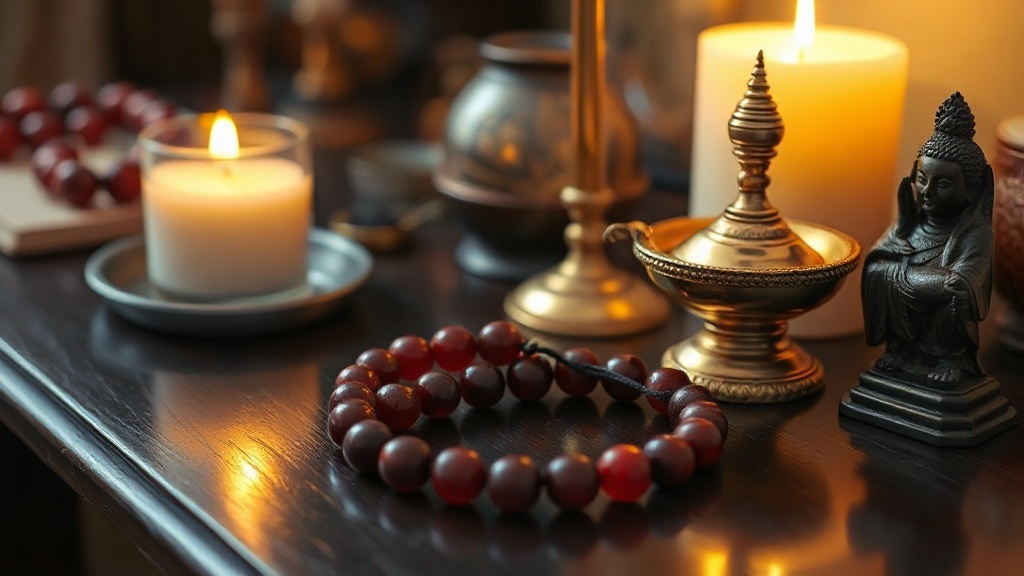
In Hindu tradition, the stone's red color connects it symbolically to the *muladhara* (root) chakra, the energetic center associated with physical grounding and stability in yogic anatomy. That association has carried over into the broader Buddhist-inflected meditation world, where practitioners sometimes use red jasper beads or palm stones during seated practice as a tactile anchor. The stone's weight and texture make it physically suitable for that purpose, regardless of one's views on subtle energy anatomy.
In Chinese spiritual practice, jasper (*yu*) has historically been associated with virtue, strength, and moral integrity, though Chinese ceremonial use more commonly featured nephrite and jadeite. Red jasper appears occasionally in feng shui applications, where its color is linked to fire energy and the south quadrant of the *bagua*.
⚠️ Important note
The qualities attributed to stones belong to spiritual traditions and beliefs. No therapeutic effect is scientifically recognized. These objects are not substitutes for medical advice or treatment. Any account of red jasper's effects on mood, energy, or health reflects cultural and traditional frameworks, not clinical evidence.
How Red Jasper Is Used in Contemplative Practice Today
The most common practical use is in mala beads. A traditional *mala* contains 108 beads, a number with deep significance across both Buddhist and Hindu practice: it represents, among other things, the 108 volumes of the *Kangyur* (the Tibetan Buddhist canon) and the 108 defilements described in certain Theravada texts. Red jasper malas are particularly common in traditions where the practitioner is working with grounding visualizations, earth-element practices, or specific protective mantras. The bead surface, slightly matte after polishing, provides tactile feedback during recitation that many practitioners find helpful for maintaining focus.
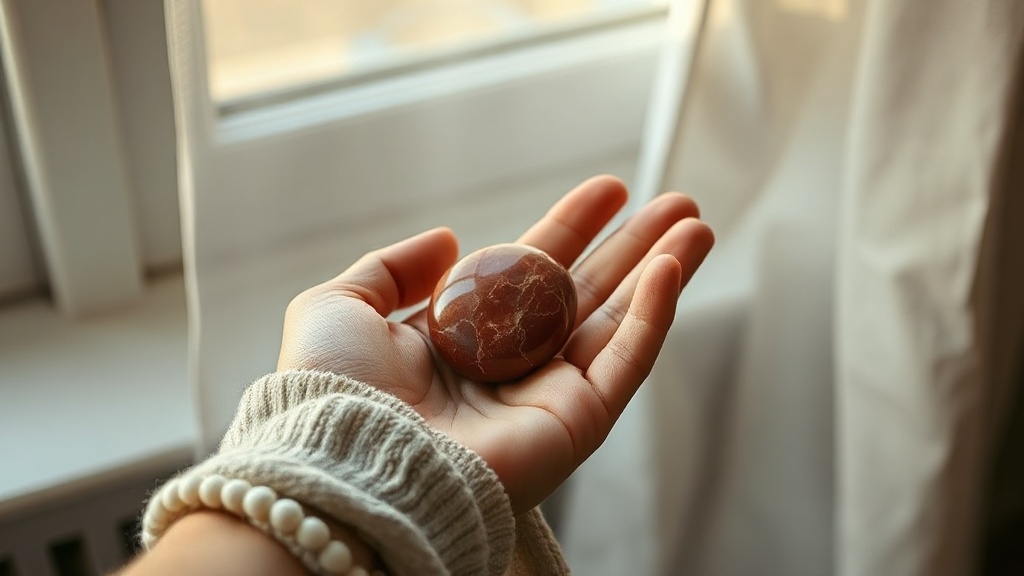
Palm stones are another format. A polished red jasper palm stone, roughly 4 to 6 centimeters across, sits naturally in a cupped hand during seated meditation. The stone's thermal conductivity is relatively low compared to metal objects, meaning it holds body warmth quickly and maintains it, which some practitioners find grounding. That is a straightforward physical property, not a metaphysical claim.
Red jasper also appears in altar arrangements. In Tibetan practice, altar objects are selected with care and placed with intention. A piece of red jasper on a home altar might occupy a position associated with earth elements or protective symbolism, depending on the practitioner's tradition. It is often placed alongside statues, butter lamp holders, and offering bowls rather than as a centerpiece. You can explore complementary altar objects in the Buddhist decor collection.

🗂️ Explore the collection
Red Jasper Bracelets and Gemstone Beads
Natural stone bracelets including red jasper formats, rooted in Buddhist craft traditions, for practitioners who carry their practice beyond the cushion.
64 references
Explore the category →Red Jasper vs. Similar Stones: Telling Them Apart
Red jasper is commonly confused with several other stones, and that confusion has commercial consequences. Here is a direct comparison of the most frequent mix-ups.
| Stone | Transparency | Surface quality | Key distinction |
|---|---|---|---|
| Red Jasper | Fully opaque | Matte to waxy polish | Grainy texture visible under magnification |
| Carnelian | Translucent to semi-transparent | Glassy, high polish | Light passes through thin edges |
| Red Agate | Semi-transparent with banding | High glass-like polish | Visible layered or concentric banding |
| Dyed Howlite | Opaque | Chalky surface, lighter weight | Color bleeds onto cloth; much lighter density |
| Brecciated Jasper | Opaque | Matte with visible fracture patterns | Angular white or cream cement lines visible |
The simplest field test: hold a thin piece up to a strong light source. Red jasper will show no transmission at all. Carnelian and red agate will glow slightly orange at thin edges. Weight is also a reliable indicator: genuine red jasper feels dense and substantial relative to its size. A bead that feels unexpectedly light for its diameter warrants closer inspection. You can also try rubbing the bead gently on a white ceramic surface; dyed materials sometimes leave a faint color trace, while genuine stone does not.
Choosing Red Jasper Pieces: What to Look For
For mala beads, consistency matters more than perfection. A set of 108 beads should have roughly uniform diameter (typically 6mm, 8mm, or 10mm), similar color depth, and no visible surface cracks. Small inclusions and minor color variation are normal and actually indicate natural stone. Factory-perfect uniformity across an entire strand can indicate dyed material or synthetic reconstruction.
For carved pieces, altar stones, or palm stones, surface finish and structural integrity take priority. Run your finger across the surface: it should feel smooth and continuous, with no soft spots or powdery areas. A genuine red jasper palm stone will feel slightly cool to the touch initially, warming quickly in the hand.
Carvings deserve extra scrutiny. Red jasper is carved into Buddha figures, Ganesha forms, and abstract shapes across India and Nepal. A well-carved piece shows clean lines, even color distribution, and natural variation in the stone's character visible within the form itself. Pieces cast from reconstituted stone dust will look more uniform and may show tiny bubbles under magnification.
Price is a rough but useful guide. Genuine red jasper is not rare, so excessively high prices are not necessarily a quality indicator. But suspiciously low prices on large lots of beads or carvings point toward dyed alternatives or synthetic material. At current market rates, a quality 8mm red jasper mala bead strand from an honest supplier runs between $15 and $45 depending on quality and finishing. A carved palm stone of 50 to 80 grams typically falls between $8 and $25.

🗂️ Explore the collection
Red Jasper Pendants and Gemstone Necklaces
Red jasper pendants and natural stone necklaces selected for material quality and cultural grounding in Eastern spiritual craft. A wearable way to keep the stone close through the day.
74 references
Explore the category →
🗂️ Explore the collection
Mala Beads: Natural Stone Strands for Practice
108-bead malas in red jasper and other natural stones, strung by hand using traditional methods. Suitable for daily mantra recitation and meditation across Buddhist and Hindu traditions.
Multiple bead sizes and materials available
Explore the category →Caring for Red Jasper Over Time
Red jasper is forgiving compared to softer stones. At 6.5 to 7 on the Mohs scale, it resists scratching from everyday contact. Still, a few practices extend its life and preserve its surface quality.
Cleaning is straightforward: lukewarm water with mild soap, a soft cloth or soft-bristled brush, and thorough rinsing. Avoid ultrasonic cleaners, which can fracture stones with internal inclusions or pre-existing micro-cracks. Avoid prolonged soaking, particularly for pieces set in metal or strung on cord. Dry thoroughly before storing.
Extended direct sunlight fades some red jasper over months or years. The iron oxide that creates the color is stable under normal indoor light, but pieces displayed outdoors or in strong sunlight near windows may show gradual lightening. Rotate pieces if long-term color retention matters to you.
For mala beads specifically: the string is usually the weak point, not the stone. Most malas use silk, nylon, or cotton cord. Check knots annually, or more frequently if the mala is used daily. Re-stringing is inexpensive and extends a mala's functional life indefinitely. The stones themselves, if free of structural cracks, will outlast many re-stringing cycles. If you are uncertain about bead sizing for a replacement string, 8mm is the most practical all-around diameter: large enough to feel substantial, small enough for a standard 108-bead count to sit comfortably in the hand.
"Even the most durable stone requires a certain attentiveness. To care for an object is already a form of practice."
A principle common across many Buddhist lineages on the treatment of ritual objects
Red Jasper as a Gift: Context and Considerations
Red jasper pieces make practical gifts for practitioners and spiritual seekers when chosen thoughtfully. A palm stone is low-commitment and works for someone at any point in their practice. A mala is more personal: ideally, the recipient chooses their own mala, since bead size, weight, and count carry meaning depending on their specific practice. That said, a quality red jasper bracelet or pendant from a reliable source is a grounded, culturally respectful gift choice.
Avoid over-promising in the gift context. The stone's value lies in its material quality, its cultural history, and the intention behind giving it, not in promises about what it will do for the recipient. A short note explaining the stone's origins and traditional associations is more honest, and usually more appreciated, than claims about energy or healing.
For altar gifts, a well-formed red jasper piece pairs naturally with other earth-toned altar objects. It fits within the aesthetic vocabulary of both Tibetan Buddhist and Hindu home shrines without requiring the recipient to subscribe to any particular metaphysical framework. You can browse the Buddhist decor collection for complementary altar pieces, or explore gemstone jewelry for wearable red jasper formats that suit different lifestyles.
Frequently asked questions about red jasper
Is red jasper a real stone or can it be synthetic?+
Red jasper is a naturally occurring microcrystalline quartz. It is not synthesized commercially (unlike some gemstones), but it is frequently imitated using dyed chalcedony, dyed howlite, or reconstituted stone material. The most reliable way to identify genuine red jasper is its full opacity when held to light, its relatively high density, and its matte-to-waxy polish finish. Rubbing the surface gently on unglazed ceramic (a streak test) can also help: natural stone leaves a pale or colorless streak, while dyed materials may leave a tinted trace.
What does red jasper mean in Buddhist tradition?+
Buddhism does not assign universal meanings to specific stones in its canonical texts. In practice, Tibetan Buddhist artisans have used red jasper in mala beads and decorative objects where its deep red color connects symbolically to grounding, protection, and certain protective deity iconography. According to Tibetan craft tradition, these associations are lineage-specific rather than universal doctrinal positions. A teacher or lineage holder will sometimes specify bead materials for a particular practice.
Can red jasper be used in a mala for daily practice?+
Yes, and it holds up well to daily use. At 6.5 to 7 on the Mohs hardness scale, red jasper beads resist scratching from everyday handling. The main maintenance concern is the mala's cord rather than the stones: check knots every few months and re-string when necessary. The stones themselves will remain in good condition for decades with basic care.
How is red jasper different from carnelian?+
Both are forms of chalcedony and share a warm reddish-orange color range, which causes frequent confusion. The key difference is transparency: carnelian is translucent, and light passes through thin sections. Red jasper is fully opaque at any thickness. Under magnification, red jasper also shows a granular microcrystalline texture, while carnelian appears more uniform. If you hold both up to a lamp in a darkened room, carnelian will glow; red jasper will not.
Does red jasper fade or change color over time?+
Genuine red jasper is color-stable under most indoor conditions. Its red hue comes from iron oxide inclusions integrated into the stone's structure, not from surface treatment. Prolonged, intense direct sunlight over months to years can cause gradual lightening in some specimens. Pieces kept away from strong UV exposure hold their color indefinitely.
What is the best bead size for a red jasper mala used in daily practice?+
The three standard sizes are 6mm, 8mm, and 10mm. For daily mantra recitation, 8mm is the most widely used: it provides enough tactile presence to feel each bead clearly without the strand becoming heavy over a long session. 6mm suits practitioners with smaller hands or those who prefer a lighter mala. 10mm gives a more substantial feel and is often used in Vajrayana practices where the bead material carries specific ritual significance. For red jasper in particular, 8mm strikes the right balance between weight and manageability.


