

Rose Quartz: Meaning, Traditions, and How to Work With It
Rose quartz is one of the most recognized stones on earth. Its pale, translucent pink, ranging from barely-there blush to a deep dusty rose, catches the eye in market stalls, meditation spaces, and jewelry cases across the world. But beyond its appearance, rose quartz carries a long history of symbolic meaning that spans ancient Greece, imperial China, Tibetan ritual practice, and contemporary spiritual traditions. Understanding that history adds depth to the stone itself, whether you wear it, keep it on an altar, or simply find it beautiful.
⭐ À retenir
- Rose quartz is a variety of macrocrystalline quartz colored pink by trace amounts of titanium, iron, or manganese.
- It appears in burial sites, religious iconography, and ritual objects dating back thousands of years across multiple cultures.
- In Tibetan and tantric Buddhist traditions, pink and rose tones are linked to compassion, the central quality of the Bodhisattva path.
- Any qualities attributed to rose quartz belong to spiritual traditions and belief, not clinical medicine.
- The stone pairs naturally with mala practice, altar work, and contemplative jewelry.
What Rose Quartz Actually Is
Rose quartz is a silicon dioxide mineral, a variety of quartz, whose pink color comes from microscopic inclusions of dumortierite or from trace elements such as titanium, iron, or manganese woven into the crystal lattice. It forms in pegmatite rock, typically in massive (non-faceted) form rather than as distinct point crystals, which explains the smooth, cloudy appearance that distinguishes it from clearer quartz varieties.
The most significant deposits are found in Brazil, Madagascar, India, and South Africa, with historically important sources in Sri Lanka and parts of the United States. The stone's hardness sits at 7 on the Mohs scale, making it durable enough for jewelry and carving while still remaining workable by hand tools, a practical quality that craftspeople have exploited for millennia.
Its translucency varies considerably. Some pieces are nearly opaque; others allow light to pass through in a soft, diffused way. High-quality specimens cut into cabochons can display asterism, a six-pointed star effect produced by needle-like inclusions, known as star rose quartz.
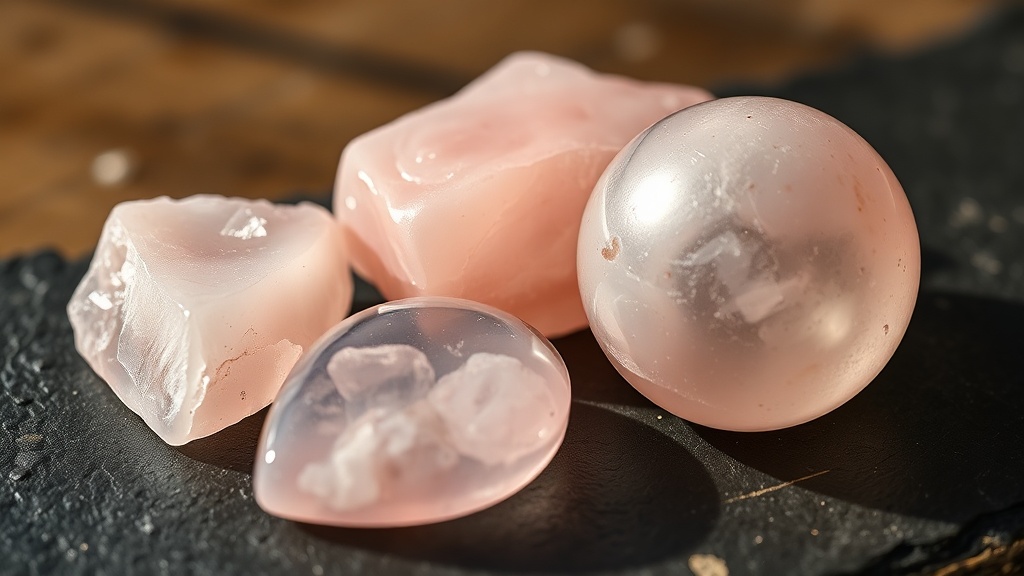
A Stone Across Civilizations
Archaeological evidence places rose quartz in human hands as far back as 7,000 BCE in Mesopotamia, where it was used as an amulet. Ancient Egyptians carved it into facial masks believed to prevent aging and preserve beauty; several such masks have been recovered from burial sites. Greek and Roman women used rose quartz cosmetic tools, and Pliny the Elder, writing in the first century CE, described quartz varieties at length in his Naturalis Historia.
In East Asia, rose quartz was worked into decorative and ritual objects across dynasties. Chinese imperial craftspeople carved it into seals, figurines, and prayer beads. Its pink hue associated it with the heart and with the virtue of benevolence (rén), one of the cardinal Confucian virtues, though this was a cultural, not a Buddhist, framing.
💡 Did you know?
In ancient Rome, rose quartz was associated with Aphrodite/Venus and her son Cupid. According to one version of the myth, the stone's pink color came from the mingled blood of Adonis and Aphrodite, a story recorded in later Roman sources to explain why the stone seemed to hold warmth even in cool conditions.
Rose Quartz in Buddhist and Tantric Traditions
Buddhism does not assign magical properties to stones in any canonical text. The Sutta Pitaka and the Abhidhamma are silent on the subject. What does exist is a rich tradition of using natural materials, including semi-precious stones, as supports for meditation, as offerings, and as components of sacred objects. The significance comes from the intention and the tradition surrounding the object, not from the mineral itself.
In Tibetan Buddhist iconography, pink is strongly associated with Amitabha (Amituofo in Chinese practice), the Buddha of Boundless Light, and with the quality of metta, loving-kindness, in Theravada traditions. The Bodhisattva Avalokiteshvara (Guanyin in Chinese Buddhism, Chenrezig in Tibetan), who embodies compassion, is often depicted in rose or soft pink tones. A mala or bracelet made of rose quartz, when used in the recitation of the Metta Sutta or the mantra Om Mani Padme Hum, functions as a tactile reminder of that compassionate intention, not as a magic talisman, but as a physical anchor for a mental posture.
In tantric Buddhist practice, certain stones are incorporated into ritual objects, thangka borders, offering bowls, and ceremonial jewelry, chosen for their color correspondence with specific Buddhas and their associated qualities. Rose quartz's pink tone places it in the Lotus family (Padma), associated with Amitabha and the discriminating wisdom that transforms attachment into clarity.

🗂️ Voir la collection
Mala Beads
Rose quartz and natural stone malas let you hold your compassion practice in your hands, bead by bead.
51 références
Découvrir la catégorie →How Rose Quartz Is Used in Contemporary Spiritual Practice
Outside of strictly canonical Buddhist use, rose quartz has been adopted widely in contemporary spiritual practice, particularly in traditions influenced by crystal healing, Wicca, and the broader New Age movement. In these contexts, the stone is associated with love, emotional openness, and self-compassion. It is placed on home altars, carried as a pocket stone, worn as jewelry, or used during meditation as a focal point for metta (loving-kindness) practice.
The stone is also commonly incorporated into chakra work. In Hindu and tantric Buddhist systems, the heart chakra (anahata) is located at the center of the chest and is linked to compassion, connection, and equanimity. Rose quartz, with its soft pink color, is traditionally associated with this center, used as a visual or tactile support during seated meditation rather than as a curative object.
⚠️ Important
The qualities attributed to stones, including rose quartz, belong to spiritual traditions and beliefs. No therapeutic effect is scientifically recognized. These objects are not substitutes for medical advice or treatment. If you are dealing with a health concern, please consult a qualified healthcare professional.
Choosing and Caring for Rose Quartz
When selecting rose quartz, the most important variable is simply what speaks to you visually: a paler, more translucent piece versus a deeper, more saturated one. For jewelry and malas, look for consistent color throughout the beads and a smooth surface without deep fractures that could compromise structural integrity over time. For altar pieces and palm stones, surface quality matters less than overall tone and weight in the hand.
Rough rose quartz is widely available and considerably less expensive than faceted or tumbled pieces; it works perfectly well as an altar offering or meditation object. Carved pieces, spheres, hearts, small Buddhas, represent more skilled labor and carry a higher price accordingly. Traditional Tibetan-style carved pieces in rose quartz do exist, typically sourced from Nepalese or Chinese workshops, and represent a genuine intersection of the stone's natural character and Buddhist iconographic tradition.
Rose Quartz in Jewelry: From Malas to Bracelets
Rose quartz beads have been threaded into prayer malas in both Buddhist and Hindu traditions. A full mala of 108 beads in rose quartz makes a quiet, weighty tool for mantra recitation, the stone's smoothness suits the rhythmic movement of fingers across beads during extended practice. Wrist malas and bracelets of 18 or 27 beads are the more common contemporary form, worn through the day as a reminder of intention.
In contemporary jewelry design, rose quartz appears in settings from simple sterling silver cabochon pendants to elaborate multi-stone pieces alongside amethyst, moonstone, and labradorite. The Buddhist market has produced a wide range of pieces combining rose quartz with auspicious symbols: the lotus, the endless knot (shrivatsa), the Dharma wheel (dharmachakra), or the Om syllable. These combinations are primarily aesthetic and devotional rather than strictly canonical.
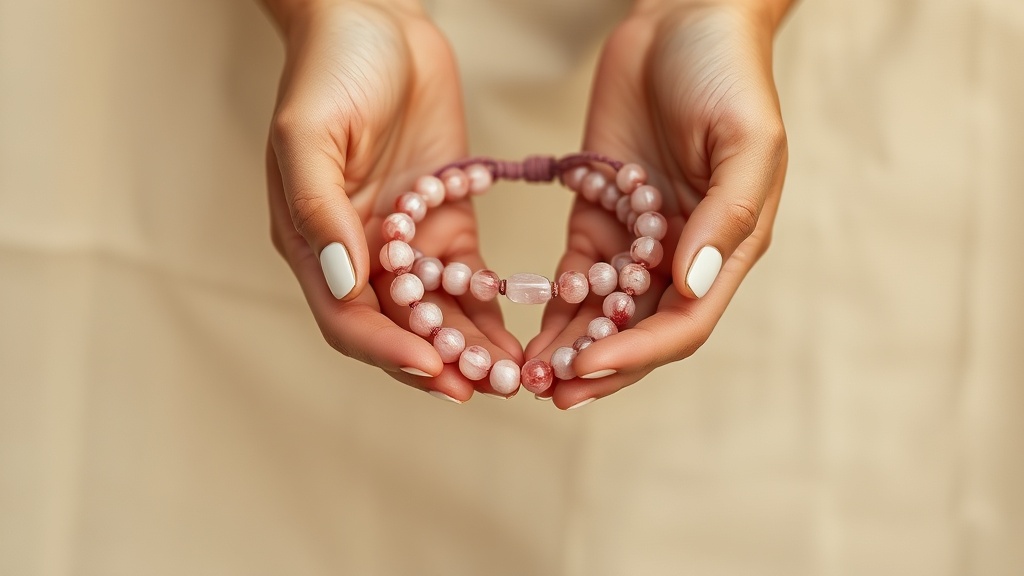

🗂️ Voir la collection
Chakra Jewelry
Natural gemstone pieces, including rose quartz, set within jewelry that honors the chakra system of Hindu and tantric Buddhist traditions.
35 références
Découvrir la catégorie →Sitting With the Stone: Practical Ways to Work With Rose Quartz
The simplest way to incorporate rose quartz into practice is to place it on a home altar or meditation cushion as a visual focal point during seated meditation. The pale pink color is genuinely calming to look at, a quality that requires no metaphysics to appreciate. During a Metta meditation, holding a rose quartz palm stone and directing loving-kindness outward through the traditional phrases ("May all beings be happy, may all beings be free from suffering") can sharpen the felt quality of the practice by giving the body something to anchor to.
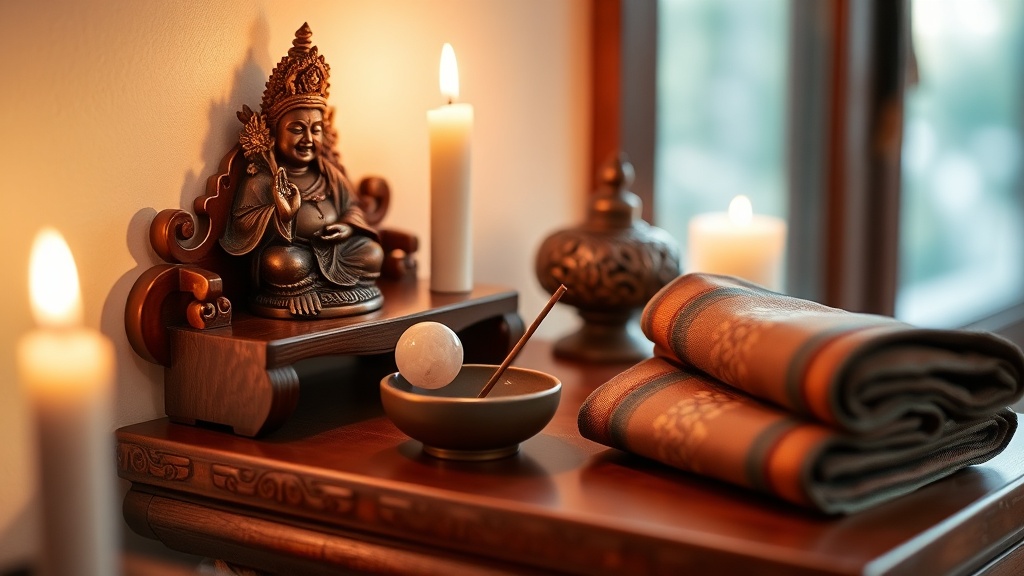
For those who maintain a Buddhist altar, a carved rose quartz piece, a small lotus, a smooth sphere, or a simple rough chunk, makes a meaningful offering alongside incense, water bowls, and flowers. The offering of a beautiful natural object has precedent in Buddhist practice: the Pali Canon describes the offering of garlands and flowers as a mark of respect and devotion (puja), and natural stones occupy a similar conceptual space in Tibetan altar practice.
"May all beings have happiness and the causes of happiness. May all beings be free from suffering and the causes of suffering."
The Four Immeasurables (Brahmaviharas), a foundational recitation in Tibetan and Theravada Buddhism, often practiced alongside a mala or stone.
Frequently Asked Questions
What gives rose quartz its pink color?+
The pink color in rose quartz comes from microscopic inclusions of dumortierite fibers or from trace elements, most commonly titanium, iron, or manganese, embedded within the silicon dioxide crystal structure. The exact combination determines whether a piece reads as pale blush or a deeper, more saturated rose.
Is rose quartz used in Buddhist practice?+
Buddhist canonical texts do not assign spiritual properties to specific stones. However, natural materials including semi-precious stones have a long history of use in Tibetan Buddhist ritual objects, altar offerings, and mala beads. Rose quartz appears in Tibetan-inspired jewelry and altar pieces, often chosen for its pink color's association with compassion (karuṇā) and the Bodhisattva Avalokiteshvara.
Can rose quartz fade over time?+
Yes. Rose quartz is sensitive to prolonged UV exposure and can fade noticeably if left in direct sunlight for extended periods. To preserve its color, store it away from windows when not in use and keep it wrapped in a soft cloth.
What is the difference between rose quartz and pink tourmaline?+
They are entirely different minerals. Rose quartz is a macrocrystalline silicon dioxide; pink tourmaline (rubellite) is a complex boron silicate. Tourmaline typically forms distinct crystals with greater transparency and stronger color saturation. Rose quartz is usually more opaque, softer in tone, and considerably less expensive than gem-quality pink tourmaline.
Does rose quartz have healing properties?+
The qualities attributed to rose quartz, emotional healing, compassion, love, belong to spiritual traditions and beliefs, not to clinical science. No therapeutic effect has been scientifically recognized. Rose quartz should not be used as a substitute for medical advice or treatment. Its value in a spiritual context is symbolic and traditional.


