

Tibetan Turquoise: The Sacred Stone of the Roof of the World
Few stones carry as much cultural weight as turquoise does across the Tibetan plateau. For thousands of years, this blue-green mineral has been woven into the fabric of Tibetan life, worn as jewelry, mounted on ceremonial objects, traded along ancient caravan routes, and placed at the throats of statues as offerings to the divine. To hold a piece of genuine Tibetan turquoise is to hold a small fragment of one of the world's most enduring material cultures.
Yet turquoise is also one of the most misunderstood and frequently imitated stones in the gemstone market. Knowing what it actually is, geologically, historically, and symbolically, helps you appreciate it on its own terms, rather than through the fog of vague spiritual marketing.
⭐ À retenir
- Turquoise has been mined and traded on the Tibetan plateau for over two millennia.
- In Tibetan culture, the stone is deeply connected to sky symbolism, protective amulets, and the color of life-force (bla).
- Genuine Tibetan turquoise is increasingly rare; most pieces sold today come from China, Iran, or the American Southwest.
- Traditional Tibetan jewelry mounts turquoise in silver alongside coral and other stones, each color holding distinct symbolic meaning.
- Stones attributed with spiritual qualities belong to belief traditions, not verified medicine.
What Turquoise Actually Is
Turquoise is a hydrated phosphate of copper and aluminum. Its color ranges from pale sky blue to deep green, depending on the ratio of copper to iron in its chemical structure. The richer the copper content, the bluer the stone; higher iron content shifts it toward green. The matrix, the darker veining running through the stone, is typically the host rock, often brown or black in color, and considered a mark of character rather than a flaw in traditional Tibetan settings.
The stone forms in arid, copper-rich environments through the percolation of water over millions of years. This is why significant deposits cluster in dry, mineral-dense regions: Iran's Nishapur district, the American Southwest, and various zones across China and Central Asia. The Tibetan plateau itself has historically produced turquoise, though the extent of ancient Tibetan mining is debated among geologists and archaeologists.
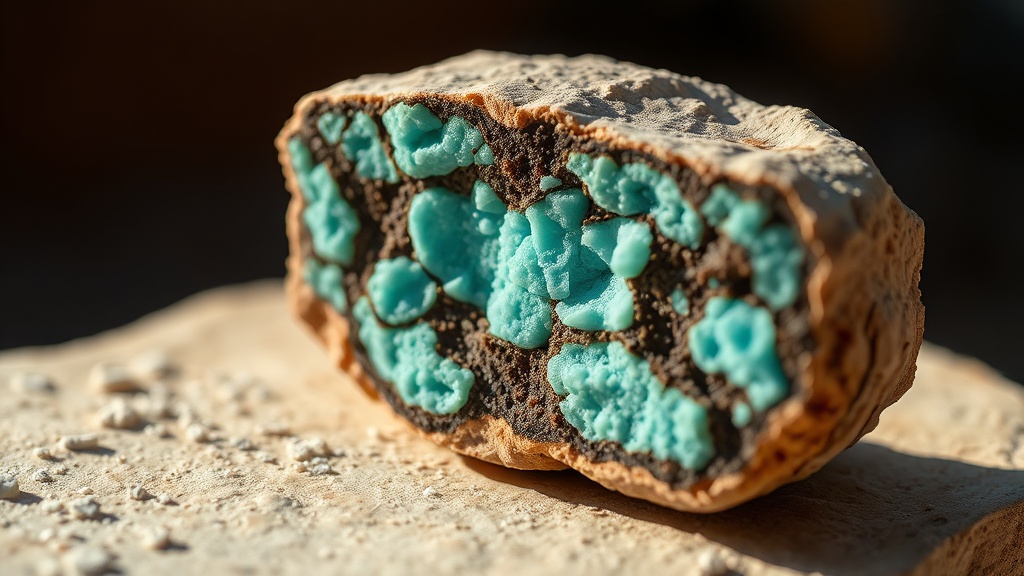
Turquoise is a relatively soft mineral, rating between 5 and 6 on the Mohs hardness scale. This makes it susceptible to scratching and to absorption, oils from skin, perfumes, and cleaning products can alter its color over time. Traditional craftspeople in Tibet and Nepal knew this and often handled stones minimally during setting.
💡 Did you know?
The English word "turquoise" derives from the Old French pierre turquoise, meaning "Turkish stone", because the stone reached European markets via Turkey, not because it was mined there. Persian turquoise, traded through Ottoman routes, was the reference point for European jewelers as far back as the 13th century.
Turquoise in Tibetan Culture and Religion
In Tibetan cosmology and folk religion, turquoise is associated with the sky, with water, and with the concept of bla, a Tibetan term referring to the vitality or life-force that sustains a person. Turquoise amulets have traditionally been worn to protect this life-force, particularly during vulnerable moments such as illness, travel, or childbirth. The stone's sky-blue tones linked it visually to the heavens and, by extension, to the protective deities that inhabit Tibetan sacred geography.
In Tibetan Buddhist ritual practice, turquoise appears on altar objects, in the robes and adornments of sacred statues, and in the regalia of lamas and religious figures. The Bardo Thodol (the text commonly known in the West as the Tibetan Book of the Dead) references jeweled adornments as part of the iconographic language of the peaceful and wrathful deities encountered after death, though it does not specify turquoise by name in most scholarly translations.
Turquoise also held secular prestige. For Tibetan nomads and traders, turquoise jewelry, particularly large headdresses (perak) worn by women in western Tibet, functioned as portable wealth. A family's turquoise collection represented accumulated resources that could be transported across the plateau. This gave the stone both spiritual and economic dimensions that are inseparable in traditional Tibetan life.
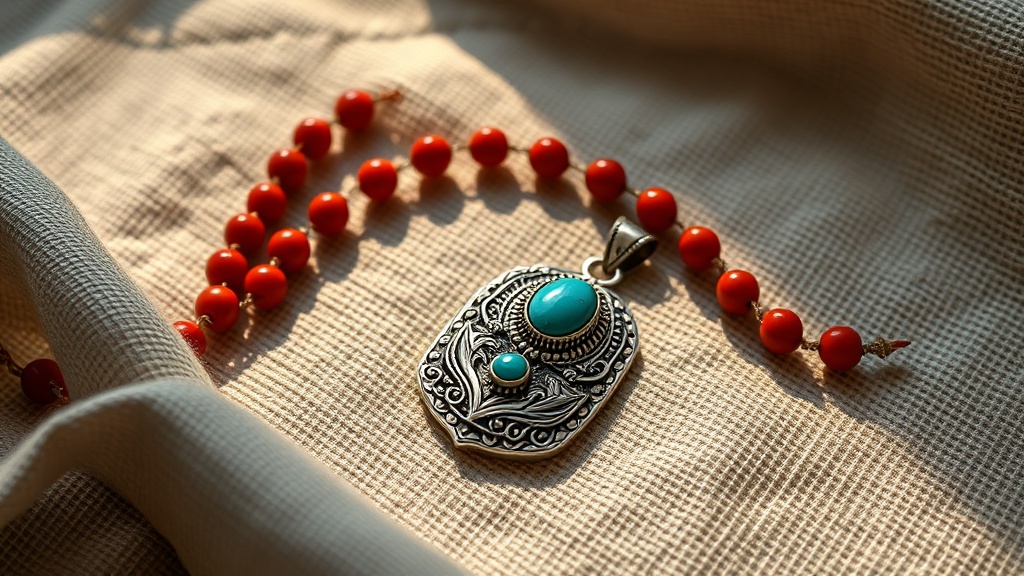
The Three Colors of Tibetan Jewelry
Traditional Tibetan jewelry rarely uses turquoise in isolation. The classic combination is turquoise (blue-green), red coral, and silver, a tricolor arrangement that appears in everything from simple pendants to elaborate festival headdresses. Each element carries symbolic associations within Tibetan culture:
- Turquoise is connected to sky, mind, and the protective life-force.
- Red coral, imported historically from the Mediterranean and Indian Ocean, is associated with blood, vitality, and compassion. In Tibetan Buddhist iconography, the bodhisattva Avalokiteshvara (Chenrezig) is often depicted wearing coral ornaments.
- Silver is linked to the moon, to purity, and to the Dharma itself, the clear, reflective quality of an unobstructed mind.
This combination appears across Tibetan regions, from Kham in the east to Ladakh in the west, with regional variations in proportion and style but remarkable consistency in the underlying symbolic logic.
| Element | Traditional Symbolic Association | Common Source |
|---|---|---|
| Turquoise | Sky, life-force (bla), protective energy | Tibet, China, Iran, Central Asia |
| Red Coral | Blood, vitality, compassion (Chenrezig) | Mediterranean, Indian Ocean |
| Silver | Moon, purity, the Dharma | Tibet, Nepal, India |
| Amber / Dzi Beads | Protection, longevity, ancient blessings | Baltic, Southeast Asia (dzi: Himalayan region) |
How to Tell Real Turquoise from Imitation
The market for turquoise, and specifically for pieces labeled "Tibetan turquoise", is flooded with imitations. Understanding the main categories helps you navigate with more confidence.
Stabilized turquoise is real turquoise that has been treated with resin or epoxy to harden it and intensify its color. The majority of turquoise sold commercially today is stabilized. It is not fraudulent, but it should be disclosed and priced accordingly, it is worth less than untreated natural stone.
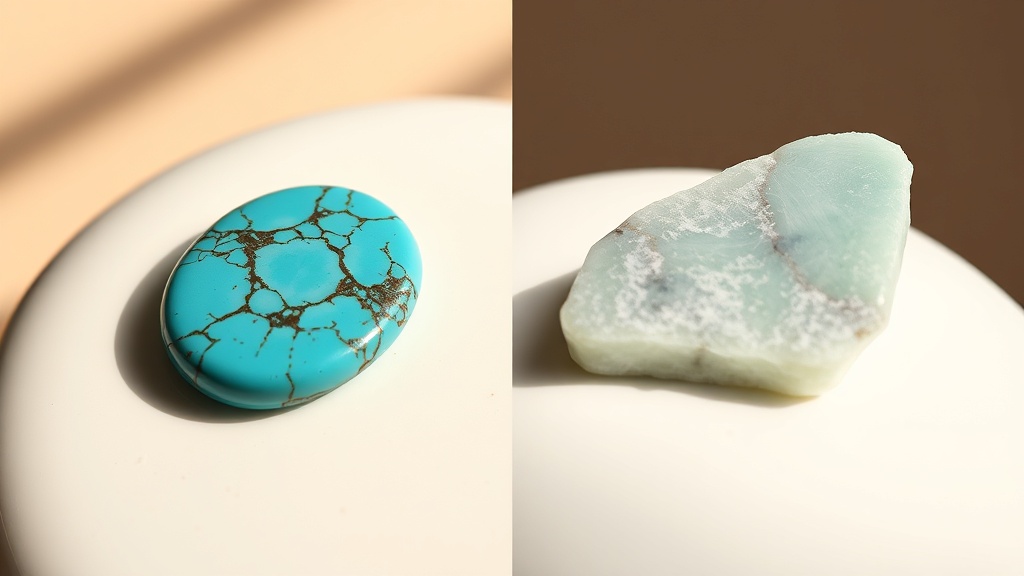
Dyed howlite or magnesite is a white, porous stone that takes blue-green dye convincingly. It is the most common substitute for turquoise in cheap jewelry. A close look at the matrix pattern often reveals it: dyed howlite typically has a more uniform, symmetrical veining compared to the organic randomness of real turquoise. A scratch test (turquoise leaves a blue-green powder; dyed stone often reveals white underneath) can help, though it damages the piece.
Reconstituted or pressed turquoise is made from turquoise dust and fragments bound with resin. It is technically turquoise material, but the end product is far removed from a natural stone. It has a uniform, plastic-like surface and no natural matrix variation.
Synthetic and glass imitations are entirely artificial and typically the cheapest category. They have no connection to natural turquoise beyond color.
⚠️ Important note
The qualities attributed to turquoise and other stones belong to spiritual traditions and beliefs. No therapeutic or protective effect is scientifically recognized. Turquoise objects are not substitutes for medical advice, psychological support, or medical treatment. If you are navigating a health concern, please consult a qualified professional.
Regional Variations: Not All "Tibetan Turquoise" Is from Tibet
The label "Tibetan turquoise" in today's market is more a style descriptor than a geographic guarantee. It typically refers to turquoise mounted in the traditional Tibetan manner, with silver metalwork, alongside coral or other stones, using bezel settings, rather than to stone actually mined on the Tibetan plateau.
The major sources of turquoise used in jewelry sold as Tibetan-style today include:
- Hubei Province, China, now the world's largest producer of turquoise, supplying most of the global market. Hubei turquoise ranges from vivid blue to green, often with a distinctive dark matrix.
- Iran (Nishapur), historically the most prized turquoise in the Islamic world and in European courts. Iranian turquoise tends toward a clear, robin's-egg blue with minimal matrix.
- American Southwest (Nevada, Arizona, New Mexico), distinct regional types such as Sleeping Beauty (clear blue, minimal matrix) and Kingman turquoise, primarily associated with Native American jewelry traditions.
- Tibet and the Himalayan region, genuine Tibetan-mined turquoise does exist but is rare in the current market. Old pieces from Tibetan collections, when genuinely antique, command significant prices.
None of this makes non-Tibetan turquoise less beautiful or less meaningful in a contemporary context. But clarity about origin is useful, both for pricing and for appreciation.

🗂️ Voir la collection
Gemstone Bracelets
Natural stone bracelets grounded in Buddhist tradition, including pieces that honor the turquoise and gemstone heritage of Tibet and the Himalayas.
64 références
Découvrir la catégorie →Caring for Turquoise Jewelry the Traditional Way
Because turquoise is porous and relatively soft, it requires more thoughtful handling than harder stones like sapphire or ruby. Traditional Tibetan craftspeople treated their turquoise with a kind of practical reverence, keeping it clean, away from oils, and stored carefully when not worn.
A few practical principles:
- Keep turquoise away from perfumes, cosmetics, and cleaning products. Apply these before putting jewelry on, and remove jewelry before washing hands or doing dishes.
- Store turquoise separately from harder stones, which can scratch it. Wrap it in a soft cloth or keep it in a padded pouch.
- Clean with a soft, dry cloth. If needed, a very slightly damp cloth is fine, but avoid soaking or ultrasonic cleaners.
- Avoid prolonged direct sunlight, which can fade the color of some treated stones over time.
Natural, untreated turquoise will gradually develop a patina with wear, a slight shift in color or surface. Traditional Tibetan wearers often viewed this as the stone "living" with its owner, though this is cultural framing rather than a documented physical property.

🗂️ Voir la collection
Gemstone Necklaces
Natural stone pendants and necklaces rooted in Eastern spiritual traditions, a considered starting point for anyone drawn to Tibetan turquoise aesthetics in wearable form.
74 références
Découvrir la catégorie →Wearing Tibetan Turquoise Today: Between Tradition and Intention
For contemporary wearers outside the Tibetan cultural context, turquoise jewelry offers a tangible point of connection with one of the world's oldest living Buddhist cultures. Wearing a piece made in the Tibetan style, silver, turquoise, and coral combined by a Himalayan craftsperson, is a form of material engagement with that tradition.
It is worth approaching this engagement thoughtfully. The most meaningful pieces tend to be those made by Tibetan, Nepali, or Ladakhi artisans using traditional techniques: hand-beaten silver, natural stones, and settings that reflect generations of skill. These pieces support living craft traditions and carry genuine cultural continuity.
Whether worn as a quiet marker of personal practice, as an appreciation of Himalayan craft, or simply because the blue-green of turquoise against silver is one of the more striking color combinations in world jewelry, the stone connects you to something much larger than a single object. The turquoise Tibetan tradition is, at its core, a story about how a culture reads the landscape around it and finds meaning in what the earth produces.
"The sky above and the stone below, in Tibet, both speak the same color."
Traditional Tibetan observation on the visual symbolism of turquoise
Questions fréquentes
What makes Tibetan turquoise different from other turquoise?+
The difference is primarily cultural and stylistic rather than strictly geological. "Tibetan turquoise" as a label often refers to the traditional Tibetan setting style, silver metalwork combined with turquoise, coral, and sometimes amber or dzi beads, rather than stone exclusively mined in Tibet. Genuine plateau-mined Tibetan turquoise does exist but is rare in today's market. The stone's meaning in Tibetan culture, connected to sky symbolism, life-force, and protective amulets, distinguishes the tradition from other turquoise cultures around the world.
How can I tell if my turquoise is real or an imitation?+
The most common imitations are dyed howlite or magnesite, which mimic turquoise's color. Real turquoise has a naturally irregular matrix pattern and a slight waxy luster. A gemologist can confirm authenticity using spectroscopic testing. At home, look for uniform symmetry in the veining (a sign of dyed stone), an overly plastic surface (reconstituted turquoise), or an unnaturally intense, flat blue (often a sign of dye). Reputable sellers will disclose whether a stone is natural, stabilized, or treated.
What does turquoise symbolize in Tibetan Buddhism specifically?+
In Tibetan culture and folk religion, turquoise is associated with the sky, with water, and with bla, the vital life-force of a person. It appears on ritual objects, statues, and personal amulets. Within Tibetan Buddhist iconography, blue and turquoise tones are associated with enlightened mind: the Medicine Buddha (Sangye Menla) is depicted with lapis-blue skin, and the stone's sky color aligns it with spacious, unobstructed awareness. These are cultural and symbolic associations rooted in tradition, not doctrinal claims of the stone's efficacy.
Does turquoise change color over time?+
Natural, untreated turquoise can gradually shift in color with prolonged exposure to oils, perfumes, sweat, and sunlight. The stone is porous and absorbs substances it contacts, which can cause color to deepen, dull, or shift toward green over years of wear. Stabilized turquoise is much more resistant to this kind of change because its pores have been filled with resin. Dyed imitations may fade with exposure to water or cleaning agents, which is one way to detect them.
Is it appropriate to wear Tibetan turquoise jewelry without a Buddhist practice?+
Turquoise jewelry in the Tibetan style is worn by people around the world for its aesthetic quality and cultural resonance, with or without a formal Buddhist practice. The most meaningful approach, regardless of one's background, is to understand something of the tradition behind the object, to wear it with awareness of its cultural origins rather than treating it as a generic accessory. Choosing pieces made by Himalayan artisans using traditional techniques is also a practical way to honor the tradition while supporting living craft communities.


