

Tiger Eye Stone: Meaning, Origins, and How It's Used in Buddhist and Eastern Traditions
Few stones attract as much immediate attention as tiger eye. Its golden-brown bands shift and shimmer as the light moves across the surface, producing a phenomenon gemologists call chatoyancy, a silky, rippling optical effect that has stopped people in their tracks for thousands of years. But tiger eye is more than a visual curiosity. Across Buddhist, Tibetan, and broader Eastern traditions, it carries a layered history of symbolic meaning, ritual use, and skilled craftsmanship that makes it worth understanding properly.
⭐ At a glance
- Tiger eye is a member of the quartz family, formed through a process called pseudomorphism
- Its characteristic shimmer is caused by chatoyancy, light reflecting off parallel fibrous structures within the stone
- In Tibetan and Buddhist traditions, it is associated with clarity, courage, and grounded awareness, always as belief, not medical fact
- Major deposits are found in South Africa, Australia, India, and Myanmar
- It is commonly set into malas, bracelets, and pendant jewelry worn as symbolic objects in contemplative practice
What Tiger Eye Actually Is
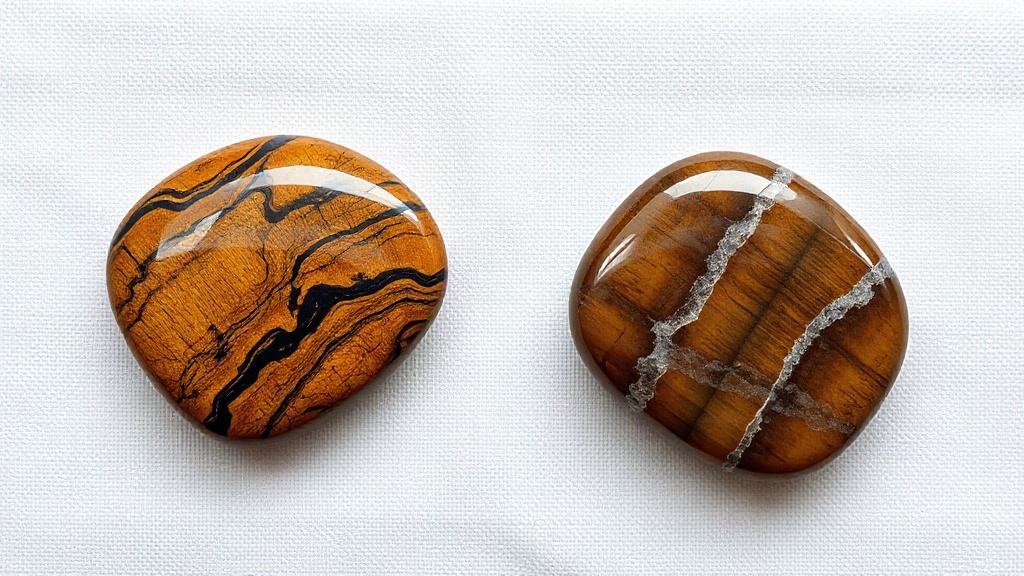
Tiger eye belongs to the quartz family, with a chemical composition of silicon dioxide (SiO₂). What makes it structurally distinct is its origin: it forms through a process called pseudomorphism, where crocidolite fibers (a blue asbestos mineral) are gradually replaced by silica over geological time. The original fibrous structure is preserved in the quartz matrix, and it is this alignment of fine parallel fibers that creates chatoyancy, the cat's-eye or silk-ribbon effect the stone is known for.
The most common variety displays warm golden-brown tones, ranging from pale honey to deep amber. Related stones include hawk's eye (blue-gray, where oxidation is incomplete) and bull's eye, also called ox eye (dark red, heat-treated). All three share the same fibrous architecture; the color differences come down to iron oxidation levels and, in some cases, deliberate heat treatment applied by lapidaries.

💡 Did you know?
The ancient Romans called tiger eye oculus Beli, the eye of Bel, a solar deity. Roman soldiers reportedly wore carved tiger eye stones as protective talismans in battle, believing the stone's luminous gaze would ward off harm. This solar association has persisted across cultures for over two millennia.
Where Tiger Eye Comes From
The world's primary source of tiger eye is the Northern Cape province of South Africa, particularly the area around Griquatown. South African deposits have supplied the global gemstone trade since the 19th century and remain the benchmark for quality today. The stone is found in metamorphic rock formations, often alongside other iron-rich minerals.
Significant deposits are also worked in Western Australia, the Rajasthan region of India, Namibia, and Myanmar (Burma). Each origin produces stone with slightly different color saturation and fiber density, which affects both the chatoyancy effect and the final polish. Skilled cutters work the stone en cabochon, a smooth, domed cut without facets, to maximize the silky band of light across the surface.
Lower-grade tiger eye is frequently dyed to produce vivid blues or greens not found naturally. These treated stones are commercially common in inexpensive jewelry, and while visually striking, they lack the fibrous optical quality of natural material. A reputable supplier will disclose any treatments applied to the stone.
Tiger Eye in Buddhist and Tibetan Traditions

Within Tibetan Buddhist practice, natural stones have long held a place in material culture, not as objects of worship in themselves, but as tangible carriers of symbolic meaning used to support contemplative life. Tiger eye is associated in these traditions with qualities of clear-eyed discernment, steady resolve, and what practitioners describe as grounded awareness: the capacity to observe one's own mind without being swept away by it.
In Vajrayana Buddhism, the tiger itself is one of the Four Dignities, alongside the snow lion, garuda, and dragon, representing a quality of confidence and disciplined energy rooted in the earth. The stone's visual association with the tiger's gaze connects it to this symbolic cluster. Tibetan craftspeople have incorporated tiger eye into mala beads, pendant amulets, and ornamental rings for generations.
"The tiger moves through the forest without disturbing the leaves. This is confidence without aggression."
Traditional Tibetan saying on the quality of the tiger among the Four Dignities
It is worth being precise here: in Buddhist doctrine, no material object possesses inherent power to alter a practitioner's karma or mental state. The value of a tiger eye mala or bracelet lies in its role as a support for intention, a tangible reminder of qualities the practitioner is cultivating. This distinction between symbolic object and magical talisman is important within serious practice communities.
⚠️ A note on stone traditions
The qualities attributed to tiger eye and other natural stones belong to spiritual traditions and cultural beliefs. No therapeutic or physical effect is scientifically recognized. These objects are not substitutes for medical advice or treatment. If you are drawn to tiger eye, appreciate it for its cultural meaning and its genuine natural beauty, both are real and significant.
How Tiger Eye Is Used in Jewelry and Mala Beads
Tiger eye is a practical stone for jewelry making. At 6.5 to 7 on the Mohs hardness scale, it resists everyday scratches well, holds a good polish, and works reliably with standard lapidary equipment. These properties have made it a consistent choice for beaded malas, stretch bracelets, ring cabochons, and pendant settings across South Asia, East Asia, and the broader global market for contemplative jewelry.
In a traditional mala, a string of 108 beads used for counting mantra repetitions in Buddhist and Hindu practice, tiger eye appears in two formats: as the primary bead for the entire mala, or interspersed with other stones as divider beads at the 27-bead intervals. The warm color sits well against brass, copper, and silver fittings commonly used in Tibetan-style work.

🗂️ Voir la collection
Gemstone Bracelet
Natural stone bracelets rooted in Buddhist tradition, tiger eye among a curated selection of contemplative pieces.
64 références
Découvrir la catégorie →Distinguishing Natural Tiger Eye from Imitations
| Feature | Natural Tiger Eye | Glass or Resin Imitation |
|---|---|---|
| Chatoyancy | Single, clean moving band of light | Diffuse shimmer or static reflection |
| Temperature | Cool to the touch initially, warms slowly | Reaches room temperature almost instantly |
| Weight | Dense, noticeably heavier than it looks | Lighter, sometimes hollow-feeling |
| Surface under magnification | Visible fibrous structure, slight inclusions | Uniform, too-perfect surface |
| Hardness | Resists scratching from a copper coin | Scratches easily with a metal edge |
A simple field test: press the stone against your cheek or the inside of your wrist. Natural quartz feels distinctly cool and takes several seconds to warm to body temperature. Glass imitations equalize almost immediately. Combined with checking the chatoyancy quality under natural light, these two tests will catch most fakes without any specialist equipment.
Caring for Tiger Eye Jewelry and Objects
Tiger eye is a robust stone by gemstone standards, but it deserves straightforward care to stay in good condition. Clean it with lukewarm water and a soft cloth, a mild, unscented soap can be used if needed, rinsed thoroughly. Avoid ultrasonic cleaners, which can fracture the internal fiber structure over time. Avoid prolonged direct sunlight on pieces you want to keep at their original color; extended UV exposure can fade the warm golden tones to a duller brown over years.
For beaded malas or stretch bracelets, the concern shifts to the cord rather than the stone. Natural cotton, silk, or nylon elastic will degrade with regular contact with water, skin oils, and sweat. If you wear a tiger eye mala bracelet daily, expect to restring it every one to three years depending on the cord quality. Any competent bead shop or jewelry repair service can do this quickly and inexpensively.

🗂️ Voir la collection
Gemstone Jewelry
Necklaces, bracelets, and pendants in natural stone, including tiger eye pieces grounded in Buddhist craftsmanship.
114 références
Découvrir la catégorie →Choosing Tiger Eye with Intention
If you are drawn to tiger eye for its role in Buddhist or Tibetan practice, the most meaningful choice is a piece made with genuine natural stone, honest craftsmanship, and clear information about its origin. The stone's visual quality is worth attending to: a well-cut tiger eye with clean chatoyancy is a genuinely beautiful object that rewards close attention, which is, in itself, a small contemplative act.
Whether you choose a mala, a bracelet, or a simple polished sphere for your altar space, tiger eye works best as a support for intention rather than a substitute for practice. In that role, as a tangible, handsome reminder of qualities you are cultivating, it has served practitioners across traditions for a very long time.
Questions about tiger eye stone
What causes the shimmer in tiger eye stone?+
The shimmering effect is called chatoyancy, from the French chat (cat). It occurs because tiger eye contains parallel fibrous structures, the preserved remains of crocidolite mineral fibers replaced by quartz over geological time. Light reflects off these aligned fibers in a single moving band, similar to the pupil of a cat's eye.
Is tiger eye stone safe to wear?+
Yes. While tiger eye forms from crocidolite (a type of asbestos), the replacement process fully encases the fibers in quartz. Polished, finished tiger eye jewelry presents no known health risk in normal wear. The concern would only arise if you were cutting or grinding the raw mineral in an unventilated space, not a situation that applies to wearing finished pieces.
What is the difference between tiger eye, hawk's eye, and bull's eye?+
All three are varieties of the same fibrous quartz material. Tiger eye is golden-brown, colored by fully oxidized iron. Hawk's eye (also called falcon's eye) is blue-gray, where oxidation is incomplete. Bull's eye (or ox eye) is dark red-brown, usually produced by heat-treating tiger eye. The fibrous structure and chatoyancy are the same across all three.
How is tiger eye used in Buddhist practice?+
In Tibetan and broader Buddhist traditions, tiger eye appears most commonly in mala beads (used to count mantra repetitions), pendant amulets, and decorative bracelets. According to these traditions, the stone is associated with clarity and grounded awareness. Buddhist teaching does not ascribe inherent supernatural power to any stone; the object serves as a support for intention and a reminder of the qualities a practitioner is working to cultivate.
How can I tell if my tiger eye stone is real?+
Three quick checks: (1) Hold it under natural light and tilt it, a genuine stone shows a single clean band of light moving across the surface. (2) Press it against your cheek, real quartz feels cool and takes time to warm up; glass imitations warm almost instantly. (3) Check the weight, natural tiger eye is denser than most glass or resin copies. For certainty, a gemologist can confirm authenticity with a refractive index test.


