

How to Use Mala Beads: A Complete Guide to Buddhist Prayer Practice
How to use mala beads is one of those questions that sounds simple but opens into a rich, layered practice. A mala is not a decoration worn on the wrist or a curiosity picked up at a gift shop, though it is often treated as both. At its core, a mala is a counting tool: a way to track the repetition of a mantra or a breath during meditation, freeing the mind from the effort of keeping a running tally. Used for over two thousand years across Buddhist and Hindu traditions, the mala gives your hands something precise to do while the mind settles.
This guide covers everything from holding your mala correctly on the first day to understanding the cultural weight behind the beads themselves. Whether you are three weeks into a sitting practice or you have been reciting mantras for years, there is something here worth slowing down for.
⭐ Key points
- A standard mala has 108 beads, with one guru bead marking the start and end of a cycle.
- The thumb pulls each bead; the index finger stays lifted in most Buddhist and Hindu conventions.
- You recite one repetition of your mantra or breath per bead, moving continuously until you reach the guru bead.
- Material and origin matter culturally; choose based on tradition, not on attributed crystal properties.
- Regular cleaning and mindful storage preserve both the physical object and the intention behind it.
What a Mala Actually Is (and Where It Comes From)
The word "mala" comes from Sanskrit, meaning garland or rosary. In Pali, the scriptural language of early Buddhist texts, a similar object is referenced in the context of recitation practice. The mala as a structured tool of 108 beads appears across Tibetan Vajrayana, Theravada, and Mahayana schools, as well as in Hindu *Japa* practice, where it is often called a japa mala. The number 108 carries philosophical significance in multiple traditions: 108 earthly desires in certain Buddhist readings, 108 names of the divine in various Hindu texts, 108 Upanishads. The count varies by tradition, but 108 is the standard across most Buddhist schools.
A mala typically includes one larger or distinctly different bead at the midpoint of the strand, called the guru bead (also called the Sumeru bead in Sanskrit). This bead signals the end of one full cycle and is never counted or passed over during recitation. When your thumb reaches it, you pause, then reverse direction for the next round if you plan to continue.
💡 Did you know?
The Catholic rosary, introduced to Europe in the 13th century, shares a structural kinship with the Buddhist mala. Scholars of comparative religion trace counting beads across Christianity, Islam (the misbaha or tasbih), and Buddhism back to common roots in early devotional practice. The impulse to count prayers on a physical object is remarkably consistent across cultures and centuries.
How to Hold a Mala: Hand Position and Finger Technique
Correct hand position is the foundation of mala practice. Get this right and everything else follows naturally.
Hold the mala in your right hand. In Tibetan Buddhist practice, the mala traditionally rests over the ring finger, with the guru bead hanging down toward the palm. In many Theravada-influenced traditions, the mala drapes over the middle finger instead. Neither is wrong. The key principle shared across all schools is this: the index finger does not touch the beads. The index finger is associated in yogic and Buddhist hand-gesture systems (mudras) with the ego-self, and keeping it lifted is a small, deliberate act of setting that impulse aside during practice.
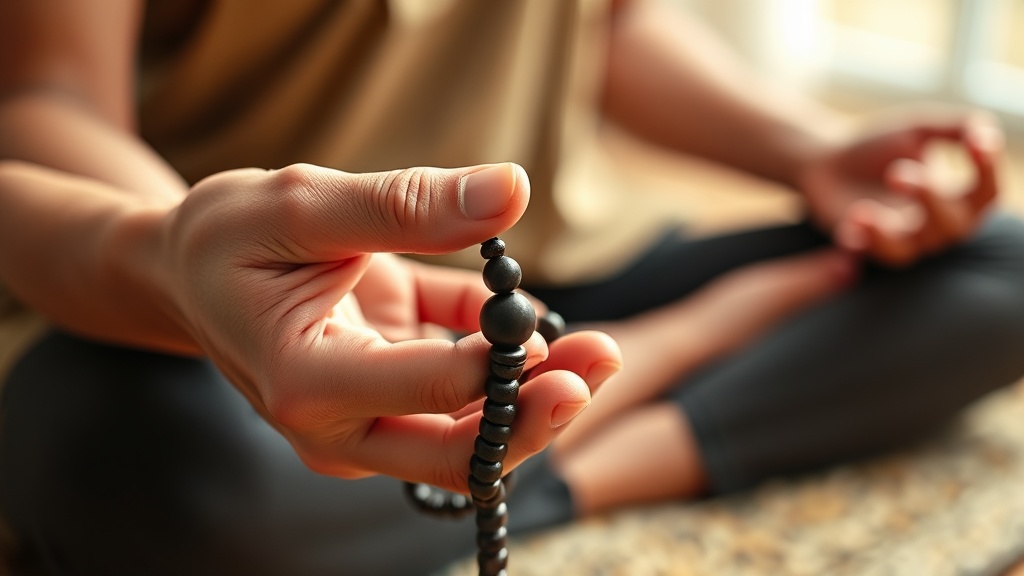
Your thumb is the active digit. It pulls each bead toward you, one at a time, after each recitation. The motion is gentle and unhurried. The bead moves only after the full recitation is complete, so the physical movement stays synchronized with the mental or spoken one. Think of it as a single gear turning at the pace of your breath.
If you are reciting a longer mantra such as Om Mani Padme Hum, complete the full six-syllable phrase before moving the bead. For a single-syllable recitation, one syllable equals one bead. If you are using the mala for breath counting rather than mantra, one full breath cycle (inhale plus exhale) equals one bead.
Left Hand vs. Right Hand
Most Tibetan Buddhist instructions specify the right hand for mala use during mantra recitation. Some Vajrayana practices, particularly those associated with wrathful deity visualization, use the left. If you are practicing within a specific lineage or under a teacher's guidance, follow their instruction. For independent daily practice, the right hand is the conventional choice.
Choosing a Mantra to Count
A mala without a mantra is just a strand of beads. The mantra is the practice. You do not need to be an ordained monk or to have received formal initiation to work with a mantra, though some Vajrayana practices do require transmission. For most practitioners, a few widely accessible mantras work well from day one.
- Om Mani Padme Hum: the six-syllable mantra of Avalokiteshvara (Chenrezig in Tibetan), the bodhisattva of compassion. Probably the most widely recited Buddhist mantra in the world.
- Om Ah Hum: a purification mantra used in Tibetan practice to bless objects, food, or oneself before practice.
- Namo Amituofo: the primary recitation of Pure Land Buddhism, most widely practiced in Chinese Buddhist traditions.
- Buddho: a two-syllable recitation used in Thai Forest Theravada, often synchronized with the breath (Bud on the inhale, Dho on the exhale).
- Om Namah Shivaya or So Hum: these come from Hindu rather than strictly Buddhist contexts, but are used by many contemporary practitioners with a non-sectarian approach.
If you have a teacher, ask them directly. If you are practicing independently, choose one mantra and stay with it for a defined period before switching. Consistency builds depth far faster than variety.
The 108-Bead Cycle: How to Count and What to Do at the Guru Bead
Start at the bead immediately next to the guru bead. Recite your mantra once, then pull that bead toward you with your thumb. Move to the next bead. Continue through all 108 beads. When your thumb reaches the guru bead, you have completed one full round of 108 recitations.
At the guru bead, stop. In Tibetan practice, you do not cross or count the guru bead. Instead, you pause briefly, sometimes touching the guru bead to your forehead as a gesture of respect to the teacher (hence the name), and then reverse direction. Turn the mala around in your hand and begin moving back through the 108 beads in the opposite direction. This reversal means you never turn your back on the guru: a symbolic act rather than a mechanical rule.
How many rounds per session depends entirely on your practice. A common commitment in Tibetan ngondro (preliminary practices) is 100,000 repetitions of a given mantra over months or years. For daily seated practice, one to three rounds (108 to 324 recitations) is a practical starting point that most people sustain without strain.
Using a Counter or Tracker
If you are working toward a large count over time, many practitioners use a small tally counter or a dedicated notebook to track rounds. In Tibetan tradition, counter beads (small rings strung separately alongside the mala) track groups of 10 or 100 rounds. These are practical tools, not substitutes for the mala itself.
Mala Bead Materials: Rudraksha, Wood, Stone, and Bone
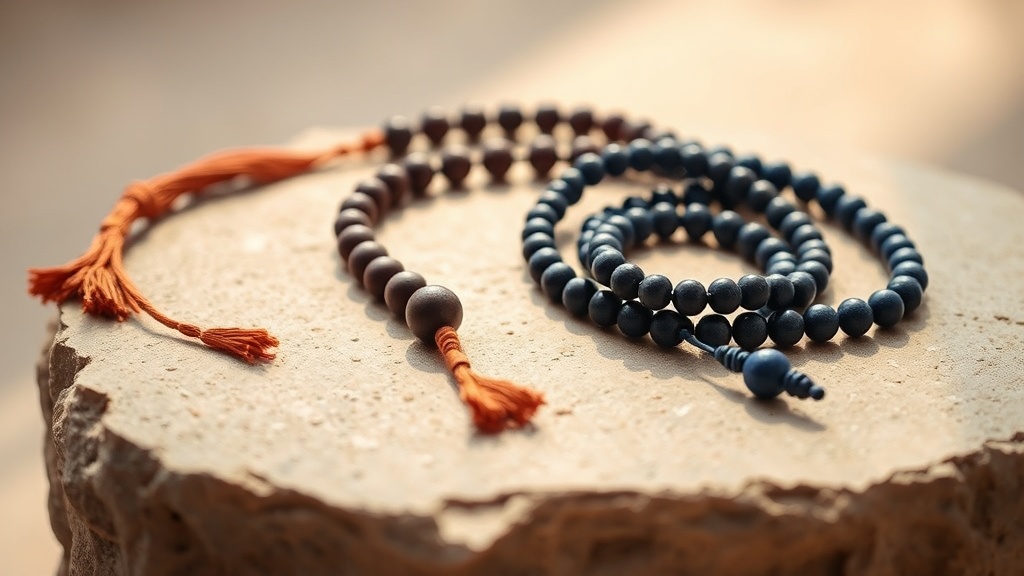
The material of a mala carries genuine cultural and traditional meaning. This is not marketing language. Different schools and lineages favor specific materials for specific reasons, and understanding the basics helps you make a grounded choice.
| Material | Traditional Association | Common Use |
|---|---|---|
| Rudraksha seeds | Hindu/Shaivite; also used in Tibetan practice. Seeds of the Elaeocarpus ganitrus tree, revered for centuries. | General mantra recitation; widely used across traditions |
| Sandalwood | Used in both Buddhist and Hindu traditions; the scent is considered conducive to concentration. | Daily meditation, altar use |
| Bodhi seed | Seeds from the sacred fig tree (Ficus religiosa), directly associated with the tree under which, according to Buddhist tradition, Shakyamuni Buddha attained enlightenment. | Buddhist practice of any school |
| Lapis lazuli | In the Tibetan tradition, this deep blue stone is associated with the Medicine Buddha (Sangye Menla) and is often used in practices dedicated to him. | Medicine Buddha practice; Vajrayana |
| Crystal (quartz) | Recommended in some Tibetan texts for Vajrasattva purification practices. | Purification mantras; Vajrayana |
| Bone or ivory (yak or conch) | Used in some Vajrayana practices; associated with awareness of impermanence. | Advanced Tantric practice; less common today |
A brief note on stones and attributed properties: the qualities that various traditions associate with stones belong to the domain of spiritual symbolism and belief, not established physiology. According to Buddhist and Hindu belief systems, certain stones carry symbolic resonance with specific practices or deities. These objects are not substitutes for medical advice or treatment. Choose a stone mala because of its cultural connection to a practice you are engaged with, not because of health claims.

Wrist Malas and Half Malas: When 108 Beads Becomes 27
A full mala of 108 beads typically hangs as a necklace or drapes over the hand during practice. Wrist malas, also called wrist mala beads for meditation, contain 27 beads (one quarter of 108) or sometimes 21 beads. These are worn between sessions as a physical reminder of practice rather than as the primary counting tool, though they can function for shorter recitation rounds. To complete a full 108 count on a 27-bead wrist mala, you simply cycle through it four times.
Some practitioners wear a wrist mala continuously as a reminder: the same way a monk's robes function as an external signal that the day's activities happen within a contemplative frame. This is a personal and practical choice, not a doctrinal requirement.
Setting Up Your Practice Space
Where you sit matters. Not because the room has mystical properties, but because humans are creatures of association and habit. A dedicated corner with consistent objects trains the nervous system to shift into a quieter register when you arrive there. The mala on the cushion, the same incense, low light: these cues accumulate over weeks into something genuinely useful.
You do not need a formal altar. A small shelf with a few meaningful objects works just as well. What you want is minimal visual distraction, a comfortable seated position (on a cushion, a chair, or the floor), and access to your mala at the start of each session. Keep the mala off the floor during practice; resting it on your knee or a small cloth is the common approach. If you use incense as a sensory anchor, light it before picking up the mala so that the scent becomes a consistent cue for the transition into practice.
"Like a lamp that dispels darkness, the recitation of a mantra purifies the mind of distraction and brings forth the light of awareness."
Paraphrase from commentarial tradition on the Mani mantra; widely cited in Tibetan practice texts.

How to Clean and Care for Your Mala
A mala that sees daily use accumulates skin oils, dust, and the physical residue of practice. Cleaning it periodically is both practical and, in many traditions, a form of respect for the object.
For wooden malas (sandalwood, rosewood, bodhi seed): wipe gently with a dry or very slightly damp soft cloth. Do not soak in water; wood will warp and the string will weaken. Sandalwood malas can be lightly re-oiled once or twice a year with a small amount of sandalwood oil on a cloth, which also revives the scent.
For stone malas: most stones tolerate a brief rinse under cool running water followed by gentle drying. Avoid prolonged immersion, especially if the mala is strung on silk or cotton thread rather than nylon. Lapis lazuli and malachite are sensitive to acids and prolonged water exposure; wipe rather than rinse.
For rudraksha seed malas: these are among the most durable. Wipe with a dry cloth. Occasional rubbing with a small amount of sesame or olive oil keeps the seeds from drying out and cracking over time. Rudraksha seeds should be kept away from strong soap.
Storing Your Mala
Store your mala in a clean pouch or small box when not in use. Many practitioners keep it on the altar, which works well as a visual reminder. Avoid leaving it in direct sunlight for extended periods; UV exposure fades dyes in tassels and causes some stones to lose color saturation over months. A small cloth bag in a drawer is perfectly sufficient.
Mala Beads Across Buddhist Schools: Theravada, Mahayana, Vajrayana
The mala is not universal across every Buddhist context. Understanding where it fits in each major school gives you a clearer sense of what you are holding.
In Theravada practice, particularly the Thai Forest tradition associated with teachers like Ajahn Chah and Ajahn Mun, a short string of beads called a bat sa lo or counting cord is used for breath counting or recitation of "Buddho." The 108-bead format appears less often here than in northern traditions, but counting-based recitation practice is deeply established.
In Mahayana Buddhism (Chinese, Korean, Japanese), the counting of the Nianfo ("Namo Amituofo") in Pure Land practice relies on malas in the 108 or 27-bead format. Japanese Zen does not emphasize mala use in the same way; the focus there is on zazen and koan practice without props. The juzu (Japanese prayer beads) appear in some Zen and Jodo Shu contexts, often with 112 or fewer beads and a distinct double-loop structure.
In Vajrayana (Tibetan) Buddhism, the mala is the most developed and liturgically precise. Specific bead counts, materials, and methods are prescribed in the sadhana (practice text) for each deity or mantra practice. Some practices call for 111 beads to account for distracted recitations. The Bardo Thodol (Tibetan Book of the Dead) and various Nyingma, Kagyu, Sakya, and Gelug liturgical texts reference specific materials for specific practices, making this tradition the richest source of mala-related instruction.
If you practice within a specific Buddhist lineage or tradition, consult your teacher or the relevant liturgical texts for guidance specific to your practice. The structure above is a general orientation, not a substitute for lineage instruction.
Common Mistakes When Starting a Mala Practice
A few patterns come up repeatedly for people beginning mala bead meditation practice. None of them are serious, but naming them saves time.
- Moving the bead before finishing the recitation. The bead moves after, not during. Slowing down the bead movement usually means slowing down the recitation, which deepens concentration rather than reducing it.
- Using the index finger. The thumb does the work. The index finger habit is hard to break if you come from a rosary background. A few sessions with deliberate attention to the hand position fixes it.
- Crossing the guru bead. Stop, pause, reverse. Do not count the guru bead as one of the 108 and do not pull past it.
- Practicing silently versus aloud. Both are valid. Loud recitation (called vaikhari in Sanskrit tradition) is useful for establishing rhythm at the start. Silent recitation at the mental level is the more refined form and is what most contemplative texts point toward eventually. Start aloud if you are distracted; go silent as focus deepens.
- Abandoning the practice after a few weeks. Mala practice builds gradually. The first month is often the flattest experientially. Commit to a fixed number of rounds per day for at least 40 consecutive days before assessing whether it is working.
Gifting a Mala: What to Know Before You Give One
A mala makes a considered, personal gift for someone engaged in meditation or Buddhist practice. A few things are worth knowing before you choose one. First, a mala given to a practitioner within a specific tradition should ideally match that tradition's material preferences. A Tibetan practitioner will often use a different material than a Theravada practitioner. When in doubt, a plain sandalwood or bodhi seed mala is widely appropriate across schools.
Second, a mala given as a gift is not pre-consecrated unless you have specifically arranged a blessing from a teacher or lama. This is not required for the mala to be functional, but if the recipient practices within a tradition that includes mala consecration (more common in Vajrayana), they may want to seek that independently. Present the gift with that clarity rather than implying anything about its spiritual status.
Third, malas are personal objects. Once a practitioner has worked with a mala for months or years, it becomes specifically theirs. Avoid handling another person's practice mala without permission; this is a convention observed across traditions.

Integrating Mala Practice Into Daily Life
The formal seated session is one context. But using mala beads throughout the day is a distinct and equally valid practice that many traditions actively encourage. Recitation while walking (called kinhin in Zen, though in other traditions it takes different forms) has strong precedent. Reciting quietly on public transit, during a walk, or while waiting is not a lesser form of practice. The Tibetan teacher Dilgo Khyentse Rinpoche reportedly recited mantras during virtually every waking moment, not as performance but as continuous training of attention.
The wrist mala makes this integration easier. Worn on the left wrist during activities that require the right hand, it stays present without interfering. Some practitioners shift a bead periodically during the day rather than doing full counted rounds: a looser form that keeps the practice thread alive across hours. Both approaches complement a more formal seated meditation practice.
What matters is regularity over intensity. Ten minutes of counted recitation every day builds more than a two-hour session once a week. The mala, by its physical nature, makes that regularity easier: you pick it up, you begin, the counting does the rest.
FAQ
Why do malas have 108 beads?+
108 is a number that holds significance across multiple traditions. In Buddhist philosophy, various texts cite 108 earthly desires or mental defilements. In mathematics, 108 is the product of 4 x 27 and relates to several geometric ratios found in Indian cosmological thinking. No single authoritative source explains the number definitively; it appears across traditions (Hindu, Buddhist, Jain) as a number of special status, and its use in malas predates any single doctrinal explanation.
Can I wear my mala as a necklace all day?+
Yes, many practitioners do. In Tibetan Buddhism, wearing the mala around the neck is common. The practical consideration is physical: a 108-bead mala worn during exercise, in water, or during work where it can snag will wear the string faster. Some practitioners keep a separate, lighter wrist mala for daytime wear and reserve the full mala for seated practice. That separation also helps psychologically: picking up the practice mala becomes a deliberate act that signals the start of a session.
Does it matter which mantra I use with my mala?+
For most independent practitioners: choose one mantra, understand its meaning and context, and repeat it consistently. The mala is a neutral tool; the mantra carries the intention. For practitioners within a specific Vajrayana lineage, certain mantras require formal transmission from a qualified teacher before being practiced, particularly tantric deity mantras. General mantras like Om Mani Padme Hum are widely taught as accessible to anyone without formal initiation.
What should I do if my mala breaks?+
Collect the beads and have the mala re-strung. In Tibetan tradition, a broken mala carries no bad omen; some teachers say it signals the completion of a cycle or the absorption of accumulated obstacles. Re-stringing on silk or nylon thread is straightforward. If you are re-stringing yourself, ensure the knot at the guru bead is double-knotted and the thread is pulled tight enough to prevent slipping during practice.
How long should a mala practice session last?+
One full round of 108 beads at a moderate pace takes roughly 5 to 10 minutes, depending on mantra length and speed of recitation. Three rounds is 15 to 30 minutes, a widely recommended duration for a daily session. The more important variable is consistency: a daily 10-minute session done every morning compounds over weeks in a way that occasional longer sessions do not replicate. Start with one round per day and increase only when that feels genuinely insufficient rather than simply habitual.
Is it disrespectful to use a mala if I am not Buddhist?+
The mala predates any single religion as a counting tool, and its use spans Hindu, Buddhist, Jain, and other traditions. Many non-Buddhist practitioners use malas for breath counting or secular meditation without any doctrinal context. The most respectful approach is to understand the object's history, use it with care, and avoid presenting it as a fashion accessory with no awareness of its origins. Informed use, even outside a formal tradition, is generally considered appropriate by most teachers across these lineages.


