

Mala Care: How to Clean, Cleanse, and Preserve Your Prayer Beads
Mala care is one of those topics that practitioners mention in passing but rarely explain with any depth. You receive a mala, you use it daily, and over months the cord darkens, a bead chips, or the tassel frays. Most people improvise. A few more wipe the beads with a damp cloth and call it done. But a mala made from natural materials, wood, bone, seeds, or gemstone, responds differently to moisture, oils, and sun. Knowing how each material behaves is the practical foundation of mala care done well.
⭐ Key points
- Different bead materials require different cleaning methods: wood, seeds, bone, and gemstone each react differently to water and oils.
- Physical cleaning and traditional "energetic cleansing" are two separate practices with distinct purposes.
- The tassel, cord, and knots need maintenance just as much as the beads themselves.
- Heat, direct sunlight, and harsh detergents are the three most common causes of bead deterioration.
- A broken mala has meaning in Buddhist tradition: it is not a bad omen, it is a natural part of a practice object's life.
Understanding Your Mala's Materials Before You Touch It
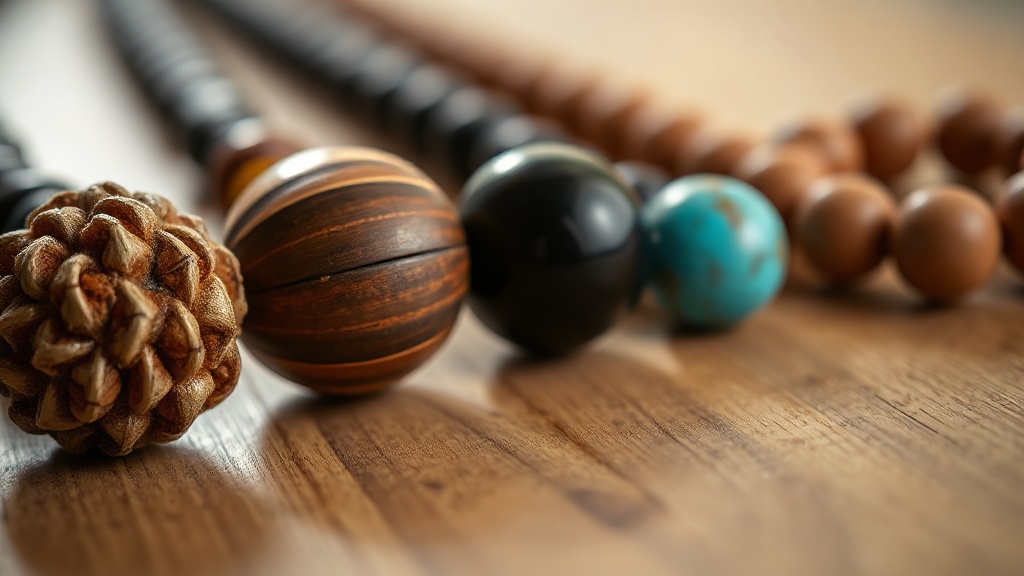
A mala is almost never made from a single material. The 108 beads may be rudraksha seeds, rosewood, sandalwood, yak bone, turquoise, lava stone, or any number of natural gemstones. The guru bead (the larger central bead) often differs from the rest. The cord is typically silk, cotton, or nylon. The tassel may be hand-knotted silk or cotton thread. Each of these materials has a different response to water, oils, alcohol, and temperature. Understanding these differences is the first principle of sound mala care.
Rudraksha seeds, the small faceted brown beads sourced from the Elaeocarpus ganitrus tree and widely used in both Hindu and Tantric Buddhist practice, are porous and swell when saturated. Soaking them loosens the seed's natural oils and can cause cracking once they dry. Woods like sandalwood and rosewood are similarly porous: their natural resins give them a mild fragrance, but repeated contact with tap water strips those oils over time.
Gemstone beads, whether amethyst, lapis lazuli, or black onyx, are denser and less porous than seeds or wood, but some stones are sensitive to light or chemical cleaners. Lapis lazuli, for example, contains pyrite flecks and a matrix of minerals that can react to acidic or alkaline solutions. Turquoise is famously soft (around 5-6 on the Mohs scale) and should never be submerged.
A quick material identification before you begin any cleaning prevents costly mistakes. If you are unsure what your beads are made from, err on the side of the driest, gentlest method available. No bead has ever been harmed by a dry cotton cloth, but many have been damaged by well-intentioned soaking.
Mala Care by Material: The Right Cleaning Method for Every Bead Type
Start with the gentlest option and work up from there only if necessary. The goal of mala care at the cleaning stage is removing skin oils, dust, and incense residue without stripping the bead's natural character or weakening the cord. The table at the end of this article gives a quick-reference summary; the sections below explain the reasoning behind each recommendation.
Wood and Seed Beads (Rudraksha, Sandalwood, Rosewood, Bodhi Seed)
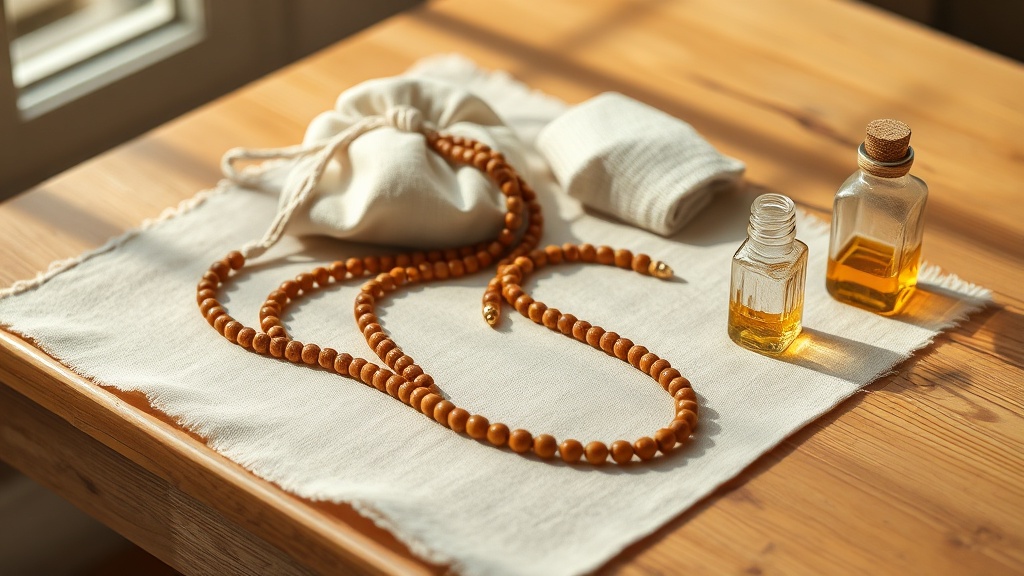
Use a dry or barely damp soft cloth, ideally cotton or microfiber. Wipe each bead individually, working with the natural grain of wooden beads. For rudraksha, a dry natural-bristle brush (a clean toothbrush works well) can dislodge debris from the seed's natural ridges without introducing moisture. Once a year, or when the wood appears dry and dull, a very small amount of natural oil, sesame or jojoba applied with fingertips and then buffed off, can restore the surface. Avoid coconut oil on light-colored woods: it can darken them permanently.
Bodhi seed beads, carved from the seeds of the sacred fig (*Ficus religiosa*) or related species, share rudraksha's porosity. Handle them the same way: dry brush for debris, a trace of natural oil once or twice a year if the surface looks parched. Never soak.
Bone and Shell Beads
Yak bone malas, common in Tibetan practice, and shell or mother-of-pearl beads need dry cleaning almost exclusively. A lightly dampened cloth is acceptable for surface grime, but the bead should dry quickly at room temperature, never in direct sun or near a heat source. Bone is calcium-based and responds poorly to vinegar, lemon, or any acidic cleaner. Even mild household soap can leave a residue that dulls the surface over time.
Gemstone Beads
Most hard gemstone beads (agate, obsidian, onyx, amethyst) can be wiped with a cloth barely dampened with plain water. Dry immediately. For beads with natural surface texture, lava stone being the most common, a dry brush removes trapped dust from the pores effectively. Avoid soap unless the soiling is serious: soap residue left in porous stones builds up over time. Soft stones (turquoise, malachite, calcite) should stay completely dry except for a surface wipe with a barely damp cloth.
When browsing a gemstone mala bead collection, pay attention to the hardness rating listed for each stone. Anything rated below 6 on the Mohs scale deserves the most conservative approach: dry cloth, no liquids, no ultrasonic cleaners.
Cord and Knot Care: The Part That Wears Fastest
The cord is structurally the most vulnerable part of any mala. Traditional Tibetan malas are strung on silk thread with a knot between each bead. This single-thread construction, while authentic, is also the most delicate: silk weakens with repeated exposure to sweat and oils, and knots tighten or loosen unevenly over time.
Check the cord twice a year by holding the mala up to a light source and inspecting the thread at each knot. Fraying, thinning, or discoloration at the knot points signals that restringing is coming. A mala that breaks during practice does so because the cord has been under slow stress, not because of any sudden failure. Catching it early means you keep all 108 beads intact.
Silk cords should not be cleaned with water: they shrink unevenly and lose tensile strength when wet. If the cord is simply dusty, airing the mala in a cool, shaded space for a few hours is enough. Cotton cords are slightly more water-tolerant but should still dry flat and never be twisted when wet. Nylon cords, used in many contemporary meditation mala beads, are the most water-resistant option and can be gently rinsed if the entire mala needs a refresh, provided the beads themselves tolerate moisture.
Traditional Cleansing Practices: What They Are and What They Are Not
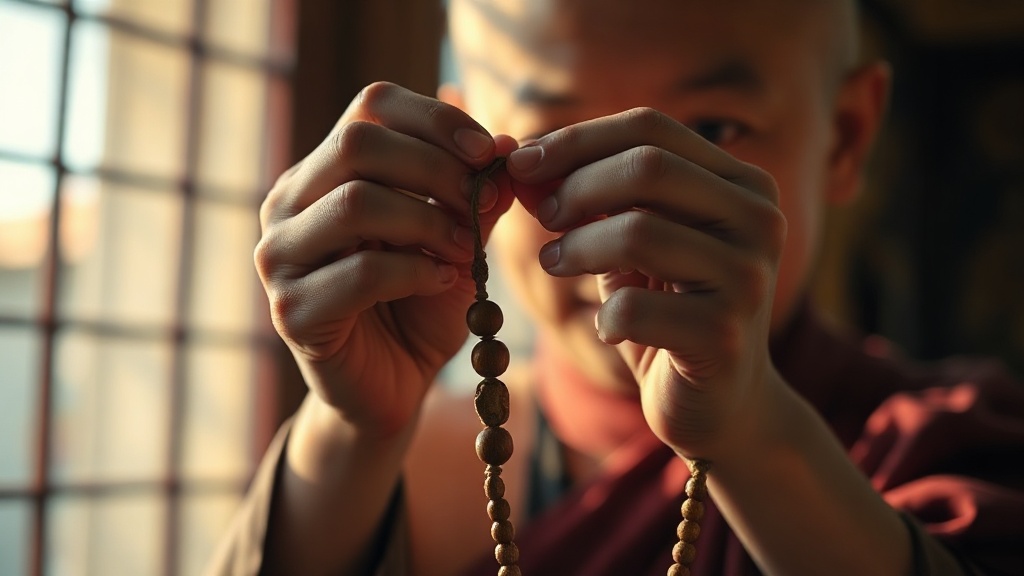
Separate from physical cleaning, many Buddhist and Hindu traditions include some form of "energetic cleansing" for practice objects. This is a ritual or symbolic act, not a hygiene procedure, and the two should not be confused.
In Tibetan Vajrayana practice, ritual objects are sometimes passed through incense smoke (typically juniper or sandalwood) as a purification gesture before or after intensive practice. In Zen contexts, the simple act of placing an object on the altar and sitting with it attentively carries its own form of reset. Some practitioners in Southeast Asian Theravada traditions leave malas outdoors under moonlight, a practice borrowed from folk custom rather than canonical scripture.
What these practices share is intention: a deliberate pause to reconnect with the object's purpose. From a strictly canonical standpoint, the Pali Canon does not prescribe specific cleansing rituals for mala beads. The practices that have accumulated around mala care come from regional traditions, monastic customs, and lay adaptations that developed over centuries.
It is worth noting the distinction between the Tibetan *threngwa* tradition, where ritual purification of objects is integrated into larger liturgical cycles, and simpler lay customs that borrow the outward form without the doctrinal framework. Neither approach is wrong; understanding which applies to your own practice helps you engage with it more honestly.
💡 Did you know?
The number 108 appears in multiple ancient Indian texts long before Buddhism adopted the mala format. In Vedic astronomy, the ratio of the Sun's distance from Earth to the Sun's diameter is approximately 108. Buddhist commentators later incorporated this number into their own cosmological frameworks, connecting the 108 beads to the 108 defilements described in various Abhidharma texts.
Mala Care for Storage: Protecting Your Beads Between Sessions
Where and how you store a mala matters more than most people realize. The three main threats are heat, direct sunlight, and physical pressure from being stuffed in a bag or pocket. Good mala care during storage is often the difference between a mala that lasts a decade and one that degrades in two years.
Heat accelerates the drying of natural oils in wood and seed beads, making them more prone to cracking. It also weakens silk cord faster than almost anything else. Keep your mala away from windowsills in summer months, away from car dashboards, and away from heaters or radiators.
Direct UV light fades many gemstones over time. Amethyst lightens noticeably with prolonged sun exposure. Rose quartz and citrine are also affected. Even dyed wooden beads can lose pigment uniformly, which changes their appearance without anyone noticing the gradual shift.
A simple cloth pouch, cotton or silk, is genuinely the best storage solution. It protects against dust and light, prevents the beads from knocking against hard surfaces, and keeps the tassel from tangling. A dedicated pouch also signals that this object belongs in a specific place, which supports consistent practice more than any spiritual reason. If you practice daily, a small altar shelf or a dedicated drawer away from direct light works well as a permanent home for your mala.

When a Mala Breaks: Tradition, Practicality, and What Comes Next
A broken mala generates more anxiety than it probably should. The cord snaps mid-practice, beads scatter across the floor, and some practitioners interpret this as a bad sign. Tibetan Buddhist teachers have addressed this directly: according to the Tibetan Buddhist tradition, a mala breaking is generally understood as a natural consequence of a well-used practice object, not as an omen. Some teachers note that a mala breaking may signify that it has absorbed considerable wear from practice, which is simply what practice objects are for.
Practically speaking, gather every bead you can find. Count them. If all 108 are present, the mala can almost certainly be restrung by a bead shop or a patient practitioner with silk cord and a beading needle. Specialist Buddhist supply shops often offer restringing services, and it is worth seeking them out rather than discarding a mala you have used for years.
If beads are lost or irreparably damaged, some practitioners choose to bury them outdoors, returning the natural materials to the earth. This is a folk custom rather than a canonical prescription, but it carries a quiet logic for objects made from seeds, wood, or stone.
A break is also a useful diagnostic moment. Examine the cord: where did it fail? A break at a knot point usually means the cord was under chronic tension there, often because the mala was stored tightly coiled or caught on a surface repeatedly. A break mid-span is rarer and usually signals general cord fatigue. Both are entirely preventable with twice-yearly inspection, as described in the cord care section above.
Tassel Maintenance and Restoration
The tassel on a mala serves two functions. First, it terminates the mala below the guru bead, gathering the ends of the cord. Second, in Tibetan iconography, the tassel is sometimes associated with the lotus root, connecting the pure flower above the waterline to the muddy ground below, a symbol of practice rooted in ordinary life.
Tassels fray. Silk tassels fray faster than cotton ones. The most common problem is individual threads breaking near the binding point where the tassel attaches to the cord. This can be repaired by carefully trimming stray threads to a consistent length and applying a very small drop of clear fabric glue to the binding point only, not the threads themselves. Cotton tassels can be gently washed with mild soap and cold water, reshaped while damp, and air-dried hanging vertically so gravity keeps the threads aligned.
If a tassel is beyond repair, replacements are available from bead suppliers and Buddhist supply shops in silk, cotton, and wool. Attaching a new tassel requires only basic knotting skill and the same cord used to string the mala. Replacing the tassel rather than discarding the whole mala is worth doing if the beads and cord are still in good condition.
Gemstone Mala Disclaimer
⚠️ A note on gemstone properties
The qualities attributed to stones belong to spiritual traditions and beliefs. No therapeutic effect is scientifically recognized. These objects are not substitutes for medical advice or treatment. When this article mentions traditional associations between certain stones and contemplative practice, it does so as cultural context, not as a health claim.
Mala Care as an Extension of Practice
The Tibetan term for a mala is threngwa (ཕྲེང་བ), meaning garland or rosary. Like any garland, it is made to be used, worn, and eventually worn out. The care you give a mala is not about preserving it indefinitely. It is about keeping it functional and present for as long as it remains useful.
Practitioners who maintain their malas well tend to have a different relationship with their practice objects than those who ignore them until something breaks. Regular handling, brief cleaning, thoughtful storage: these small acts extend the life of the mala and, perhaps more importantly, keep the practitioner in contact with an object they otherwise interact with on autopilot.
Meditation mala beads used in dedicated practice deserve the same straightforward attention you give any tool you rely on daily. That is not a spiritual claim. It is a practical one: you are less likely to be interrupted mid-session by a bead falling off if the cord is in good condition.
For practitioners looking to complement their mala with a broader range of Buddhist jewelry chosen for material quality and cultural grounding, the options available today are considerably more varied than they were a generation ago. Choosing well from the beginning, and caring for what you have chosen, makes the difference between an object that lasts years and one that becomes a source of frustration.

| Bead Material | Cleaning Method | Water Tolerance | Main Risk |
|---|---|---|---|
| Rudraksha seed | Dry brush, no soaking | Very low | Cracking when wet then dried |
| Sandalwood / Rosewood | Dry cloth, occasional natural oil | Low | Loss of natural resin and scent |
| Yak bone | Dry cloth only | Very low | Acids cause surface damage |
| Hard gemstone (agate, obsidian) | Lightly damp cloth, dry immediately | Moderate | Soap residue buildup in pores |
| Soft gemstone (turquoise, malachite) | Barely damp surface wipe only | Very low | Surface damage, colour change |
| Lava stone | Dry brush for pores | Low-moderate | Trapped soap in porous surface |
"Whatever is subject to arising is subject to ceasing."
Dhammacakkappavattana Sutta, Sutta Pitaka - a reminder that practice objects, like all conditioned things, are impermanent. Care extends their life; it does not stop it.
Frequently asked questions about mala care
How often should I clean my mala beads?+
For daily-use malas, a quick wipe with a dry cloth after each practice session keeps surface oils from building up. A more thorough clean, using the method appropriate to the bead material, is needed every one to three months depending on use frequency and how much hand contact the mala receives. Good mala care at this level requires only a few minutes per session and prevents longer restoration work down the line.
Can I wash my mala in water?+
It depends entirely on the bead material and the cord type. Hard gemstone beads tolerate a brief damp wipe. Wood, seed, and bone beads should stay dry or use only the slightest surface moisture. Silk cords should never be submerged: they weaken and shrink unevenly when wet. Cotton cords are slightly more tolerant. Nylon cords are the most water-resistant. When in doubt, dry cleaning is always the safe default.
What does it mean when a mala breaks?+
According to the Tibetan Buddhist tradition, a mala breaking is generally understood as a sign that the object has been used well, not as a negative omen. The cord simply reaches the end of its usable life, especially with silk threads under repeated tension. If all the beads are gathered, the mala can usually be restrung. If some beads are lost, practitioners sometimes bury the remaining ones or return them to nature, returning natural materials to the earth.
How should I store my mala when not in use?+
A simple cotton or silk pouch in a cool, shaded place is ideal. Avoid windowsills, car dashboards, and surfaces near heat sources. Direct sunlight fades gemstones and dries out wooden or seed beads over time. Keeping the mala in a pouch also prevents the tassel from tangling and protects beads from knocking against hard surfaces.
How do I know when it is time to restring a mala?+
Hold the mala up to a light and look closely at the cord at each knot point. Fraying, thinning, discolouration, or any visible weak spots in the thread are signs that restringing should happen soon. A cord that looks fine but feels stiff or brittle when flexed is also near the end. Catching it before a full break keeps all 108 beads intact and avoids the frustration of a mid-practice snap.
Can I use essential oils or perfume on my mala beads?+
Essential oils should be used with caution and only on wood beads that already absorb natural oils, such as sandalwood or rosewood. Apply a single drop on a fingertip, work it very lightly over the bead surface, and buff immediately with a dry cloth. Never apply essential oils to gemstone beads, bone, seed, or cord material: they can stain porous surfaces, degrade silk, and alter the appearance of softer stones. Commercial perfumes contain alcohol and fixatives that cause irreversible damage to most bead materials and should be kept away from malas entirely.


