

Prayer Wheel Buddhism: History, Meaning, and How to Use One
Pick up a Tibetan prayer wheel for the first time and you notice it immediately: the weight of the cylinder, the faint sound of the axle spinning, the mantras inscribed in relief around the metal casing. It feels deliberate. It is deliberate. The prayer wheel is one of the most recognizable objects in Tibetan Buddhism, and also one of the most frequently misunderstood outside the tradition.
This is not a decorative spin toy. The prayer wheel belongs to a living practice that stretches back over a thousand years, rooted in Mahayana and Vajrayana Buddhist doctrine, shaped by Tibetan monastic culture, and still used daily by millions of practitioners across Tibet, Nepal, Bhutan, and the Himalayan diaspora worldwide.
⭐ À retenir
- A prayer wheel (Tibetan: mani chos 'khor) is a cylindrical ritual object containing rolled mantras, most commonly Om Mani Padme Hum.
- Each full rotation is held, according to Tibetan Buddhist tradition, to carry the same merit as reciting the mantras within.
- Prayer wheels exist in hand-held, standing, water-powered, and wind-powered forms.
- Correct use involves spinning the wheel clockwise, in the direction of the sun's movement.
- The practice belongs to Vajrayana Buddhism and is most closely associated with the Tibetan tradition.
What Is a Prayer Wheel?
The Tibetan term is mani chos 'khor, often shortened to mani wheel. The word mani refers to the jewel in the mantra Om Mani Padme Hum, the six-syllable invocation of Avalokiteshvara, the bodhisattva of compassion. Chos 'khor means Dharma wheel, linking the object symbolically to the Dharmachakra, the Wheel of the Law set in motion by Shakyamuni Buddha at Sarnath.
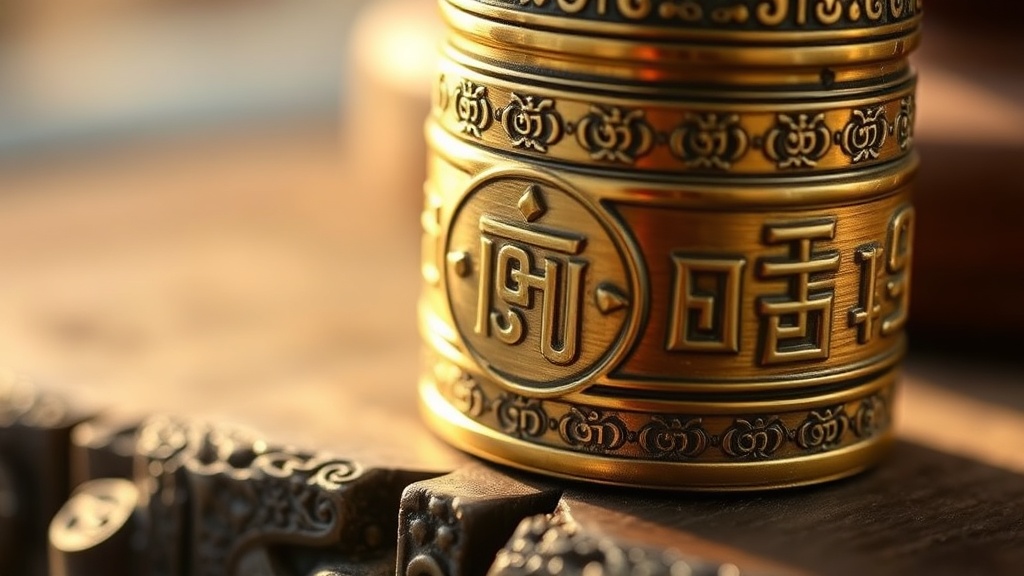
The physical object is a hollow metal cylinder, typically brass or silver-toned alloy, mounted on a handle or fixed to an axle. Inside the cylinder sits a tightly wound scroll bearing the mantra Om Mani Padme Hum, written thousands or even millions of times in Tibetan script. Some high-quality wheels contain printed copies of entire texts, including the Kangyur, the Tibetan Buddhist canon.
The exterior is usually engraved with the mantra and with symbolic motifs: the Eight Auspicious Symbols (ashtamangala), lotus forms, the Dharmachakra itself. A small weighted chain or bead is often attached to the side of the cylinder to aid rotation.
The Doctrinal Basis: Why Spinning Counts
The logic behind the prayer wheel is rooted in Vajrayana doctrine, which emphasizes the power of sacred sound and the written word as living expressions of enlightened mind. In this framework, mantra syllables are not merely sounds; they are understood as embodiments of the Buddha's speech, functioning at a level beyond ordinary language.
According to traditional Tibetan belief, spinning a prayer wheel bearing Om Mani Padme Hum carries the same spiritual weight as orally reciting the mantra the same number of times it appears inside the wheel. A single wheel may contain the mantra written hundreds of thousands of times. Each rotation, by this reckoning, is an act of devotion equivalent to an enormous accumulation of recitation.
This concept connects to the Mahayana doctrine of merit (punya) and its transfer. Practitioners often dedicate the merit generated by spinning a wheel to all sentient beings, a gesture central to the bodhisattva path.
💡 Did you know?
The first textual reference to prayer wheels in Tibetan literature is often attributed to the translator Thönmi Sambhota in the 7th century CE, though the practice likely developed and spread more widely between the 11th and 14th centuries alongside the flourishing of Vajrayana Buddhism across the Himalayas.
Types of Prayer Wheels
Prayer wheels are not a single object. They exist in a wide range of forms, each suited to different contexts of practice.
Hand-held wheels (mani wheels)
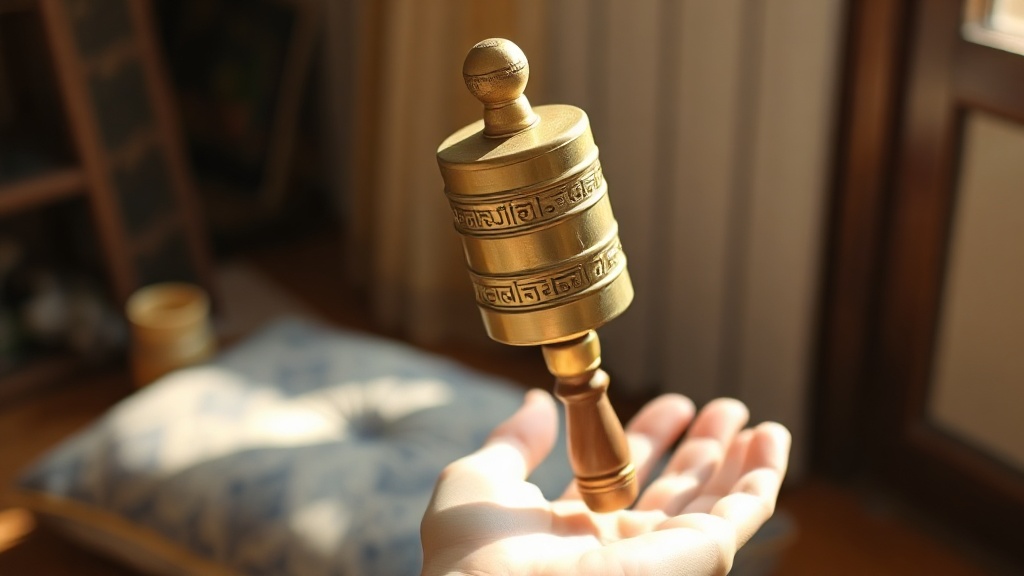
The most personal and portable form. A wooden or metal handle supports the cylinder, and a practitioner spins it while walking, sitting, or reciting mantras. Pilgrims circumambulating temples and stupas in Tibet, Nepal, and Bhutan commonly carry one. The motion becomes rhythmic and almost meditative on its own.
Standing and fixed wheels
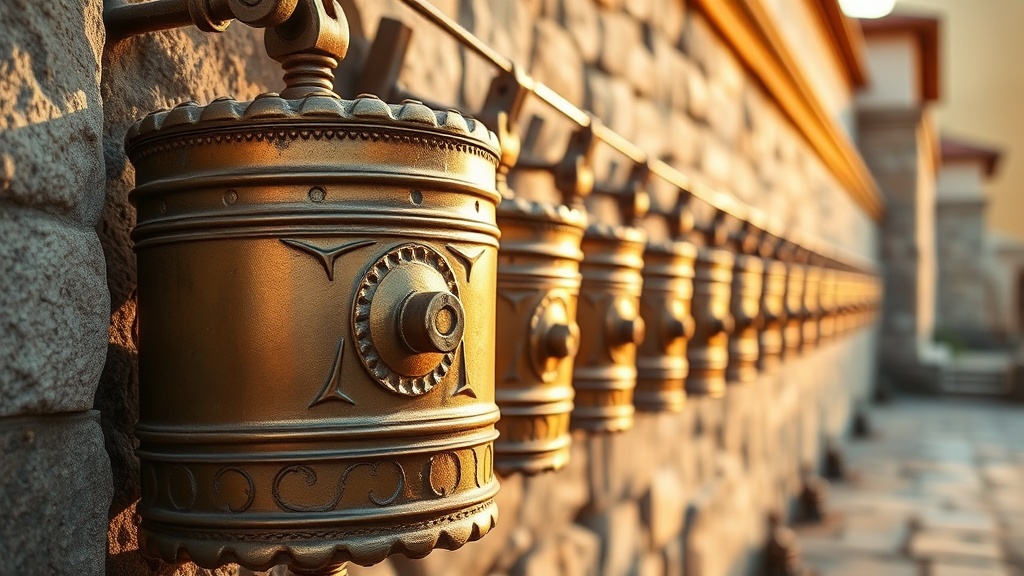
Large cylindrical wheels set into the exterior walls of monasteries, stupas, and pilgrimage routes. Rows of them line the circumambulation paths of major sites such as the Barkhor circuit around the Jokhang Temple in Lhasa. Pilgrims spin each wheel as they pass. Some standing wheels are enormous, requiring both hands or a full arm rotation to set them moving.
Water-powered and wind-powered wheels
In areas with fast-running streams, wheels are mounted on axles turned by flowing water, generating continuous rotation day and night. Wind-powered versions function similarly. These forms express an ecological ingenuity: the forces of nature themselves become instruments of devotion. Some contemporary practitioners have created solar-powered versions that spin through daylight hours.
Fire wheels
A smaller subset, placed above butter lamps so that rising heat from the flame turns the wheel. Less common, but documented in certain monastery contexts.
| Type | Size & Setting | How it turns |
|---|---|---|
| Hand-held (mani wheel) | Palm-sized, personal use | Practitioner's wrist motion |
| Wall-mounted / fixed | Large, monastery & stupa walls | Hand-spun by passersby |
| Water-powered | Medium to large, riverside | Stream current, continuous |
| Wind-powered | Variable, open terrain | Wind, like a turbine |
| Fire (butter lamp) | Small, altar setting | Rising heat from flame |
Om Mani Padme Hum: The Mantra Inside
Almost every prayer wheel in the Tibetan tradition contains the mantra Om Mani Padme Hum, the six-syllable formula associated with Avalokiteshvara (Tibetan: Chenrezig), the bodhisattva who embodies compassion. In Tibetan Buddhism, Chenrezig is considered the patron protector of Tibet, and the Dalai Lamas are understood as his human manifestations.
The mantra is not a prayer directed at an external deity in the way a Christian or Islamic prayer might be. It is closer to a concentration practice: each syllable corresponds, in Vajrayana commentary, to one of the six realms of existence and to specific qualities of enlightened mind. The Karandavyuha Sutra, a Sanskrit Mahayana text, is among the scriptures that elaborate on the significance of this mantra and the merits attributed to its recitation.
"When you recite the mantra Om Mani Padme Hum, you are doing all the practices of the Dharma simultaneously."
Attributed to Dilgo Khyentse Rinpoche, 20th-century Tibetan Buddhist master
This is why the wheel is so central: it is a technology for multiplying recitation beyond what any individual voice could accomplish in a single lifetime.
How to Use a Prayer Wheel: Practical Guidance
The basics are straightforward. A hand-held prayer wheel should be spun clockwise when viewed from above. This direction mirrors the clockwise circumambulation of sacred sites (pradakshina) observed across Tibetan and Theravada Buddhist traditions. Spinning counter-clockwise is considered contrary to the intention of the practice in the Tibetan context.
There is no single required posture. Practitioners spin prayer wheels while circumambulating monasteries and stupas, during seated meditation, while reciting mantras aloud, or simply while walking. In many Tibetan households, a prayer wheel sits near the door and is spun at the start and end of each day.
Beginners sometimes ask whether intention matters, or whether mechanical spinning alone is sufficient. Tibetan teachers tend to distinguish between levels of practice: a mindful recitation combined with spinning generates the fullest engagement with the practice, but even absent-minded spinning is considered meritorious within the logic of the tradition, because the mantra itself, as sacred speech, operates independently of the practitioner's moment-to-moment awareness.
Prayer Wheels Beyond Tibet: Spread and Adaptations
The prayer wheel is most deeply embedded in Tibetan Buddhism, but variants exist across the Himalayan Buddhist world: in Bhutan, Sikkim, Ladakh, Nepal's Sherpa communities, and among Mongolian Buddhist practitioners. Diaspora communities in India (particularly around Dharamsala, seat of the Tibetan government-in-exile), Europe, and North America have carried the practice with them.
In recent decades, some Western practitioners have adapted the prayer wheel concept: desktop versions, software applications that display spinning virtual wheels, and even prayer wheel jewelry. A Tibetan spinner ring, for instance, uses the same rotating-cylinder principle at a miniaturized scale. These adaptations sit at the edge of the tradition; whether they carry the same doctrinal weight is a matter for individual teachers and students to navigate within their own practice lineage.

🗂️ Voir la collection
Buddhist Decor
From standing prayer wheels to Tibetan statues and altar pieces, objects that bring Buddhist practice into your home with care.
57 références
Découvrir la catégorie →Reading the Object: Symbols on the Wheel
The decorative program of a prayer wheel is rarely arbitrary. Each motif carries a specific meaning within Tibetan Buddhist iconography.
- The Dharmachakra (eight-spoked wheel): represents the Buddha's first teaching at Sarnath, the turning of the Wheel of Dharma. Its presence on a prayer wheel links the object to that foundational moment.
- The Eight Auspicious Symbols (ashtamangala): the parasol, golden fishes, treasure vase, lotus, conch shell, endless knot, victory banner, and Dharmachakra. These appear frequently on ceremonial objects across Mahayana and Vajrayana traditions.
- The Endless Knot (shrivatsa): a symbol of interdependence and the interwoven nature of all phenomena, central to the Buddhist concept of dependent origination (pratityasamutpada).
- Lotus forms: representing purity of mind arising from the conditions of samsara, as the lotus flower rises clean from muddy water.
- The Snow Lion: a Tibetan cultural symbol, often appearing on objects connected to Tibetan national and religious identity.
When choosing a prayer wheel, reading its surface decoration is part of understanding the object you are bringing into your practice or your home.
Prayer Wheels as Gifts and Devotional Objects
A prayer wheel makes a considered gift for someone with an established Buddhist practice or a genuine interest in Tibetan culture. It is not a casual decorative object; it carries doctrinal weight and historical roots. A brass hand-held wheel, approximately 10, 15 cm in height on a wooden handle, is the most accessible entry point: usable, portable, and visually grounded in the tradition.
When selecting one, look for clear engraving of Om Mani Padme Hum on the cylinder, solid metal construction (brass is traditional), and a balanced weight that allows smooth, free rotation. A well-made wheel spins with minimal resistance. Cheap versions sometimes have axles that bind or cylinders that wobble. The scroll inside should be confirmed as present by the maker or seller.

🗂️ Voir la collection
Zen Decor
Ritual objects, altar pieces, and contemplative decor rooted in centuries of Buddhist and East Asian tradition, for practice spaces that mean something.
206 références
Découvrir la catégorie →Living with a Prayer Wheel: Practice, Not Decoration
The prayer wheel is at its most meaningful when it lives inside a practice rather than on a shelf. That does not require ordination, monastic training, or even a formal teacher, though working with a teacher in any Vajrayana practice is genuinely recommended by every lineage that uses these objects. It does require some basic orientation: understanding what the mantra means, why the direction of rotation matters, and where the object sits within the broader framework of Tibetan Buddhist devotion.
For someone new to prayer wheel Buddhism, a useful first step is simply sitting with the wheel in hand, spinning it slowly, and reciting Om Mani Padme Hum aloud or silently. No ceremony is required to begin. The practice is deliberately accessible: it was designed to give everyone, regardless of literacy or contemplative training, a way to engage with the Dharma through the body as well as the mind.
Over time, the motion becomes its own kind of anchor. Practitioners who have used a hand-held prayer wheel for years often describe the spinning as inseparable from their daily rhythm, a reminder, in the simplest physical terms, that the wheel of Dharma is always turning.
Questions fréquentes
What is inside a Buddhist prayer wheel?+
A tightly wound scroll bearing the mantra Om Mani Padme Hum, written anywhere from hundreds to millions of times in Tibetan script. Some wheels contain full canonical texts. The scroll is sealed inside the metal cylinder and is not meant to be removed or unrolled.
Which direction should a prayer wheel spin?+
Always clockwise, when viewed from above. This mirrors the direction of circumambulation of sacred sites in Tibetan Buddhism and is considered the correct orientation for activating the mantra inside. Spinning counter-clockwise is considered contrary to the practice's intention.
Do you need to be Buddhist to use a prayer wheel?+
There is no formal religious requirement. However, using a prayer wheel with some understanding of its cultural and doctrinal context is more meaningful than treating it purely as a decorative object. If you are seriously interested in the practice, connecting with a Tibetan Buddhist teacher or Sangha community will give you a proper grounding.
What does Om Mani Padme Hum mean?+
The Sanskrit mantra is often translated as "the jewel in the lotus," referring to Avalokiteshvara (Chenrezig), the bodhisattva of compassion. In Vajrayana commentary, each of the six syllables (Om, Ma, Ni, Pad, Me, Hum) corresponds to one of the six realms of existence and to qualities of enlightened mind, including compassion, ethics, patience, diligence, concentration, and wisdom.
Is prayer wheel practice found outside Tibetan Buddhism?+
Prayer wheels are most closely associated with Tibetan Vajrayana Buddhism. They are also found in Bhutanese, Mongolian, and Himalayan Buddhist communities that share the Vajrayana tradition. They are not a feature of Theravada or most East Asian Mahayana Buddhist practices, which use different ritual objects and methods.


