

Buddhist Altar Offerings: What to Place, Why It Matters, and How to Begin
Buddhist altar offerings are not decoration. They are a structured practice rooted in texts that are, in some cases, over two thousand years old. Whether you keep a single candle on a shelf or maintain a full seven-bowl Tibetan shrine, each object placed on the altar carries a specific purpose within a tradition that spans Theravada, Mahayana, and Vajrayana schools. This guide walks through what those offerings are, where they come from, and how to work with them honestly at home.
⭐ Key points
- The traditional Buddhist altar offerings include seven categories, each corresponding to a sense faculty or a virtue.
- Offerings are not transactions. They train generosity (dana) and cut through attachment, not appeal to a deity for favors.
- Theravada, Mahayana, and Vajrayana traditions share the same core logic but differ significantly in ritual form and symbolism.
- A home altar does not need to be elaborate. Sincerity of practice matters more than the cost of the objects.
- Certain offerings, particularly light and water, carry specific etiquette that varies by tradition and lineage.
Why Buddhist Altar Offerings Exist in Practice
Buddhism is not a theistic religion in the Western sense. The historical **Buddha**, Siddhartha Gautama, is not a god who receives gifts and grants wishes in return. So why make offerings at all?
The answer sits in the concept of dana, the Pali word for generosity or giving, which the Sutta Pitaka identifies as the first of the ten perfections (paramitas) a practitioner cultivates on the path to awakening. The act of offering trains the mind away from clinging. You prepare something carefully, place it with attention, and eventually let it go. The object itself is secondary. The mental gesture is what counts.
In Mahayana and Vajrayana frameworks, Buddhist altar offerings also function within a relational context: the altar represents the Three Jewels (Buddha, Dharma, Sangha), and offerings honor that relationship in a tangible, embodied way. Several Mahayana sutras, including the Avatamsaka Sutra, include lengthy passages describing vast imagined offerings, clouds of flowers, oceans of perfume, to illustrate that the quality of generosity is not bounded by material limits.
Vajrayana practice takes this further. In tantric ritual systems, offerings are understood to purify specific obscurations corresponding to each sense: form purifies visual grasping, scent purifies olfactory attachment, and so on through the six sense fields. The ritual is methodical, not merely symbolic.
Understanding this logic is foundational. Whether your altar holds one candle or fourteen objects, the purpose is the same: to train a mind that gives without calculation, and to bring the practitioner into consistent, embodied relationship with the Dharma.
The Seven Traditional Buddhist Altar Offering Bowls: What Each One Means
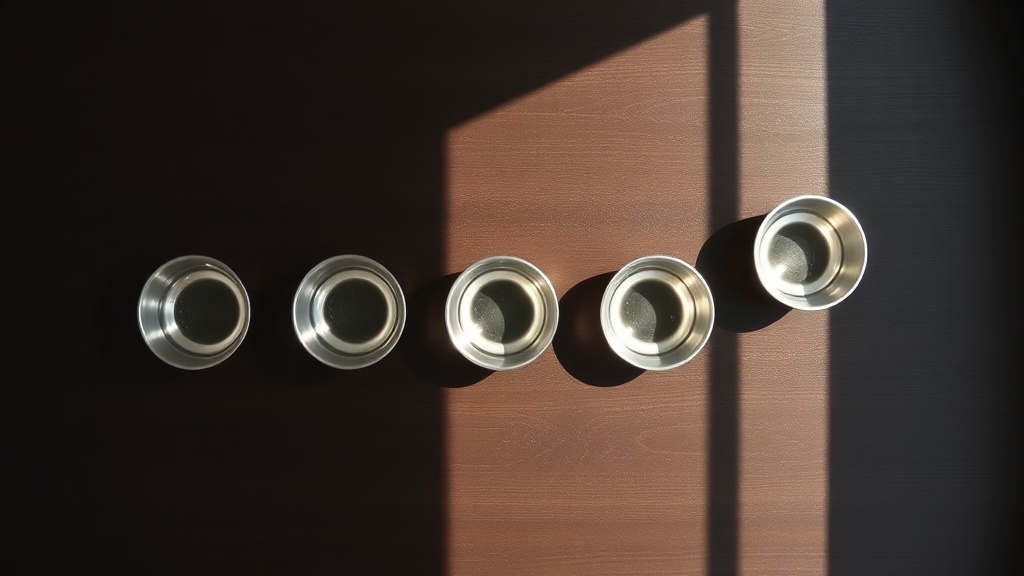
The most recognizable feature of a Tibetan Buddhist altar is the row of seven offering bowls (Tib. yonchab dunpa), typically made from brass, silver, or copper, filled each morning and emptied each evening. Each bowl corresponds to a traditional Buddhist altar offering made to honored guests in ancient Indian culture. The practice has roots in pre-Buddhist hospitality ritual that Buddhist tantra absorbed and reinterpreted within the framework of sense purification.
| Bowl | Traditional Offering | What It Purifies |
|---|---|---|
| 1st | Water for drinking (argham) | Attachment to taste |
| 2nd | Water for washing feet (padyam) | Attachment to touch |
| 3rd | Flowers (pushpe) | Attachment to form / visual grasping |
| 4th | Incense (dhupe) | Attachment to scent |
| 5th | Light (aloke) | Attachment to visual form / ignorance |
| 6th | Perfumed water (gandhe) | Attachment to scent (subtle form) |
| 7th | Food (newide) | Attachment to taste (subtle craving) |
In practice, many home altars fill all seven bowls with plain water to represent each offering symbolically. The gesture of pouring each morning, with attention, and emptying each evening, before the water stagnates, is itself the practice. Leaving water to go cloudy is considered disrespectful in most Tibetan lineages.
Light as a Buddhist Altar Offering: Lamps, Candles, and What They Represent
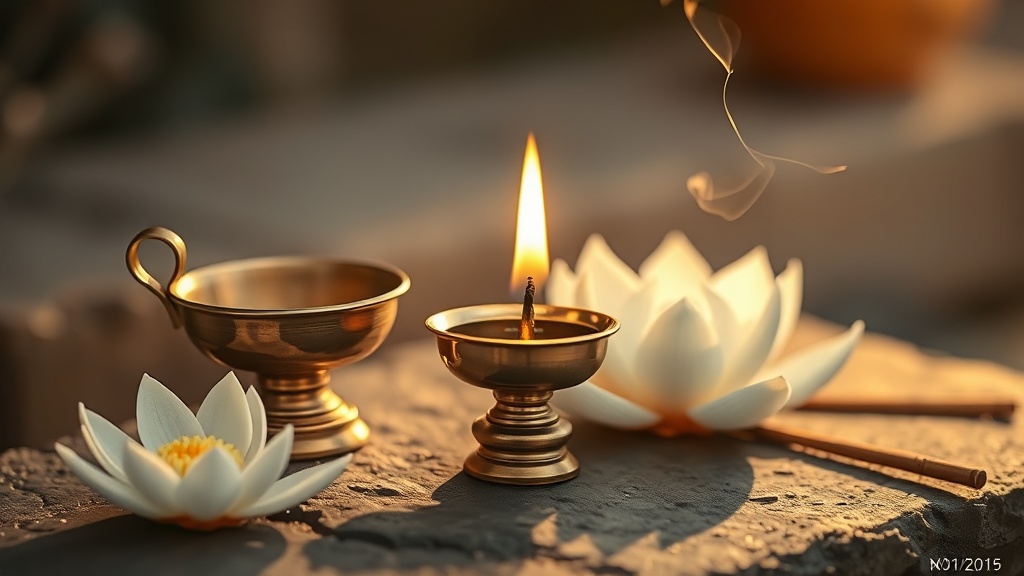
Across every Buddhist school, light is the Buddhist altar offering most consistently placed before the central image. The Pali word for it, pajjota, appears in early texts as a metaphor for wisdom cutting through the darkness of ignorance. Offering a flame is understood as an aspiration: may wisdom arise in the mind the way this light illuminates the room.
In Theravada practice, particularly in Sri Lanka, Myanmar, and Thailand, butter lamps or simple oil wicks burn in front of a Buddha image as an ongoing act of veneration. In Tibetan Buddhist monasteries, rows of hundreds of butter lamps (Tib. chhöme) are kept lit around the clock, especially during the night hours of Losar (Tibetan New Year) or during puja ceremonies.
At home, the form is less important than the consistency. A small brass oil lamp placed on the altar, lit at the beginning of practice and extinguished at the end, works well. Some practitioners use candles; others prefer electric lamps when fire is impractical. Most Tibetan teachers accept electric light for lay practitioners while noting that an open flame carries a particular quality of impermanence, it can go out, which a bulb cannot.

Incense on the Buddhist Altar: Tradition, Etiquette, and Types
Incense is among the oldest recorded offerings in Buddhist practice. The Dhammapada (verse 54) uses fragrance as a direct metaphor for virtue that spreads in all directions, unlike flowers whose scent only travels downwind. Incense on the altar carries that same logic: the scent of offerings moves outward without direction or preference, a quality associated with the impartiality of Dharma teachings.
Different traditions use different forms. Tibetan incense tends to be thick, rolled from juniper, herbs, and aromatic resins, and burns slowly, a single stick can last 45 minutes to an hour. Japanese incense, by contrast, is much thinner and more refined, often made from aloeswood (agarwood, known in Japanese as jinko) or sandalwood. Theravada traditions in Southeast Asia commonly use incense sticks made from sandalwood paste.
Etiquette varies. In most Tibetan lineages, incense is placed to the left side of the altar from the practitioner's perspective. The number of sticks matters in some traditions: three sticks represent the Three Jewels (Buddha, Dharma, Sangha). Offering a single stick is also acceptable in many schools. Offering two sticks is traditionally reserved for funerary contexts in certain East Asian Buddhist lineages, so it is worth knowing your own tradition's norms before defaulting to two.
💡 Did you know?
The Sanskrit term for the incense offering, dhupa, shares a root with the English word "fume." In ancient Indian hospitality ritual (from which Buddhist altar protocol partially derives), burning perfumed wood to welcome guests was standard practice. The early Buddhist community absorbed this custom and gave it a new doctrinal frame, relating each sense offering to a specific form of attachment to be recognized and released.
Flowers, Food, and Water: Buddhist Altar Offerings That Teach Impermanence Directly
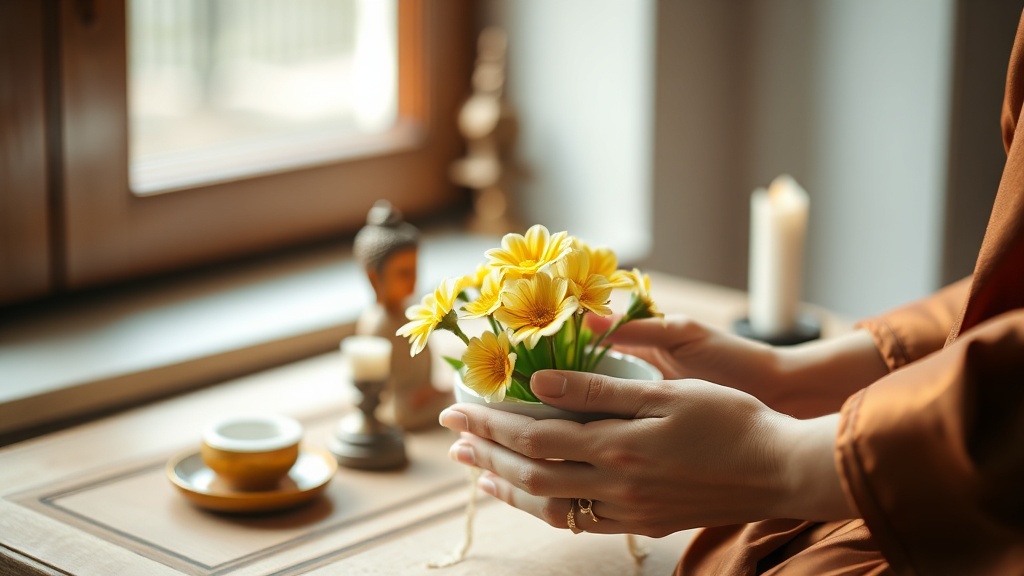
Fresh flowers on a Buddhist altar are not there to look pretty. They are there because they will die. A flower placed on the altar on Monday and left through Thursday has already done half its teaching by then, it is wilting, browning at the edges, losing scent. That visible change is the practice. Most teachers recommend changing flowers before they decay noticeably, not because death is aesthetically inconvenient, but because a well-maintained altar reflects the care a practitioner brings to the Three Jewels.
Lotus flowers hold special status in Buddhist iconography. The lotus grows from mud through water to bloom above the surface, a visual metaphor, recurring across Mahayana and Vajrayana texts, for awakening arising within samsara. Where fresh lotus flowers are unavailable (which is most of the world most of the time), any clean, unfragrant flower works. Fragrant flowers are used in some traditions and avoided in others, particularly where incense already provides the scent offering.
Food offerings (newide in Sanskrit, or prasad in the Hindu-adjacent terminology that some Mahayana lineages carry) are placed in front of the altar image and later consumed by the practitioner or shared. The act of consecrating food, offering it, and then eating it with mindfulness is itself a complete practice. In Theravada contexts, fruit is common. In Tibetan traditions, torma, sculpted ritual cakes made from roasted barley flour (tsampa) mixed with butter, are used in formal puja settings.
How Theravada, Mahayana, and Vajrayana Altars Differ in Practice
The underlying intention behind altar offerings is shared across Buddhist schools. The outward forms differ substantially, and knowing those differences helps when you are setting up your own altar or visiting a monastery for the first time.
A Theravada altar in Southeast Asia typically centers on a single Buddha image in the Dhyana mudra (hands resting in the lap, palms up) or the Bhumisparsha mudra (right hand touching the earth, referencing the moment of awakening). Offerings are simple and consistent: water, flowers, incense, and light. The altar is clean, uncluttered, and the Buddha image is placed at a height above eye level when the practitioner is seated. You do not make eye contact at the same level with the image, it is positioned to look slightly down, which is not authority but traditional iconographic convention across most of Buddhist art history.
A Mahayana altar, particularly in East Asian traditions (Chinese, Japanese, Korean, Vietnamese), often includes multiple figures: bodhisattvas such as Guanyin (Avalokiteshvara) or Manjushri flanking the central Buddha. Offerings expand to include incense coils, water, rice, tea, fruit, and in some Chinese traditions, three sticks of incense in a large sand-filled censer. The altar cloth is often red or gold brocade. Ritual chanting accompanies offering preparation in formal temple settings.
A Vajrayana altar is the most visually complex. The Tibetan tradition typically includes: a central image (statue or thangka painting) of the main practice deity or Buddha, the seven water bowls, butter lamps or candles, a conch shell filled with saffron water, a Dharma text (often wrapped in cloth, representing the Dharma Jewel), and a bell and dorje (vajra scepter) representing method and wisdom. Specific lineages add additional objects: a mirror, grain, a seven-offering mandala plate in formal practice.
In all three traditions, the central logic is identical: Buddhist altar offerings are not gifts to a deity. They are acts of the practitioner's mind, given form through deliberate, repeated physical gesture.
Setting Up a Home Altar: Practical Decisions for Real Spaces
Most people reading this are not monks. They have apartments, shared living spaces, family members who may not share the same practice, and limited shelf space. A home altar does not need to replicate a monastery shrine room. It needs to be honest, consistent, and respected.
Height matters: in most traditions, the central image should be at or above eye level when you sit in practice. Placing a Buddha image on the floor is considered disrespectful across all major schools. A dedicated shelf, a small table, or a wall-mounted bracket all work. The altar should face into the room, with the practitioner sitting opposite.
Direction varies by tradition. Tibetan altars often face south or west. In Feng Shui-influenced East Asian homes, east-facing altars are preferred, as they receive morning light. For most lay practitioners in Western contexts, the most practical and respectful direction is the one that allows you to sit comfortably in front of the altar without your back to a door.
Keep the surface clean. Do not stack unrelated objects on or around the altar. Do not place the altar in a bathroom or directly adjacent to a kitchen waste area. These are not superstitions, they reflect the same care you would extend to any object or space you genuinely value.
For practitioners building their altar from scratch, beginning with a single, well-chosen Buddha statue (representing the Buddha Jewel), a clean cloth, and one or two offering items, such as a lamp and a small cup of water, is entirely sufficient. The altar grows as the practice deepens, not before.

Mandala Offerings and Visualization: Going Beyond Physical Objects
In Vajrayana practice, the mandala offering is a distinct and more elaborate ritual that goes beyond what sits on the physical altar surface. Using a flat metal plate (mandal), the practitioner builds up layers of grain or rice while reciting a text that imagines offering the entire universe, Mount Meru at the center, the four continents, the sun, moon, and all riches, to the Buddha and Sangha. The Ngöndro preliminary practices (foundational Tibetan practice sequences) typically require 100,000 repetitions of this offering as part of a formal accumulation.
For practitioners not following a formal Vajrayana path, visualization offerings are available in a simpler form. Several teachers in the Tibetan tradition teach that you can mentally multiply any physical offering: as you pour one bowl of water, you visualize an infinite ocean. The quality of the visualization, its stability, clarity, and vividness, is itself the training. This brings the practice within reach even when physical offerings are minimal.
The Avatamsaka Sutra describes the bodhisattva Samantabhadra making offerings of vast, imagined "clouds of flowers" stretching across infinite Buddha-fields. That text is not prescribing a literal purchasing list. It is pointing at the quality of a mind that gives without reservation.
"The fragrance of virtue travels against the wind, in all directions, to every quarter."
Dhammapada, verse 54 (Pali canon)
Offerings to Avoid: Common Errors and Respectful Corrections
A few patterns come up repeatedly for home practitioners that are worth naming plainly.
- Leaving offerings to decay: wilted flowers, cloudy water, old food left indefinitely. This reflects inattention more than devotion. Change offerings regularly.
- Mixing unrelated objects on the altar: keys, mail, phone chargers. The altar is not a shelf. Objects placed there should be chosen deliberately. If space is tight, use a small tray or cloth to demarcate the altar clearly from adjacent items.
- Candles left burning unattended: straightforward fire safety. A butter lamp or candle on an altar should not be left lit in an empty room overnight. The offering is the lit flame during practice, not an indefinitely burning one.
- Inappropriate images: placing images of living teachers directly beside or above a Buddha image is handled differently across lineages. In Theravada contexts this is often avoided. In Tibetan traditions, the guru image is placed above the Buddha image on one's personal altar, reflecting the understanding that the teacher is the embodiment of the Three Jewels for the student. Know your lineage's norms.
- Mixing traditions without grounding: a Theravada Buddha image flanked by Tibetan protector deities and a Shinto ofuda is not necessarily harmful, but it reflects an approach to the altar as aesthetic collage rather than practice support. There is nothing wrong with appreciating multiple traditions. A working altar benefits from coherence.
Buddhist Decor
Statues, thangkas, altar objects, and ritual decor grounded in Buddhist tradition, the full range of what a thoughtfully arranged home altar might hold.
57 références
Découvrir la catégorie →Bringing Consistency to Daily Altar Practice
The most common difficulty for home practitioners is not knowing what to offer, it is showing up every day. A monastery schedule solves this by structure. A lay practitioner in a city has to build that structure from scratch, around work, family, and every other competing claim on attention.
Short is better than skipped. If your formal practice time is reduced on a given day, the altar offerings still happen. Two minutes to pour the water bowls, light the lamp, and sit for three conscious breaths before leaving for work is a real practice. It is not a diluted version. It is practice adapted to conditions, which is itself a core Buddhist principle.
Some teachers suggest treating the morning offering as the first conscious act of the day, before screens, before coffee, before any decision-making. The act of bringing fresh water to the altar before anything else sets a direction for the day that is not rushed or reactive. That quality of intention, arriving at the altar before the day's noise accumulates, is harder to describe than to try.
A dedicated meditation and prayer practice supported by a well-kept altar tends to be more stable than one that relies on mood or inspiration. The physical altar, with its objects and its daily care, provides an external anchor for an internal orientation. Maintaining Buddhist altar offerings as a daily gesture, however minimal, is the most reliable foundation for a practice that lasts.
Frequently Asked Questions: Buddhist Altar Offerings
Do I need to follow a specific tradition to set up a Buddhist altar at home?+
No formal affiliation is required. That said, choosing one tradition as your primary reference gives the altar coherence. A Theravada setup (single Buddha image, water, flowers, incense, light) is the simplest and most universally recognized starting point. If you have a teacher or belong to a Sangha, their lineage's norms take precedence over general guidelines.
Can I use tap water for the seven offering bowls?+
Yes. Clean tap water is entirely appropriate. In Tibetan tradition, the water is sometimes scented very lightly with saffron, but this is optional. The key requirements are that the water is clean, poured fresh each morning, and emptied before it stagnates, typically by evening. The purity of intention matters more than the source of the water.
Is it acceptable to offer food that contains meat or alcohol?+
This varies significantly by tradition. Theravada practice in mainland Southeast Asia (Thailand, Myanmar) does not restrict what monks receive as alms, including meat under specific conditions laid out in the Vinaya. However, food offerings on a home altar are typically vegetarian across most schools. Alcohol appears in certain Vajrayana ritual contexts as a transformed offering, but this is strictly within formal tantric practice with a qualified teacher, not a general recommendation for home altars.
What do I do with food offerings after they have been placed on the altar?+
Eat them, or share them. In most Mahayana and Theravada traditions, food that has been offered is considered consecrated by intention and is consumed respectfully by the practitioner or offered to guests. Do not discard it unused if it is still edible. In some Vajrayana contexts, specific ritual foods are disposed of outdoors after the ceremony. Your teacher's instructions will specify this where it applies.
Do I need to recite prayers or mantras when making offerings, or can I do it in silence?+
Both are valid. In formal Vajrayana practice, offerings are accompanied by specific Sanskrit or Tibetan dedication verses. In Theravada lay practice, a simple Pali phrase such as "Idam no natinam hotu" (may this be for the benefit of my relatives and all beings) is common. For practitioners without a specific liturgical commitment, making offerings with clear, present-minded intention and no words at all is legitimate. Silence is not a lesser offering.
What is the minimum a home altar needs to be considered complete?+
According to most Theravada and general Mahayana guidance, a complete basic altar includes: a representation of the Buddha (statue, image, or thangka), a light source (lamp or candle), and one offering of water or flowers. This covers the Three Jewels symbolically (Buddha image for the Buddha, a text if available for the Dharma, and the practitioner's own presence and Sangha connection). Beyond this minimum, additions are welcome but never obligatory. The altar serves the practice. It does not define it.


