

The Vajrasattva Mantra: Meaning, Practice, and the Tradition of Purification
There is a mantra in the Vajrayana tradition that practitioners return to again and again, not because it is the most dramatic or esoteric, but because it addresses something fundamental: the weight of past actions. The Vajrasattva mantra is, at its core, a practice of purification. It has been recited in Himalayan monasteries for over a thousand years, integrated into the foundational curriculum of Tibetan Buddhist practice, and passed from teacher to student with precise instructions about how to engage it properly.
This guide covers the full text of both the short and long forms of the mantra, the meaning of each Sanskrit syllable, the visualization and mental posture required, and the broader context of Vajrasattva as a figure in Buddhist iconography. Whether you are encountering this practice for the first time or looking to deepen what you already know, the following pages treat the subject with the seriousness it deserves.
⚠️ A note on transmission
In most Vajrayana lineages, formal Vajrasattva practice as part of Ngondro requires an empowerment (lung or abhisheka) from a qualified teacher. Reciting the mantra without transmission is not considered harmful, and many teachers encourage it as preliminary practice. However, the full Ngondro accumulation is typically undertaken only after receiving the appropriate authorization. If you are unsure about your own lineage's requirements, ask your teacher or a senior sangha member directly.
⭐ Key points
- Vajrasattva is a Sambhogakaya Buddha, recognized across Tibetan, Japanese Shingon, and other Vajrayana schools.
- The full 100-syllable mantra (Skt: Vajrasattva Shatakshara) is the standard form used in Ngondro and purification retreats.
- A short 6-syllable form - OM VAJRASATTVA HUM - is used for daily recitation and on the breath.
- Traditional sources recommend 100,000 repetitions of the long mantra as part of the foundational Ngondro practices.
- The practice pairs mantra recitation with a specific visualization; the two are inseparable in most instructional lineages.
- The full Ngondro accumulation generally requires transmission from a qualified teacher before beginning.
Who Is Vajrasattva in Buddhist Tradition?
Vajrasattva (Sanskrit: vajra = thunderbolt or diamond, sattva = being) is a figure representing the primordial purity of mind. In Tibetan Buddhist cosmology, he belongs to the Sambhogakaya - the "enjoyment body" of Buddhas, accessible through meditative experience rather than physical perception. He is sometimes described as the sixth Buddha, synthesizing the qualities of all five Dhyani Buddhas. In other formulations, he is treated as an aspect of Akshobhya, the Buddha of the eastern direction.
His iconographic form is consistent across traditions: white in color (white being the Tibetan symbol for purity), seated in vajra-posture, holding a five-pointed golden vajra at his heart with his right hand and a silver bell (ghanta) at his left hip. The vajra represents upaya (skillful means, or method), and the bell represents prajna (wisdom). Together they signal the non-dual union of compassion and insight that characterizes awakened mind.
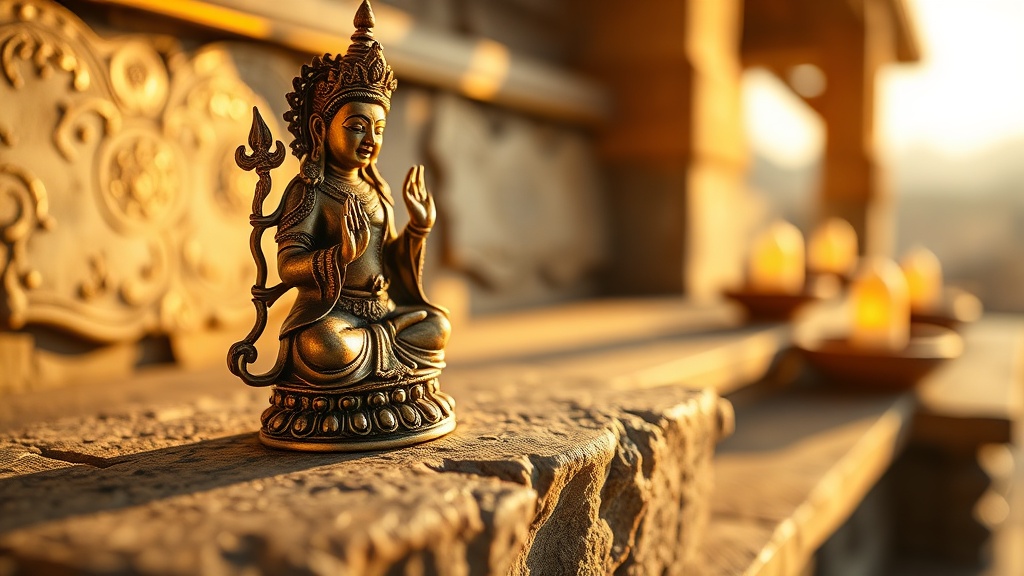
In the Shingon school of Japanese esoteric Buddhism, the corresponding figure is Kongosatta (金剛薩埵), who serves a parallel function and shares the same Sanskrit root name. The figure also appears in the Bardo Thodol (the Tibetan Book of the Dead), where he is said to appear on the second day of the bardo journey as a luminous blue-white light.
💡 Did you know?
According to the Bardo Thodol, each of the 49 days of the bardo (intermediate state between death and rebirth) corresponds to a specific Buddha and light. On the second day, the practitioner who recognizes the luminous blue-white light of Vajrasattva as the nature of their own mind is said, according to this tradition, to attain liberation. Failing to recognize it, they are drawn instead toward the duller light of lower realms. This is one reason Vajrasattva practice is considered a preparation not only for this life but for the moment of death.
The Full 100-Syllable Vajrasattva Mantra: Text and Transliteration
The full form of the Vajrasattva purification mantra is known in Sanskrit as the Vajrasattva Shatakshara - "the hundred syllables of Vajrasattva." The standard Tibetan transliteration used in most practice texts is given below. Note that different lineages use slightly variant spellings; the version below follows the most widely used Tibetan rendering:
OM VAJRASATTVA SAMAYA
MANUPALAYA
VAJRASATTVA TVENOPATISHTHA
DRIDHO ME BHAVA
SUTOSHYO ME BHAVA
SUPOSHYO ME BHAVA
ANURAKTO ME BHAVA
SARVA SIDDHI ME PRAYACCHA
SARVA KARMA SUCHA ME
CHITTAM SHRIYAM KURU HUM
HA HA HA HA HOH
BHAGAVAN SARVA TATHAGATA
VAJRA MA ME MUNCHA
VAJRI BHAVA MAHA SAMAYA SATTVA AH HUM PHATStandard Tibetan lineage transliteration of the Vajrasattva Shatakshara
This text is not decorative. Each phrase carries a specific meaning within the logic of Vajrayana ritual speech, and understanding that meaning - even partially - shifts the quality of recitation from mechanical repetition to engaged practice.
Syllable-by-Syllable: What the Mantra Actually Says
Breaking down the Vajrasattva mantra phrase by phrase clarifies what the practitioner is actually doing when they recite it. This is not a prayer of petition to an external deity; it functions more like a vow-renewal and an invocation of innate clarity.
| Sanskrit phrase | Approximate meaning |
|---|---|
| OM VAJRASATTVA SAMAYA | OM, Vajrasattva, [honor to your] sacred commitment (samaya) |
| MANUPALAYA | Protect me, uphold me [within that commitment] |
| VAJRASATTVA TVENOPATISHTHA | Vajrasattva, stand firm in me / remain present with me |
| DRIDHO ME BHAVA | Be steady / firm for me |
| SUTOSHYO ME BHAVA | Be thoroughly pleased / satisfied with me |
| SUPOSHYO ME BHAVA | Be fully nurturing toward me |
| ANURAKTO ME BHAVA | Be kindly disposed / affectionate toward me |
| SARVA SIDDHI ME PRAYACCHA | Grant me all accomplishments (siddhi) |
| SARVA KARMA SUCHA ME | Make all my actions virtuous / auspicious |
| CHITTAM SHRIYAM KURU HUM | Make my mind glorious / radiant; HUM (seed syllable of Vajrasattva) |
| HA HA HA HA HOH | Exclamations of joy; seed syllables of the four immeasurables or the four Vajra activities |
| BHAGAVAN SARVA TATHAGATA | Blessed One, all Tathagatas (those who have gone thus / Buddhas) |
| VAJRA MA ME MUNCHA | Do not abandon me, O Vajra [holder] |
| VAJRI BHAVA MAHA SAMAYA SATTVA AH HUM PHAT | Become the Vajra-holder; Great Commitment Being; AH (purity of speech); HUM (mind); PHAT (dispelling obstacles) |
The word samaya (sacred commitment or vow) appears twice: at the opening and near the close. This is not accidental. The mantra frames itself as a renewal of relationship between the practitioner and the quality of primordial purity that Vajrasattva embodies. The assumption within Vajrayana is that this purity is the practitioner's own nature, temporarily obscured by habitual patterns and past actions. Recitation is less an appeal to an outside force and more a process of recognizing what is already present.
The Short Form: OM VAJRASATTVA HUM
The six-syllable short mantra - OM VAJRASATTVA HUM - functions as a condensed version of the full 100-syllable text. Most teachers authorize its use for daily informal practice outside of formal Ngondro sessions. Some practitioners synchronize it with the breath: OM VAJRASATTVA on the inhale, HUM on the exhale. Others use it on the mala between longer sessions of the full mantra.
The three components carry straightforward resonance. OM is the universal opening seed syllable, present across Hindu and Buddhist tantra. VAJRASATTVA names the deity and quality being invoked. HUM is the seed syllable specifically associated with Vajrasattva's mind, his "heart syllable," and signals the moment of contact between the practitioner's awareness and the quality being cultivated.

The Ngondro Context: Why 100,000 Repetitions?
In Tibetan Vajrayana, the Vajrasattva mantra is the second of the four foundational practices called Ngondro (Tib: sngon 'gro, "that which goes before"). The four are: taking refuge and generating bodhicitta (100,000 repetitions), Vajrasattva recitation (100,000 repetitions of the 100-syllable mantra), mandala offering (100,000 repetitions), and Guru Yoga (100,000 repetitions). These are prerequisites, in most Kagyu, Nyingma, and Gelug lineages, before receiving higher tantric transmissions.
The number 100,000 is not arbitrary, though it should not be understood as a transaction. Kyabje Dilgo Khyentse Rinpoche wrote that the accumulation serves to wear down the habitual tendency of the mind to treat its own obscurations as solid and permanent. Repetition is the mechanism that gradually loosens that grip. The number simply ensures the practitioner stays in contact with the practice long enough for that loosening to occur.
Practitioners doing a formal Ngondro retreat typically count on a counter (Tib: grangs 'debs) and track sessions in a dedicated notebook. Daily minimums vary by teacher: some recommend 1,000 per day, others 111 (the base count on a mala plus three extra for miscounts). The math at 1,000 per day places completion at approximately 100 days of sustained practice.
Visualization: The Other Half of the Practice
Recitation without visualization is, in most Vajrayana instructional lineages, considered incomplete. The standard Vajrasattva visualization - transmitted consistently across most Kagyu and Nyingma traditions - runs as follows:
- Sit upright. Generate the motivation of bodhicitta: the wish that all beings be free from suffering and its causes.
- Visualize Vajrasattva seated above the crown of your head, roughly the size of your thumb, white and luminous, facing forward, in full ornament.
- At his heart, see a white lunar disc. On it sits the seed syllable HUM, white, upright. Around its rim, the 100-syllable mantra is arranged clockwise in Sanskrit letters.
- As you recite the mantra, white nectar flows from the syllables, down through your crown, filling your body from head to feet, washing away the residue of negative actions like ink diluted in clear water.
- At the end of the session, Vajrasattva dissolves into light, which merges into you. Rest briefly without conceptual elaboration.
The image of nectar and purification is not meant to be taken as literal hydraulics. In the Vajrayana view, the visualization works by training the mind to recognize the purity already present rather than manufacturing a new quality from outside. The nectar is, symbolically, the recognition itself.
Samaya: The Concept at the Heart of the Mantra
The word samaya is often translated as "sacred vow" or "tantric commitment," but both translations flatten something more specific. In the Vajrayana context, samaya refers to the bond formed between student and teacher, and between the practitioner and a given deity, at the moment of empowerment (Skt: abhisheka). To break samaya - through actions like abandoning practice, disparaging the teacher, or misusing the empowerment - is considered among the most serious transgressions in the Vajrayana framework.
This is precisely why Vajrasattva practice holds its central position in Ngondro. The Vajrasattva mantra for samaya restoration is the prescribed antidote to samaya breakage. Traditional texts specify that if the 100-syllable mantra is recited 21 times daily without break, deteriorated commitments are prevented from hardening into permanent damage. Recited 100,000 times with genuine regret and the four opponent powers, even seriously broken samaya can be purified, according to traditional sources including commentaries on the Guhyasamaja Tantra lineage.
The Four Opponent Powers in Vajrasattva Practice
Tibetan Buddhist texts are explicit that mantra recitation alone does not constitute a complete purification practice. Four mental factors - known as the Four Opponent Powers or Four Forces - must accompany the recitation for it to function as intended. These are described in detail in Lama Zopa Rinpoche's commentary on the Vajrasattva practice and in the Bodhicharyavatara of Shantideva.
- The power of reliance (taking refuge and generating bodhicitta): Establishing the ground by reconnecting with the Three Jewels and the aspiration for liberation for all beings.
- The power of regret (not guilt, but clear recognition): Seeing past harmful actions without self-punishment but with honesty. Tibetan teachers often distinguish regret from guilt: regret is clear-eyed; guilt is self-centered rumination.
- The power of the antidote (the practice itself): This is where the Vajrasattva recitation and visualization function as the direct antidote to the actions being purified.
- The power of resolve (the commitment not to repeat): Without this, purification practice becomes a loop. The resolve does not need to be absolute certainty; it needs to be genuine direction.
These four are not stages to pass through once before practice begins. In a well-structured session, all four are present simultaneously: the motivation at the start, the recognition of what is being purified throughout, the recitation as the active vehicle, and the resolve at the dedication of merit at the close.

Vajrasattva Across Buddhist Schools
While the Vajrasattva mantra is most strongly associated with Tibetan Vajrayana, the figure and related practices appear across a broader range of Buddhist traditions than many practitioners realize.
In the Shingon school of Japan, founded by Kukai (Kobo Daishi) in the 9th century on the basis of texts he brought from Tang Dynasty China, Kongosatta (the Japanese name for Vajrasattva) holds a central position. He is considered the second patriarch of the Shingon lineage, having received the teachings directly from Dainichi Nyorai (Vairocana) and transmitting them to Nagarjuna. The mantra used in Shingon is phonetically very close to the Tibetan transliteration, reflecting their shared Sanskrit source.
In Newar Buddhism of the Kathmandu Valley - one of the oldest continuous traditions of esoteric Buddhism still in practice - Vajrasattva appears in major ritual cycles, including the Vajracharya consecration ceremonies. The Kathmandu tradition preserves practices that predate the Tibetan reception of tantra by several centuries, making it a significant comparative source for understanding how the figure developed.
💡 Did you know?
The 100-syllable mantra is sometimes counted differently depending on how certain Sanskrit conjunct consonants are split. Some lineage texts count 99 or 101 syllables depending on pronunciation conventions. This is why it is called "the hundred-syllable mantra" as a round number rather than a literal syllable count. What matters for practice is not the arithmetic but the precision of transmission from teacher to student.
Building a Daily Vajrasattva Recitation Practice
For practitioners outside a formal Ngondro program, the Vajrasattva mantra remains fully accessible as a standalone daily practice. Most teachers agree on a few basic structural elements:
- Time: Morning practice, before the day's activities accumulate, tends to be more stable than evening practice for most people. Even 15 minutes is a coherent session.
- Posture: Seated, spine upright. A cushion or folded blanket under the sit bones works for most people who don't have a formal zafu. The spine's alignment matters more than the specific position of the legs.
- Opening: Three slow breaths to settle. A brief statement of motivation (even mentally: "May this practice benefit all beings").
- Short visualization: Even a simplified version of the Vajrasattva visualization above the crown - held for 30 seconds before starting recitation - changes the quality of what follows.
- Recitation: The short mantra (OM VAJRASATTVA HUM) or the full 100-syllable text, depending on your authorization and comfort level. Use a mala to count.
- Closing: Dedicate the merit. A simple phrase like "May the virtue of this practice benefit all sentient beings without exception" closes the session cleanly.
Common Questions About Pronunciation and Authenticity
The Sanskrit of the Vajrasattva mantra reached Tibet through a chain of translation and phonetic adaptation that spans roughly 400 years (7th through 11th centuries CE). As a result, the Tibetan pronunciation differs from reconstructed classical Sanskrit. Neither is wrong for practice purposes: what matters most is lineage consistency, not Sanskrit philology.
A few specific points practitioners frequently ask about:
- SAMAYA: Pronounced roughly "sa-ma-ya" in Tibetan, with even stress across syllables.
- SIDDHI: Sanskrit siddhi means accomplishment or attainment. In Tibetan transliteration it sometimes appears as "siddhi" and sometimes phonetically modified. Both are conventional.
- PHAT: The closing seed syllable is pronounced sharply, often described as a sudden expulsion of breath. It signals the dispersal of obstacles. In ritual contexts, it is spoken more emphatically than the rest of the mantra.
- HUM: In Tibetan, this is often pronounced closer to "hung" - a nasal close vowel. Both pronunciations are in current use across different teachers and lineages.
If you have received the mantra from a teacher, follow their pronunciation over any text-based system. The oral transmission carries the living form of the practice; written guides like this one are supplements, not replacements, for that transmission.

Where the Vajrasattva Mantra Sits in a Broader Practice Life
For practitioners who work across multiple traditions or who come to Vajrayana after years in Theravada or Zen practice, a natural question arises: how does this mantra-based purification practice relate to what they already know?
The Theravada framework does not use mantra in the same structural way, but the concept of purification through repetitive contemplative practice is not foreign to it. The Karaniya Metta Sutta (Sutta Nipata 1.8) prescribes systematic cultivation of goodwill as a counterweight to aversion and harmful action. The logic shares something with the Vajrasattva model: directed, repeated mental activity works on the texture of habitual mind over time.
In Zen, the question of purification takes a different form entirely - less about accumulated karma and more about cutting through the delusion that there is anything to purify. Both views have their internal consistency. The Vajrayana approach to purification through Vajrasattva mantra recitation does not require rejecting other frameworks; it asks the practitioner to engage fully with its own logic while doing the practice, then step back into their broader view afterward.
Most practitioners who sustain Vajrasattva recitation over months report two things: a gradual reduction in the sense of accumulated "stuckness" that often underlies low-grade spiritual anxiety, and an increased sensitivity to the gap between intention and action in daily life. Neither of these is a supernatural result. Both are natural consequences of repeatedly directing attention, with genuine feeling, at the quality of one's own mind and conduct.
FAQ
Do I need an empowerment to recite the Vajrasattva mantra?+
For informal daily recitation, most teachers say no - the short mantra (OM VAJRASATTVA HUM) in particular is considered open practice. For the full Ngondro accumulation of 100,000 repetitions of the 100-syllable mantra, most Kagyu and Nyingma lineages require a lung (reading transmission) or full abhisheka (empowerment) from a qualified teacher. Check with your own teacher or sangha if you are unsure about your specific lineage's requirements.
How many times should I recite the Vajrasattva mantra per day?+
Traditional texts recommend a minimum of 21 recitations of the 100-syllable mantra daily to prevent deterioration of samaya. For active Ngondro practice, 1,000 repetitions per day is a common target. For informal daily practice outside of Ngondro, consistency matters more than volume: 108 repetitions (one full mala) each morning is a sustainable and meaningful commitment for most practitioners.
What is the difference between the short and long forms of the Vajrasattva mantra?+
The long form - the 100-syllable Shatakshara - is the complete ritual mantra used in formal Ngondro practice and in purification retreats. It contains the full vow-renewal language and is considered the primary vehicle for purifying samaya breakage. The short form (OM VAJRASATTVA HUM) distills the essence into three syllables and is used for informal daily practice, on the breath, or as a between-session recitation. Most teachers treat them as complementary rather than interchangeable.
Can I practice Vajrasattva recitation without doing the full Ngondro?+
Yes. While Vajrasattva practice is the second of the four Ngondro preliminaries in most Tibetan lineages, it can also stand alone as a daily purification practice. Many teachers recommend it independently to students who are not yet committed to a full Ngondro program. The four opponent powers (reliance, regret, antidote, resolve) apply equally whether you are doing a formal accumulation or a standalone daily session.
Is the Vajrasattva mantra used outside of Tibetan Buddhism?+
Yes. The figure of Vajrasattva and related mantras appear in Japanese Shingon Buddhism (as Kongosatta), in Newar Buddhism of the Kathmandu Valley, and in some Chinese esoteric Buddhist traditions derived from Tang Dynasty transmissions. The core mantra text is phonetically very close across these traditions, reflecting their shared Sanskrit origin. The specific ritual context and visualization instructions differ between lineages.
What does the word samaya mean in the context of the Vajrasattva mantra?+
Samaya refers to the sacred commitment or bond established between a student and their teacher, and between a practitioner and a deity, at the moment of Vajrayana empowerment. In the mantra itself, samaya appears twice - at the opening and near the close - framing the entire recitation as a renewal of that commitment. The Vajrasattva practice is, among other things, the traditional antidote to deteriorated or broken samaya, which is why it occupies a central place in the Ngondro curriculum of most Tibetan lineages.


