

The Damaru Drum: Sacred Percussion at the Heart of Buddhist Ritual
Pick up a damaru drum and you are holding something that has been passed from teacher to student for more than a thousand years. It fits in the palm. It weighs almost nothing. And yet across Tibet, Nepal, India, and the broader Himalayan world, this small hourglass-shaped instrument carries more ritual weight than instruments ten times its size. Understanding why takes a little history, a little iconography, and a genuine look at how the damaru drum actually functions inside a living practice.
⭐ À retenir
- The damaru is a two-headed hourglass drum central to Vajrayana Buddhist and Hindu Shaivite ritual.
- Its Sanskrit name comes from a root meaning "to make sound" or "to call out"; in Tibet it is known as cang te'u.
- Iconographically, Shiva holds the damaru in his upper right hand during the Nataraja pose; in Buddhism, Vajradhara and numerous tantric deities carry one.
- The two drumheads represent the union of opposites: method and wisdom, the phenomenal and the absolute.
- In the Chod ritual, the damaru is always paired with the hand bell (ghanta) and the kangling (thigh-bone trumpet).
What "Damaru" Actually Means
The word damaru (Sanskrit: डमरु) derives from the verbal root dam, broadly associated with producing sound or vibration. Some scholars connect it to an Austroasiatic substrate entering Sanskrit before the common era, which would place the instrument's ancestry in the subcontinent's pre-Vedic percussion traditions. In Tibetan, the instrument is called cang te'u (sometimes rendered damaru in loan usage). In Bengal, a closely related form is called dugdugi; in Rajasthan, it appears as dumroo or damroo.
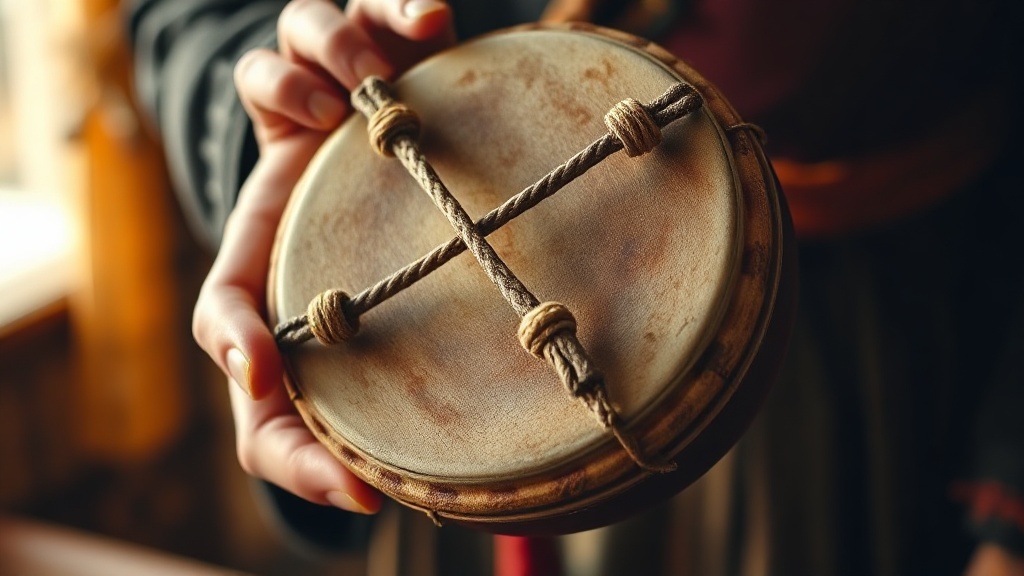
None of these regional names change the core identity: a double-headed membranophone with an hourglass or spool-shaped body, two drumheads stretched over each end, and two knotted cords that strike the heads when the player rotates the wrist rapidly back and forth. The resulting sound is a rapid, rattling pulse rather than a sustained tone. That pulse is the point.
A Brief History Spanning Shiva and the Buddha
The damaru drum predates the spread of Buddhism into Tibet. Its earliest certain iconographic appearances are in Hindu Shaivite contexts, where it is one of the attributes of Shiva in his Nataraja form, dancing within a ring of fire. The drum in Shiva's upper right hand is said, in the Shaiva tradition, to produce the primordial sound of creation, specifically the syllable that gives rise to all language. The Shaiva Agamas, a body of Sanskrit scriptures, describe this sound as the source from which Sanskrit grammar itself emerged.
When Vajrayana Buddhism absorbed and reframed many Shaivite ritual elements between roughly the 7th and 11th centuries CE, the damaru came with them. **Padmasambhava**, the 8th-century tantric master credited with establishing Buddhism in Tibet, is frequently depicted holding a damaru in his right hand and a skull cup in his left. From that period onward, the instrument became inseparable from the tantric ritual vocabulary of the Himalayan Buddhist world.
💡 Did you know?
The Cleveland Museum of Art holds a damaru made from two human skull-caps joined at the crown, dating to 19th-century Tibet. This type, called a thodpai damaru (skull damaru), is the most ritually charged form of the instrument. According to the iconographic program of Vajrayana practice, using skull material is not macabre but rather a direct confrontation with impermanence, one of the three marks of existence identified throughout the Pali Canon. Note: all ritual objects of this kind are sourced and used according to traditional lineage protocols; their function is spiritual and symbolic, not medicinal or therapeutic.
How a Damaru Is Made: Materials and Construction
Most damarus in circulation today fall into three broad categories based on body material, and the choice of material is not purely aesthetic. It carries symbolic and ritual weight that practitioners take seriously.
Wooden damarus
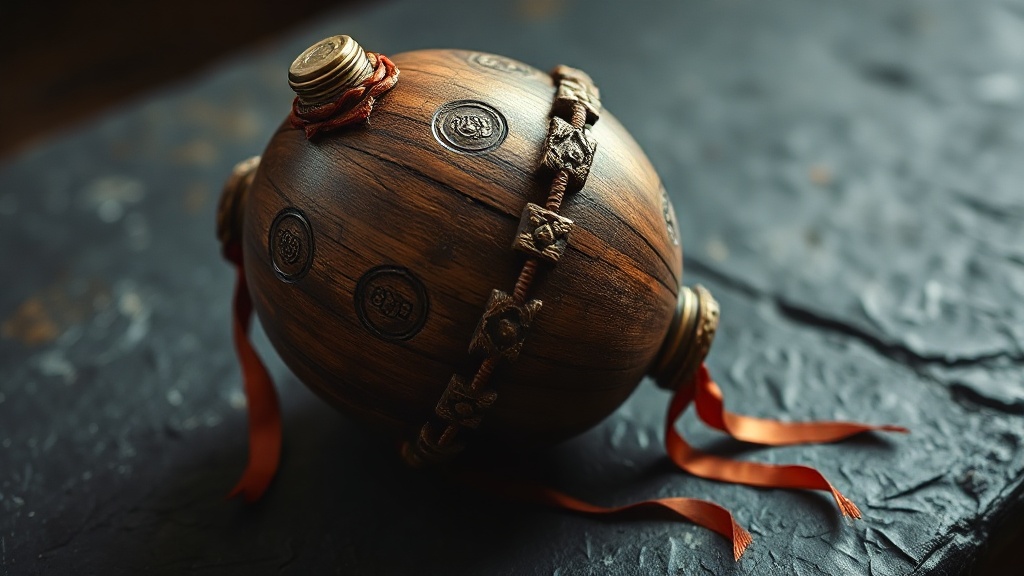
The most common type uses a turned or carved hardwood body, often from a single piece of Bhutanese or Indian hardwood, though Himalayan craftsmen also work with rosewood and teak. The hourglass waist is narrow enough to fit in a closed fist, allowing the wrist rotation that drives the beaters. Drumheads are typically stretched goat or lizard skin, fixed with lacquer or adhesive and sometimes held by a rim of wrapped cord. Wooden damarus range from about 10 cm to 20 cm in length and are what most practitioners outside monastic settings use for daily practice.
Kapala (skull) damarus
Traditionally constructed from the tops of two human skulls, joined at the crown with copper or brass fittings and silk ribbons, these instruments are rare and their production is governed by strict ritual protocols within specific Vajrayana lineages. Replicas made from bone-colored resin or carved wood are widely available as practice tools, though lineage teachers often specify that only the genuine article carries the full ritual function for certain advanced practices. As with all Vajrayana ritual objects involving human material, their use is strictly spiritual and symbolic in nature, following the conventions of the tradition that produced them.
Metal damarus
Some ritual damarus have copper or brass bodies with skin heads. These are less common than wooden forms but appear in specific monastic settings, particularly where durability across generations matters. The metal body can produce a slightly brighter resonance, though the fundamental playing technique remains identical.
The Symbolic Architecture of the Two Heads
Nothing on a ritual object in Vajrayana Buddhism is accidental. The damaru's double-headed structure carries a precise symbolic meaning that teachers transmit alongside practical instruction in how to play it.
The two drumheads represent the inseparability of two complementary principles. In the Mahayana and Vajrayana philosophical framework, these are typically glossed as prajna (wisdom, often associated with the female principle in tantric iconography) and upaya (skillful means or method, associated with the male principle). Neither alone is sufficient for awakening; their union is the very condition of enlightenment. Every time the damaru sounds, the two heads strike together symbolically, enacting that union.
A second symbolic reading maps the two heads onto samsara and nirvana: the conditioned world of ordinary experience and the unconditioned state that Buddhist practice points toward. The drum does not privilege one side over the other. Both heads must be taut; both must sound. The practitioner's wrist holds the axis point between them.
"The sound of the damaru is the sound of awakening calling out across the three realms."
Oral commentary attributed to the Nyingma tradition; cited in liturgical contexts for the Chod practice
📖 Textual Source
The pairing of prajna and upaya as the twin foundations of the Bodhisattva path is elaborated throughout the Bodhicaryavatara (Guide to the Bodhisattva's Way of Life) by the 8th-century Indian scholar Shantideva, and receives its most explicitly tantric formulation in the Hevajra Tantra. Both texts remain core reference points in Kagyu and Nyingma curricula.
How the Damaru Is Played: Technique and Context
The basic playing position is simple to describe and takes real time to internalize. The player holds the narrow waist of the instrument between thumb and index finger, or sometimes between the ring finger and little finger when the playing hand also holds other ritual objects. A rapid rotation of the wrist causes the two knotted cords to swing outward and strike alternate drumheads. The rhythm is not a free improvisation. In ritual contexts, specific sequences of strokes correspond to specific moments in the liturgy.
Standard rhythmic patterns in Tibetan practice move between three broad speeds. A slow, deliberate beat of roughly one stroke per second marks opening invocations and the calling of protective presences. A moderate rolling pulse serves as the undercurrent beneath mantra recitation. A rapid, sustained rattle signals the height of visualization practice or moments of intense invocation. Practitioners with decades of experience can shift between these seamlessly without breaking concentration on the visualization or mantra.
The Damaru in the Chod Ritual
Of all the contexts in which the damaru drum appears in Tibetan Buddhist practice, Chod (Tibetan: gcod, meaning "to cut") is probably the most vivid and the most demanding. Chod is a practice within the Kagyu and Nyingma schools, systematized by the 11th-century Tibetan yogini **Machig Labdron**, though its philosophical roots draw on Prajnaparamita (Perfection of Wisdom) literature, specifically the notion that the ego itself is the fundamental obstacle to liberation.
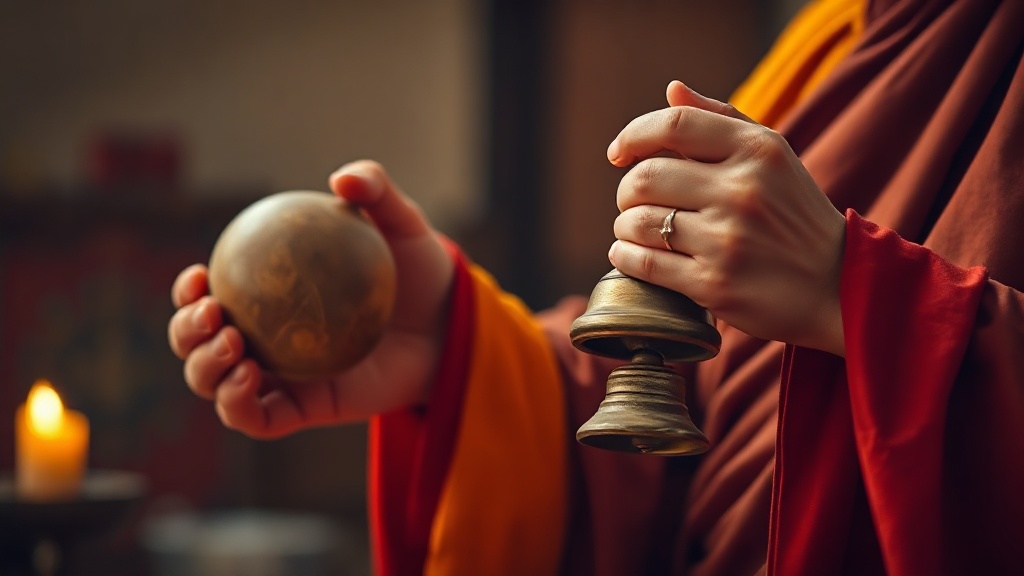
In a Chod session, the practitioner sits alone, often in a cemetery, charnel ground, or any place where fear arises naturally. They ring the hand bell (ghanta) in the left hand, beat the damaru in the right, and blow the kangling (a trumpet traditionally made from a human femur) at specific liturgical moments. The sound environment they create is deliberate. The bell represents the voice of wisdom; the damaru calls in all beings, particularly those ordinarily avoided: demons, hungry ghosts, whatever form fear takes. The practitioner then performs a visualization in which they offer their own body as a feast to all these guests, cutting through attachment to the physical self as an object of protection.
Without the damaru, the Chod ritual as Machig Labdron transmitted it cannot be performed correctly. The instrument is not an accompaniment; it is a liturgical requirement, its rhythm punctuating each stage of the visualization and marking transitions between sections of the text.
If you are looking for a damaru drum to accompany your own sitting practice, or for hand bells and other liturgical supports used alongside it, our Meditation & Prayer collection brings together instruments sourced from Nepal and the broader Himalayan region.

The Damaru Beyond Tibet: Shaivism, Nepal, and the Indian Subcontinent
While this article has focused primarily on the Vajrayana Buddhist context, the damaru's life extends well beyond it. In Hindu Shaivite worship, the instrument retains its identity as the drum of Shiva, and it appears in devotional music across Rajasthan, Uttar Pradesh, and Tamil Nadu. Street performers and wandering sadhus have carried damarus for centuries as both musical instruments and markers of Shaivite identity.
In Nepal, where Hindu and Buddhist traditions overlap and interpenetrate, the damaru sits comfortably in both ritual worlds. Newar Buddhist priests (vajracharyas) use it in initiatory and funerary rites, and the same craftsmen in the Kathmandu Valley often produce instruments for both Hindu and Buddhist buyers. This shared material culture reflects the historical reality: the sharp boundary between Hinduism and Buddhism that Western categories often assume was, in many Himalayan contexts, far more porous.
In the Bengali tantric tradition, the related dugdugi appears in devotional contexts associated with Kali and Durga worship, again demonstrating the instrument's ability to cross sectarian lines while retaining its core function: to call, to mark time, to signal the sacred.
Identifying an Authentic Damaru: What to Look For
The market for damarus ranges from mass-produced tourist items at a few dollars to hand-crafted ritual-grade instruments costing several hundred. Knowing the difference matters if you intend to use one in practice rather than as decor.
| Feature | Practice-grade instrument | Tourist or decorative item |
|---|---|---|
| Body material | Dense hardwood (rosewood, Bhutanese hardwood) or bone; smooth finish | Soft pine or MDF; rough or overly lacquered |
| Drumheads | Stretched natural skin, evenly tensioned, resonates on both heads | Synthetic material or uneven skin; one or both heads silent |
| Cord beaters | Twisted cotton or silk cord with weighted knot; balanced weight on both sides | Plastic or rubber beads; uneven weight causes inconsistent strike |
| Sound test | Sharp, dry crack on each strike; consistent at all wrist speeds | Dull thud or rattle; inconsistent volume |
| Origin marking | Nepal or Tibet; often sold by specialist suppliers with provenance information | No origin stated; mass-produced in bulk |
The simplest test when purchasing in person: rotate the wrist with the damaru loosely held and listen. A well-made instrument produces a clean, distinct crack from each head, with both heads sounding at roughly equal volume. If one head is dead or the sound is muffled, the drumhead has not been correctly tensioned and the instrument will not function in practice.
🪷 Wisdom Note
When purchasing a damaru for practice rather than display, it is worth asking the seller whether the instrument has been used before and whether it comes with replacement cords. Practice-grade instruments from established Kathmandu workshops typically include a spare set of beater cords, a small detail that signals genuine craft knowledge.
The Damaru in Iconography: Reading the Deity Images
Knowing what to look for when you encounter a damaru in a thangka painting or bronze statue adds considerably to the experience of viewing sacred art. The instrument almost always appears in the upper right hand of a deity figure, held at the wrist between thumb and forefinger in the same grip used in actual practice. This is not artistic convention for its own sake. The right side in Vajrayana iconography typically corresponds to upaya (method), while the left corresponds to prajna (wisdom). The left hand frequently holds the bell (ghanta) or a skull cup (kapala).
Deities commonly depicted with a damaru include Vajradhara (the primordial Buddha of the Kagyu and Gelug schools), Padmasambhava, Cakrasamvara, and the wrathful forms of protective deities in the Buddhist deity iconography tradition. In each case, the drum signals that the deity operates within tantric space, where sound, visualization, and mantra work together as a unified vehicle of transformation.
Mahakala, the fierce protector deity found in nearly every Tibetan monastery, also appears with a damaru in some iconographic forms, specifically the six-armed version known as Shad-dril-ma, where the drum underscores his role as master of the charnel ground.
If you are drawn to the visual language of these deity images and would like to bring that iconographic tradition into your own space, our collection of Buddhist altar objects and sacred art includes statues and wall pieces that reflect the same symbolic grammar described above, each object documented with its iconographic context.

Learning to Use a Damaru Without a Teacher: What Is Realistic
The question comes up often from practitioners outside Asia who have purchased a damaru and want to work with it seriously. The short answer is that the basic wrist technique is fully learnable from video and written instruction. The rhythmic patterns for general meditation support, the opening invocations used in many Tibetan liturgies, and the simple rolling beat that accompanies mantra recitation are all accessible to a patient self-directed learner.
What requires transmission is different. Specific Chod liturgies, wrathful deity practices, and funerary rites within the Vajrayana tradition are formally considered empowerment-dependent. Most Tibetan teachers in the Kagyu, Nyingma, and Gelug schools are explicit that practicing the full Chod ritual without the relevant lung (oral transmission) and wang (empowerment) is not advisable, not because it is dangerous in a supernatural sense, but because the context and intent that give the practice its meaning cannot be conveyed through a book or a video alone.
For beginners exploring Tibetan meditation tools, starting with the damaru as a rhythm anchor during mantra practice is entirely appropriate and carries no such prerequisite. Many practitioners worldwide use the instrument's rolling beat to maintain concentration during long sessions of Tibetan Buddhist chanting, without any claim to full ritual performance.
The Damaru and Sound in Vajrayana: Why Percussion Matters
Vajrayana Buddhism has an unusually sophisticated theory of sound as a vehicle of awakening. The ritual soundscape of a Tibetan ceremony typically includes the long dung-chen horns, the gyaling oboe, cymbals, a large standing drum (ngachen), the hand bell, and the damaru. Each has a distinct liturgical function, and their combination is not conceived as music in the Western aesthetic sense but as a structural support for collective visualization and mantra.
The damaru's specific contribution in this environment is its portability and its rhythmic precision. It can be operated one-handed, which matters because the other hand is occupied with a bell or hand gesture (mudra). Its sound cuts through larger instruments without dominating them. And its physical intimacy with the practitioner's body, held in the hand rather than set on a stand, creates a direct somatic connection that Tibetan teachers describe as important for the quality of presence in the practice.
The Bardo Thodol (the so-called Tibetan Book of the Dead, more precisely translated as "Liberation Through Hearing in the Intermediate State") describes the sounds encountered by consciousness after death as progressively more intense. Some traditional commentaries use the damaru's rattling pulse as a point of reference for the sharp, cutting quality of certain sounds in the bardo experience, sounds that the practitioner learns to recognize as the voice of the Dharma rather than as threats.
💡 Did you know?
The Tibetan damaru and the rkang-gling (thigh-bone trumpet) are the only two instruments in traditional Tibetan Buddhist ritual music that were classically made from human bone. Both appear together in Chod and in some Vajrabhairava practices. The museum in Toulouse (Musée Saint-Raymond) holds examples of both, acquired via 19th-century Himalayan expeditions, and their catalog notes describe them as among the most ritually significant objects in their Asian collection. Their function is understood within the tradition as symbolic and spiritual, not medicinal.
Caring for a Damaru: Practical Notes for Practitioners
A wooden damaru with natural skin heads is sensitive to humidity and temperature change. The drumheads can loosen in humid conditions or crack in very dry environments. Keep the instrument away from direct heat sources and avoid leaving it in a car during summer. If a drumhead goes slightly loose, a few hours in a cool, dry room will often restore tension naturally. Never attempt to retighten a skin head by applying direct heat; the skin will contract unevenly and may split.
The cord beaters should be checked periodically for fraying at the attachment point. Replacement cords are widely available from Himalayan instrument suppliers, and retying them is a straightforward process. The knot at the end of each cord should be a compact overhand knot, firm enough to strike cleanly without being so large that it deadens the sound on impact.
When not in use, many practitioners wrap their damaru in a silk cloth and store it alongside the hand bell. This is partly protective and partly a reflection of the care that Vajrayana tradition encourages toward all ritual objects, treating them as extensions of the practice rather than as equipment.
FAQ
What does damaru mean in Sanskrit?+
The Sanskrit word damaru (डमरु) is associated with the verbal root dam, broadly meaning "to sound" or "to produce vibration." Some linguists trace the term to a pre-Vedic Austroasiatic origin, suggesting the instrument itself predates the Sanskrit vocabulary used to name it. In Tibetan, the equivalent instrument is called cang te'u, with damaru used as a Sanskrit loan term in scholarly and ritual texts.
What is a damaru drum used for in Buddhism?+
In Vajrayana Buddhist ritual, the damaru drum serves as a rhythmic support for mantra recitation, a liturgical marker signaling transitions between sections of a practice, and a symbolic instrument representing the union of wisdom and method. It is central to the Chod ritual, where it is paired with the hand bell (ghanta) and sometimes the kangling horn. Outside formal ritual, practitioners also use it as a focus aid during seated meditation.
How do I choose the right damaru for a beginner?+
For a first instrument, a mid-size (12-15 cm) wooden damaru with natural skin heads is the most practical starting point. Look for balanced cord beaters, both of equal weight, and check that both drumheads produce a clean sound when the wrist is rotated. Avoid instruments with synthetic heads or plastic beaters. A reputable Himalayan supplier with provenance information is a more reliable source than a general gift shop. Budget instruments under $20 almost always sacrifice sound quality; a well-made beginner damaru from Nepal typically falls in the $40-$80 range.
What is the difference between a wooden and a skull damaru?+
A wooden damaru is made from a turned hardwood body and is the standard instrument for daily practice and general liturgical use. A skull damaru (Tibetan: thodpai damaru) is traditionally constructed from the tops of two human skull-caps joined at the crown. In the Vajrayana tradition, the skull material is understood symbolically as a direct engagement with impermanence; it is used in specific advanced practices such as Chod and certain wrathful deity liturgies. Skull damarus require lineage authorization for their full ritual use. Resin replicas are available and widely used as practice tools.
What is a Buddhist drum called?+
Different Buddhist traditions use different drums. In Tibetan Buddhism, the main ritual drums are the damaru (small hourglass hand drum), the ngachen (large standing drum struck with a curved beater), and ceremonially the kangling, which is technically a trumpet but occupies a percussion-adjacent role in ritual timing. In Zen Buddhist ceremony, a large wooden fish-shaped drum (mokugyo in Japanese) marks chanting. In Theravada monasteries, a standing drum may signal the schedule of the day.
Can anyone use a damaru, or is it restricted to ordained practitioners?+
Owning and playing a damaru for personal practice or meditation is not restricted. Many lay practitioners worldwide keep one as part of their practice toolkit. However, using the damaru within specific Vajrayana rituals, particularly Chod, traditionally requires the relevant empowerment (wang) and oral transmission (lung) from a qualified teacher in a recognized lineage. The instrument itself carries no restriction; the practice context around certain liturgies does.
How is the damaru different from other Indian drums?+
The damaru is distinguished from other Indian drums by its hourglass shape, its small size (typically 10-20 cm), its use as a one-handed instrument operated by wrist rotation rather than finger or palm striking, and its explicitly ritual function. Instruments like the tabla or mridangam are primarily musical, requiring two hands and serving primarily in performance and devotional music contexts. The damaru's design makes it impossible to play with the fingers; the cord beaters do the work, which is precisely why the playing hand remains free to hold another ritual object.


